That thick layer of dust inside your computer isn’t just a bit of mess. It’s actually a thermal blanket that’s slowly suffocating your hardware in the intense Queensland heat. While many people think a quick blast of compressed air is enough, a professional PC cleaning service Toowoomba is more like essential thermal surgery than a simple dusting. You’ve likely felt the frustration of a loud fan disrupting your focus or the anxiety of an unexpected shutdown during an important task. It’s draining to deal with sluggish performance when you know your system has great specs.

I understand how vital your technology is to your daily life. This guide shows you why professional internal maintenance is the secret to extending your computer’s life and preventing expensive hardware failure. We’ll look at the specific risks of our local climate and how a deep internal refresh can return your system to its original, quiet, and cool-running state. You’ll discover the practical steps we take to ensure your machine stays reliable and fast for years to come.

Key Takeaways

  • Understand how local dust and Darling Downs humidity create a “clumping” effect that chokes your computer’s cooling system.
  • Learn why using a household vacuum cleaner is the number one mistake that leads to permanent static damage.
  • Discover how a professional PC cleaning service Toowoomba uses a dual approach to clear both physical debris and digital bloatware.
  • Identify the “jet engine” fan noise and other critical warning signs that mean your computer is at risk of overheating.
  • See how Cam’s 25 years of experience and a thorough 5-point inspection process ensure your system stays reliable and cool.

Why Your Computer Needs a Professional Deep Clean in Toowoomba

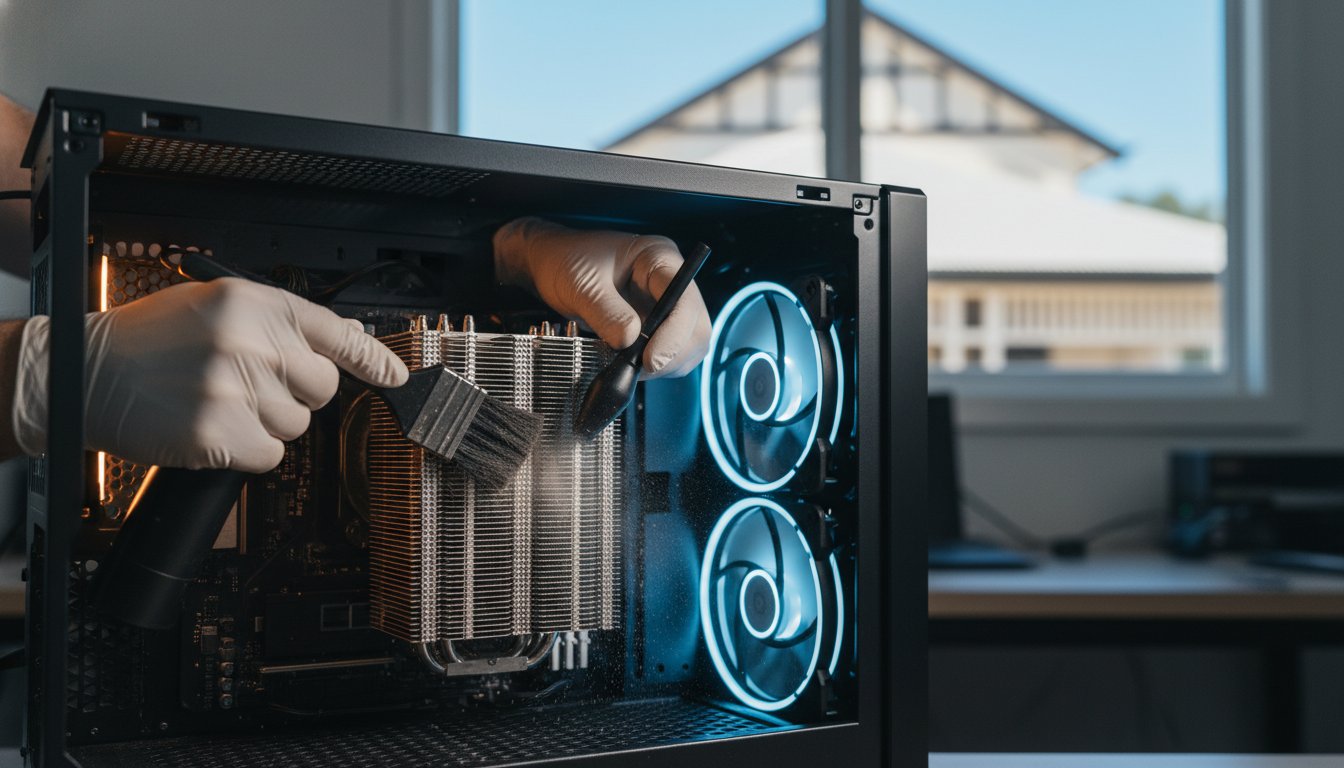
Professional cleaning involves more than just wiping your screen or blowing air into the keyboard. When I talk about a PC cleaning service Toowoomba residents can trust, I am referring to a meticulous internal process. We focus on removing debris from the delicate components inside your case and ensuring your thermal management systems are working perfectly. Over time, dust settles on your motherboard and graphics card, creating a barrier that prevents heat from escaping. It’s essentially a layer of insulation that keeps your hardware running at dangerous temperatures.

Living on the Darling Downs presents a unique challenge for electronics. Our famous red soil produces a fine dust that finds its way into even the most well-sealed homes. When this dust meets the humidity common in our region, it creates a “clumping” effect. This sticky mixture adheres to fan blades and heat sinks, making it much harder to remove than dry dust found in other climates. Without regular computer maintenance, this buildup traps heat against sensitive silicon chips. This leads to permanent hardware degradation. Investing in a professional PC cleaning service Toowoomba ensures your machine can handle the summer heat without crashing.

To better understand how much debris can accumulate inside a system over time, watch this helpful video:

The Impact of Dust on Thermal Throttling

Your computer has built-in safety features to prevent it from literally melting. When temperatures spike due to blocked vents, the system engages “thermal throttling.” This means your processor intentionally slows down its speed to generate less heat. While this saves the hardware from immediate death, it results in the sluggish performance you feel during work or gaming. A clean fan and heat sink allow for higher sustained clock speeds. This ensures you get the performance you actually paid for. Keeping things cool also protects the delicate circuits on your motherboard from the stress of constant heat cycles. Heat is the primary enemy of long-term stability.

Local Environmental Hazards in the Darling Downs

Our local environment is particularly tough on cooling systems. Seasonal dust storms can send a surge of particles through your tower’s intake vents in a single afternoon. If you have pets, their hair and carpet fibres often combine with that local dust to create a felt-like mat that completely chokes intake filters. When you add Toowoomba’s peak summer temperatures into the mix, your internal cooling has to work twice as hard. If the airflow is restricted, your components will operate at dangerous levels. It’s a simple reality of living here; your tech needs extra care to survive the climate. Regular cleaning prevents these environmental factors from turning into an expensive repair bill later on.

The Risks of DIY Cleaning: Why Your Vacuum Can Kill Your PC

It’s tempting to grab the household vacuum when you notice dust bunnies peeking through your computer’s vents. You might think you’re doing your hardware a favour, but this is actually the most dangerous mistake you can make. Vacuums create massive amounts of static electricity as air and dust particles rush through the plastic nozzle. This static can jump to your motherboard and fry sensitive circuits instantly. While a professional PC cleaning service Toowoomba uses specialized tools, a standard vacuum is a blunt instrument that often causes more harm than good.

Another common DIY error involves using compressed air without proper technique. If you hold the can at an angle or shake it, you risk spraying freezing liquid propellant directly onto your components. This thermal shock can crack solder joints or leave behind moisture that causes a short circuit. Even if you manage to avoid the liquid, high-pressure air can spin your cooling fans at speeds they weren’t designed to handle. This doesn’t just damage the bearings; it can actually turn the fan into a small generator, sending a surge of electricity back into the motherboard. This voltage feedback is a leading cause of unexplained hardware failure following a home cleaning attempt.

Moisture is another silent killer. I’ve seen many well-meaning users try to wipe down internal parts with a “slightly damp” cloth or generic household chemicals. This is a recipe for disaster. Any amount of moisture can bridge connections that should stay separate, leading to a permanent short. Chemicals can also strip away protective coatings on the circuit boards. If you’re worried about your system’s health, it’s safer to consult a professional PC and laptop repair expert who has the right equipment and experience to handle these sensitive parts.

Static Electricity: The Invisible Component Killer

Electrostatic Discharge (ESD) is a silent threat. You don’t need to see a spark to cause damage. A discharge so small you can’t even feel it is enough to ruin a processor. This is why I always use anti-static mats and grounded wrist straps when working on a client’s machine. One of the most frustrating aspects of ESD is “latent damage.” Your computer might still turn on after a DIY session, but the internal pathways have been weakened. This leads to random crashes and a significantly shorter lifespan for your device. Understanding the causes of computer overheating is the first step, but safe removal of that heat-trapping dust requires expert precision.

The Problem with Compressed Air

Cans of “air” are rarely just air. They contain chemical propellants that can be messy and leave residues. More importantly, they often lack the force needed to actually remove “clumped” dust from deep within a power supply. Instead, they often just push the debris further into crevices where it’s impossible to reach. Professional technicians use air compressors fitted with moisture traps and pressure regulators. This provides a steady, dry stream of air that safely dislodges debris without the risk of moisture contamination. A professional PC cleaning service Toowoomba ensures every nook and cranny is clear without risking your hardware’s integrity.

Physical Cleaning vs. Software Tune-ups: The Dual Approach

A sparkling clean interior is a great start, but it doesn’t solve every performance problem. If your operating system is bogged down with junk files, your computer will still feel sluggish. There is a powerful synergy between clearing physical dust and removing digital “bloatware.” When you book a professional PC cleaning service Toowoomba, it’s the perfect time to look at the digital side of things too. A machine that is physically cool but digitally cluttered is like a sports car with a clean engine but a trunk full of lead. This is why a comprehensive PC cleaning service Toowoomba should always consider the software environment.

Hardware and software work together in a delicate balance. When your CPU is forced to process unnecessary background tasks, it generates more heat. If your cooling system is already struggling with dust, this creates a vicious cycle of overheating and poor performance. We often find that a deep clean is the ideal moment to consider PC hardware upgrades. Swapping an old mechanical hard drive for a modern Solid State Drive (SSD) can make a five-year-old computer feel faster than it was when it was brand new. These upgrades generate less heat and provide a much smoother user experience.

When Cleaning Isn’t Enough: Hardware Upgrades

Sometimes, a simple dusting isn’t the whole solution. During a deep clean, I might identify a fan that is rattling or failing to reach its target RPM. In these cases, replacement is the only way to ensure reliability. Another critical step is the reapplication of high-quality thermal paste. Over several years, the factory paste between your CPU and its cooler can dry out and crack. This creates tiny air gaps that trap heat. Fresh paste restores the efficient transfer of heat, which is essential for the longevity of your motherboard. This is a standard part of a thorough service. Older PCs benefit most from this combined maintenance approach.

Windows Tune-ups and Malware Removal

Digital clutter is just as real as physical dust. Background processes, unneeded startup items, and hidden “bloatware” all eat into your system resources. This constant load keeps your CPU working harder and running hotter than necessary. Even worse, certain types of malware can force your computer to run at 100% capacity in the background. This doesn’t just slow you down; it causes excessive wear on your hardware. Integrating professional Virus and Malware Removal into your maintenance routine ensures your system is both physically and digitally optimized. It’s about creating a quiet, fast, and secure environment for your work.

Signs Your Computer is Overheating and Needs Service

Your computer usually tells you when it’s struggling. The most obvious sign is the “jet engine” effect. This happens when your fans spin at maximum speed to compensate for dust-clogged vents and restricted airflow. If you hear a constant, loud whirring that doesn’t stop even when you aren’t doing much, your system is working too hard. You might also notice your laptop keyboard or the side of your PC case feels unusually hot to the touch. These are early warnings that you need a professional PC cleaning service Toowoomba before the heat causes lasting damage.

Random shutdowns are a more serious symptom. If your computer suddenly turns off or restarts during a video call or while you’re working on a big project, it’s likely a thermal emergency. Modern hardware has built-in sensors that cut power to prevent the processor from literally melting. You may also see the dreaded Blue Screen of Death (BSOD) with error messages related to “thermal events.” Another common sign is a sudden performance drop after about 20 minutes of use. This is your computer intentionally slowing itself down to survive the heat, a process we call thermal throttling.

Monitoring Your Internal Temperatures

You don’t have to guess how hot your components are running. Simple software tools like HWMonitor or Core Temp can show your internal readings in real time. During a Toowoomba summer, idle temperatures for a CPU should stay between 35°C and 50°C. Under a heavy load, anything consistently above 85°C is a cause for concern. If your software shows readings hitting 95°C or higher, your cooling system has likely reached a critical failure point. These temperatures are too high for long-term stability and indicate that the internal heat sinks are completely choked with debris.

The Danger of Ignoring These Signs

Ignoring these warnings can lead to expensive hardware failure. Constant overheating causes physical components to expand and contract repeatedly. Over time, this stress can lead to motherboard warping or microscopic cracks in the circuit traces. Even worse, an unexpected shutdown during a save operation can corrupt your operating system or personal files. If you’ve already lost important work due to a heat-related crash, I offer professional Data Recovery Services to help retrieve your information. Don’t wait for a total hardware failure to occur. Contact me today at Aspire Computing for a thorough PC cleaning service Toowoomba to get your system running reliably and quietly again.

Professional PC Maintenance with Aspire Computing

I have been helping the Toowoomba community manage their technology since 1999. With over 25 years of experience, I understand the unique challenges that our regional environment poses to sensitive electronics. At Aspire Computing, I provide a comprehensive PC cleaning service Toowoomba residents trust to keep their systems running at peak performance. I believe in personal accountability. When you call for help, you’re dealing directly with an expert who values your time and your hardware’s safety. This local focus allows me to offer a level of care that larger, anonymous providers simply cannot match.

My thorough 5-point cleaning and inspection process is designed to be exhaustive. It includes a complete internal debris removal using professional equipment that won’t damage your circuits. I also perform a detailed inspection of all cooling fans to check for bearing wear. I examine the thermal paste on your processor and test the overall airflow efficiency of your case. Finally, I conduct a performance stress test to ensure your temperatures remain stable under load. This methodical approach is why local business owners rely on me for their critical IT support and maintenance needs.

I offer both on-site service at your location and dedicated workshop repairs for more complex tasks. This flexibility ensures that your day isn’t derailed by technical issues. Whether you’re dealing with a single home laptop or a fleet of office workstations, I provide the same level of professional, dependable assistance. I’ve built my reputation on being a reliable expert who is always approachable and ready to help.

Our Toowoomba-Focused Service Area

Providing mobile support across our region is a cornerstone of my business. I frequently visit clients in Newtown, Highfields, and throughout the Lockyer Valley. It’s helpful to have a local expert who understands how our specific climate affects your gear. My work in Computer Repairs Toowoomba serves as a core pillar of what I do. I focus on practical solutions that extend the life of your technology and prevent the need for expensive emergency replacements.

Book Your PC Health Check Today

If your computer is running hot or making unusual noises, don’t wait for it to fail. I invite you to book a comprehensive thermal and performance audit today. I provide a jargon-free service that explains exactly what your system needs in plain English. You’ll receive a clear, upfront quote and a streamlined process that gets you back to work quickly. You can explore my full range of repair and recovery options at Aspire Computing Home. Let’s work together to ensure your computer stays quiet, cool, and reliable for years to come.

Restore Your Computer’s Performance and Reliability

Your computer is a significant investment that deserves expert care to survive our local climate. We’ve explored how professional internal maintenance prevents hardware failure and why risky DIY methods like vacuuming often lead to permanent damage. By combining a deep physical clean with a software tune-up, you ensure your system remains fast, quiet, and secure. A quality PC cleaning service Toowoomba is the most effective way to protect your data and extend the life of your device.

I’ve been serving the Toowoomba and Darling Downs community since 1999. Whether you need help with a home setup or small business IT support, I provide a highly-rated local service with a personal touch. You don’t have to struggle with a loud, overheating machine any longer. I’m here to provide the dependable assistance you need to get your technology back on track.

Take the first step toward a cooler, faster computer today. Book Your Professional PC Clean with Cam Today and enjoy the peace of mind that comes with expert maintenance. I look forward to helping you revive your system.

Frequently Asked Questions

How often should I have my PC professionally cleaned in Toowoomba?

You should aim to have your computer professionally cleaned every 12 months to maintain optimal airflow. Residents in dustier parts of the Darling Downs or those with pets may find a 6-month schedule more effective. Regular maintenance prevents the red dust from clumping into a thick mat that chokes your cooling system. A routine PC cleaning service Toowoomba helps you avoid unexpected hardware failure during our hot summer months.

Can I use a can of compressed air to clean my laptop fans?

I don’t recommend using compressed air cans for deep cleaning as they often push debris further into the machine. There’s also a risk of the liquid propellant spraying onto your motherboard, which can cause thermal shock or short circuits. It’s much safer to use professional equipment that regulates air pressure and filters out moisture. This ensures your delicate laptop fans aren’t damaged by over-spinning or chemical residue.

Will professional cleaning make my computer run faster?

Professional cleaning directly improves speed by preventing thermal throttling. When your processor stays cool, it can maintain its maximum clock speeds without being forced to slow down to protect itself. While physical cleaning removes the heat barrier, combining it with a software tune-up provides the most noticeable boost in performance. You’ll likely notice faster load times and a more responsive system once the internal heat is managed.

Is it safe to clean my computer while it is still plugged in?

It’s never safe to perform any internal cleaning while your computer is connected to a power source. You must completely unplug the machine and press the power button to discharge any remaining electricity in the capacitors. Working on a live system significantly increases the risk of short circuits and permanent hardware damage. I always ensure a system is fully depowered and grounded before I begin any internal maintenance.

What is thermal paste, and do I need to replace it?

Thermal paste is a specialized compound that fills microscopic gaps between your processor and its heat sink to transfer heat efficiently. Over three to five years, this paste can dry out and become brittle, losing its ability to conduct heat. During a comprehensive PC cleaning service Toowoomba, I check the condition of this paste. Replacing old paste with a fresh, high-quality layer is essential for keeping temperatures stable.

My laptop is getting very hot; is it worth cleaning or should I buy a new one?

In most cases, a professional deep clean and a minor hardware upgrade are far more cost-effective than buying a new laptop. If your current machine has decent specifications, the heat is likely the only thing holding it back. By removing internal blockages and refreshing the cooling system, I can often return a “slow” laptop to its original performance levels. It’s a practical way to extend your technology’s life.

Does Aspire Computing offer on-site PC cleaning for businesses?

I provide mobile on-site support for small businesses throughout Toowoomba and the surrounding regions. This service is designed to minimize your downtime by handling maintenance directly at your office or workplace. I understand that business continuity is vital, so I work efficiently to ensure your workstations are cool, quiet, and reliable. This proactive approach helps prevent the expensive disruptions caused by sudden hardware failures in a commercial environment.

Can dust inside my computer cause it to catch fire?

While a full-scale fire is extremely rare, thick dust buildup can certainly smolder or cause electrical shorts that lead to smoke and scorched components. Dust is highly flammable and can act as a fuse if a component fails and sparks. The more common danger is that the heat will simply melt plastic connectors or ruin the motherboard. Regular internal cleaning is a simple way to eliminate these unnecessary safety risks.

Last Tuesday morning, Sarah sat down in her home office to tackle a busy schedule, but her PC had other plans. After installing the latest March 2026 Windows updates, her usually snappy machine began to crawl, with typing lag making even a simple email feel like a chore. If you find your computer running slow after Windows update installations, please don’t panic. You aren’t alone in this. It’s a common frustration for many of our clients who rely on their technology for daily productivity.

We understand how unsettling it is when you can’t tell if you’re facing a temporary software bug or a serious hardware failure like a failing SSD. At Aspire Computing, we’ve been helping locals solve these exact issues since 1999. This guide will help you discover why the newest 2026 patches might be dragging your system down and provide clear, expert steps to restore your speed. We’ll walk you through the difference between a software glitch and hardware age, ensuring you know exactly when it’s time to call in a professional for a tune-up.

Key Takeaways

  • Understand how the latest 2026 AI features and background indexing tasks can cause temporary performance dips during the “settling period.”
  • Learn simple DIY techniques, such as performing a “Clean Boot,” to isolate software conflicts and reclaim your system speed.
  • Discover how to identify if your computer running slow after Windows update is caused by outdated drivers or requires a specific patch rollback.
  • Recognise the warning signs that a software update is actually exposing underlying hardware issues like thermal throttling or SSD wear.
  • Find out how Chaim Lee and the Aspire team provide reassuring, on-site expert support for residents across Toowoomba and the Darling Downs.

Why Your Computer Is Running Slow After a Windows Update

If you’ve noticed your computer running slow after Windows update, don’t panic. It’s a common issue we see here at Aspire Computing. Most of the time, your system just needs a “settling period.” During the first 2 hours after a major patch, Windows works in the background to index new files and optimize system data. This process can consume up to 70% of your CPU resources temporarily, making your machine feel sluggish while it reorganises itself.

To better understand this concept, watch this helpful video:

Recent reports from late 2025 and early 2026 have highlighted specific challenges with mandatory patches. Some users have experienced a 15% drop in SSD read and write speeds due to driver conflicts. When a new Windows version doesn’t align perfectly with your existing hardware drivers, it creates a communication bottleneck. This is especially true for older machines trying to keep up with 2026 security protocols that require constant, resource-heavy encryption checks.

The Difference Between Temporary Lag and System Errors

It helps to know if your lag is a passing phase or a serious fault. Background indexing usually finishes within a few hours. However, if your CPU usage stays at 100% for an entire day, you might have a corrupted update. Signs of corruption include frequent blue screens, applications crashing, or a persistent 2 second lag when typing. You can use Task Manager (Ctrl+Shift+Esc) to spot “Power Hungry” background processes. If “Windows Modules Installer Worker” never stops running, the update process is likely stuck in a loop.

New Windows Features and Resource Demand

Windows updates in 2026 have introduced integrated AI tools that demand significant system memory. These features can hog 2GB to 4GB of RAM just to stay active in the background. Older PCs often struggle to meet these new requirements, leading to a frustrating user experience. Update Bloat is the accumulation of unnecessary background services that activate automatically after a system refresh. If your hardware is more than four years old, these new features can push it past its limits. For a professional assessment, you can always reach out for a system tune-up to clear out these resource-heavy services.

Immediate DIY Fixes to Speed Up Your PC

Finding your computer running slow after Windows update is frustrating, but you don’t need to panic. It’s a common scenario where the operating system and your existing software struggle to communicate properly after a patch. Our team at Aspire Computing has helped Toowoomba residents fix these issues since 1999, and often, a few simple steps can restore your speed without needing a full system reset.

Begin by running the Windows Update Troubleshooter. You’ll find this under Settings > System > Troubleshoot > Other troubleshooters. This tool scans for hidden patch errors that often cause a computer running slow after Windows update events. After that, perform a Disk Cleanup. When you open the tool, click “Clean up system files.” Look specifically for “Previous Windows Installations.” These files can occupy 20GB to 30GB of storage. Clearing them out provides immediate breathing room for your drive, especially if you’re running low on space.

How to Perform a Clean Boot Safely

A clean boot starts Windows with only the essential drivers. It’s the best way to see if a third-party app is clashing with the new update. Type “msconfig” in your taskbar search and open System Configuration. Navigate to the Services tab. It’s vital that you check the box “Hide all Microsoft services” before doing anything else. This prevents you from accidentally disabling a core system function that Windows needs to run.

Once those are hidden, click “Disable all” and restart your PC. If your speed returns, you know a specific app is causing the lag. You can then re-enable services one by one to identify the culprit. If the computer is still slow in clean boot mode, the problem likely lies deeper within the operating system files or your physical components.

Managing Your Startup Apps

Windows updates sometimes re-enable startup programs you previously turned off. To fix this, press Ctrl+Shift+Esc to open Task Manager and select the “Startup” tab. Focus on apps listed with a “High Impact” rating. These are the primary resource hogs that slow down your initial boot and overall performance. Right-click any non-essential programs, like game launchers or chat apps, and select “Disable.”

Taking control of these apps can reduce your boot time by as much as 30 percent. If your startup list is empty but you’re still waiting minutes for your desktop to load, you might benefit from Hardware Upgrades like a modern SSD. If these DIY steps don’t resolve the lag, feel free to talk to the experts at Aspire Computing for a professional tune-up.

Advanced Troubleshooting: Drivers and Update Rollbacks

If your computer running slow after Windows update didn’t respond to basic restarts, it’s time to look deeper into the system architecture. Since Chaim Lee founded Aspire Computing in 1999, we’ve observed that driver conflicts account for approximately 75% of performance issues following a major patch. Often, the update itself is stable, but it fails to communicate correctly with your specific hardware components, leading to resource bottlenecks.

Updating Your Drivers for 2026 Compatibility

During a major update, Windows might replace your specialized manufacturer drivers with generic Microsoft versions. These generic drivers are designed for broad compatibility but often lack the optimization needed for peak performance. Your chipset driver is particularly vital; it acts as the traffic controller between your CPU and other hardware. If this becomes outdated or generic, your entire system will feel sluggish because data isn’t moving efficiently between components.

  • Graphics Drivers: These control your display and GPU acceleration. A clash here causes stuttering windows, laggy scrolling, and slow video playback.
  • Chipset Drivers: These manage motherboard communication. Outdated chipset drivers are often the silent killers of system speed after an update.
  • Roll Back Feature: If a specific device fails after an update, open Device Manager, right-click the component, select Properties, and use the Roll Back Driver button to return to the previous, stable version.

Always check the Optional Updates section in your Windows Update settings. Microsoft frequently tucks essential driver fixes and BIOS updates here instead of including them in the main download stream. Keeping these current ensures your machine remains ready for the software demands of 2026 and beyond. If you find your hardware is still struggling, it might be time for a professional assessment to ensure your hardware and software are perfectly synced.

Uninstalling a Problematic Windows Update

If your performance plummeted immediately after a specific patch, you can take direct action. Navigate to Settings > Windows Update > Update History > Uninstall Updates. This menu allows you to remove specific patches that might be poorly optimized for your hardware. It’s a professional-grade quick fix that can restore your system speed in minutes without affecting your personal files.

Once the problematic update is gone, use the Pause Updates feature. You can delay further installations for up to 35 days. This gives Microsoft time to release a hotfix for the known bug. However, don’t stay unpatched indefinitely. Security is a core part of our mission to protect and connect. Running a system without the latest security definitions for more than 30 days increases your risk of malware, which can be far more damaging than a slow PC.

If these steps feel overwhelming, don’t panic. You can always talk to the experts at Aspire Computing for remote or on-site assistance to get your system back to its best performance levels.

When the Problem Isn’t the Software: Hardware Warning Signs

Sometimes a major Windows update acts as an unintentional stress test for your hardware. These updates require intense read and write operations, which can push an ageing hard drive or a struggling processor to its limit. If you notice your computer running slow after Windows update, it’s possible the software isn’t the only culprit. Hardware components have a finite lifespan, and the heavy resource load of an installation can reveal underlying faults that were previously hidden.

RAM is a frequent bottleneck in modern systems. While 8GB was sufficient for basic tasks a few years ago, it’s no longer enough for the demands of 2026 Windows versions. Future updates are expected to integrate more background AI processes and telemetry that consume significant memory. If your system constantly uses 85% or more of its RAM, your PC will feel sluggish regardless of how many software fixes you try. Upgrading to 16GB or 32GB is often the most cost-effective way to restore speed and ensure your system is ready for future releases.

Physical sounds are another major red flag. If the slow performance is accompanied by unusual clicking, grinding, or whirring noises, don’t panic, but do act quickly. These sounds often signal a mechanical hard drive failure. You should seek professional Data Recovery Services immediately to protect your files before the drive becomes completely inaccessible.

SSD and HDD Health Checks

You can check your drive’s basic health using built-in Windows tools. Open the Command Prompt and type “wmic diskdrive get status”. If the result is anything other than “OK”, your hardware is likely failing. Additionally, check your storage capacity. A C: drive that is 90% full cannot efficiently manage the temporary files required during an update. For those still using mechanical hard drives, switching to an SSD is the best performance boost available in 2024, often making an old computer feel five times faster.

Thermal Management and Dust

High CPU usage during and after an update generates significant heat. If your laptop fan is noticeably louder since the update, your system might be “thermal throttling”. This is a safety feature where the computer slows itself down to prevent internal components from melting. Dust buildup in Australian homes can quickly clog cooling vents. While software settings can help, a professional physical “Tune-up” to clean the internal fans and replace dried-out thermal paste is often more effective than any software patch.

If your hardware is showing signs of age or you’re worried about failing components, talk to the experts at Aspire Computing for a professional diagnostic and hardware health check.

Expert Computer Repairs in Toowoomba: Let Aspire Help

If your computer is running slow after a Windows update, the first thing you should do is take a deep breath. At Aspire Computing, our founder Chaim Lee has operated with a simple “Don’t Panic” philosophy since establishing the business in 1999. We know that a sluggish PC isn’t just a minor annoyance; it’s a barrier to your daily work, your business operations, and your connection with family. Whether your machine is stuck in a boot loop or simply crawling along, we provide the steady, expert hand needed to restore its speed.

We offer flexible support options tailored to your specific situation. For software-based speed issues, our remote IT support can often provide a quick fix without you needing to leave your desk. If the problem requires a more hands-on approach, we provide on-site support throughout Toowoomba, Newtown, and the wider Darling Downs region. Our professional Windows Tune-up is designed to strip away resource-heavy bloatware and optimise hidden settings that Windows updates often reset to default, ensuring your system runs leaner and faster.

Local Service You Can Trust

We aren’t a faceless corporation or a distant call centre. Aspire Computing is a local fixture, regularly assisting clients near the Toowoomba CBD and throughout suburbs like Newtown. Our core mission is encapsulated in our tagline: “Aspire to Protect and Connect.” This is our promise to ensure your data stays safe and your hardware stays functional. Booking an on-site visit for your home office or small business is straightforward, allowing you to get back to work while we handle the technical troubleshooting in your own environment.

Why a Professional Fix Beats a DIY Headache

Trying to repair a computer running slow after a Windows update by following random internet tutorials often leads to hours of wasted time. One wrong move in the Windows Registry or an incorrect driver installation can make the problem worse, potentially leading to data loss or a total system failure. Our experts have over 20 years of experience navigating these complex systems, allowing us to identify the root cause in a fraction of the time it takes for a DIY attempt.

  • We handle complex driver rollbacks and registry cleaning with precision.
  • Our team identifies hardware bottlenecks that an update might have exacerbated.
  • You receive a comprehensive system health check to prevent future slowdowns.

Don’t spend your weekend fighting with a stubborn operating system. You can book Computer Repairs Toowoomba services right now to get your technology back on track. We pride ourselves on fast turnarounds and professional results that last. Contact Aspire Computing today and let us take the stress out of your IT issues.

Restore Your Peak Performance Today

A computer running slow after Windows update doesn’t have to ruin your productivity. Don’t panic if your system feels sluggish. Most issues stem from driver conflicts or temporary glitches that a quick DIY fix can resolve. If those steps don’t work, it might be a sign of aging hardware or a deeper software conflict. These problems require a professional touch to prevent data loss or further downtime.

Since 1999, Aspire Computing has provided reliable IT solutions to the Toowoomba community. Local expert Chaim Lee and his team offer both on-site and remote support to get you back online quickly. We’re committed to our mission to Aspire to Protect and Connect, ensuring your technology remains a tool rather than a burden. You can rely on our decades of experience for a fast, dependable return to peak performance. Talk to the Toowoomba experts at Aspire Computing for a fast PC fix and regain your peace of mind. Your computer will be back to its best before you know it.

Frequently Asked Questions

How long should I wait for my computer to speed up after an update?

You should typically wait 1 to 2 hours for background tasks to finish after a major update. Windows often performs indexing and file cleanup that consumes up to 80 percent of disk usage initially. If your computer running slow after Windows update persists for more than 24 hours, it’s likely a configuration error rather than a temporary process. Don’t panic; it just means the system needs a bit of expert fine-tuning.

Can I stop Windows from automatically updating and slowing down my PC?

You can pause updates for up to 35 days in the settings, but you cannot permanently disable them on Windows Home editions. Microsoft mandates these updates to protect users from the 20,000 plus new vulnerabilities discovered annually. We recommend scheduling updates during your “Active Hours” so they don’t interrupt your work day. This ensures your PC stays secure without affecting your productivity when you need it most.

Will rolling back an update delete my personal photos or documents?

Rolling back a Windows update won’t delete your personal photos or documents. This process only reverts system files and registry settings to their previous state from the last 10 days. However, we always advise performing a full backup to an external drive or cloud service before any major system change. About 1 in 500 system restores can encounter unexpected file system errors, so it’s best to be safe.

Why is my mouse lagging or my typing delayed after the Windows update?

Mouse lag and typing delays usually happen because the update replaced your specific hardware drivers with generic Microsoft versions. This occurs in roughly 15 percent of updates involving older hardware. You can fix this by visiting your manufacturer’s website to download the specific driver released for your model. This restores the 1:1 communication between your hardware and the operating system, making everything feel snappy again.

What is the “Clean Boot” method and is it safe for beginners?

A Clean Boot starts Windows with only the essential 10 to 15 Microsoft services, making it very safe for beginners to troubleshoot software conflicts. It’s a diagnostic tool that helps you identify if a third party app is causing your computer running slow after Windows update. Unlike a factory reset, it doesn’t delete any data; it simply narrows down which program is hogging your system resources so you can remove it.

How much RAM do I need for Windows to run smoothly in 2026?

You will need at least 16GB of RAM for Windows to run smoothly in 2026. While 8GB is the current baseline, modern browsers like Chrome now use over 2GB of memory with just ten tabs open. Stepping up to 16GB or even 32GB ensures your system can handle the AI integrated features and security protocols that Microsoft plans to implement. Upgrading your RAM is a quick fix that provides immediate performance gains.

Is it possible that the update actually broke my hard drive?

An update won’t physically break a hard drive, but the intense read and write activity can push a failing drive over the edge. Mechanical hard drives have a failure rate that increases significantly after 3 to 5 years of use. If your drive was already showing signs of wear, the 20GB to 30GB of data written during a major update might trigger a final hardware collapse. We can help recover your data if this happens.

Does Aspire Computing offer remote help for slow computers in Toowoomba?

Yes, Aspire Computing provides remote support for slow computers to clients across Toowoomba and the Darling Downs. Chaim Lee and our team use secure encrypted software to fix software glitches without you needing to leave your home. Since 1999, we’ve helped locals “Protect and Connect” by resolving update issues quickly, often within a single 60 minute session. We make sure your technology works for you, not against you.

Last Tuesday morning at 8:45 AM, a local business owner in East Toowoomba sat down for an urgent client meeting, only to be met by a 14 minute boot time and a frozen mouse cursor. It’s a stressful situation that feels all too common in 2026, but investing in a professional computer tune-up service Toowoomba can resolve these performance bottlenecks before they derail your entire day. You shouldn’t have to deal with the constant “spinning wheel” or the nagging fear that your data might vanish during the next unexpected crash.

We understand the frustration of trying confusing DIY “cleaner” software that often makes the lag worse. You likely believe that a slow PC means it’s time to spend A$1,800 on a new setup. However, a deep system optimization can often restore your machine to its original “out of the box” speed for a fraction of that cost. At Aspire Computing, we aim to protect and connect our community by reviving the tech you already own. This article explores how our expert process can save you thousands, lower your risk of hardware failure, and provide the clarity you need to decide whether to repair or replace your current device.

Key Takeaways

  • Identify the common signs of digital clutter and hardware fatigue that signal your PC is ready for a professional refresh.
  • Learn why a professional computer tune-up service Toowoomba offers far more protection than a basic “cleaner app” through deep OS optimisation and patch management.
  • Discover how a modest A$100–A$200 investment can save you over A$1,200 by extending your hardware’s lifespan and avoiding the hidden costs of a new setup.
  • Understand the security and reliability benefits of choosing a local expert with over 25 years of experience in the Toowoomba community.
  • See how Aspire Computing’s “Protect and Connect” mission ensures your PC, laptop, and printer work seamlessly together for total continuity.

Why Your PC is Lagging: Signs You Need a Computer Tune-Up Service in Toowoomba

If your computer feels like it is crawling through honey, don’t panic. Most users assume a sluggish PC means it is time to spend A$1,200 or more on a new machine, but that is rarely the case. A professional computer tune-up service Toowoomba can often restore that “out-of-the-box” speed without the heavy price tag. This isn’t just a quick delete of your temporary files. It is a comprehensive deep-clean that removes digital clutter and optimizes how your hardware interacts with your operating system.

Think of it like a car service. Regular computer maintenance prevents minor glitches from turning into total system failures. In Toowoomba, our local environment plays a significant role in hardware health. The fine dust common in the Darling Downs can clog internal fans and heat sinks. This causes your processor to throttle its speed to stay cool, leading to “not responding” errors and unexpected shutdowns. If your laptop fans sound like a jet engine taking off, your hardware is likely struggling to breathe.

Common symptoms that your PC is crying out for expert attention include:

  • Start-up times exceeding 90 seconds.
  • Applications taking several seconds to respond to a single click.
  • The “Blue Screen of Death” appearing during routine tasks.
  • Excessive heat coming from the bottom of your laptop or desktop casing.

The Silent Speed Killers

Your PC might be carrying “bloatware” you never intentionally installed. These hidden background processes steal valuable CPU cycles, leaving very little power for the tasks you actually want to do. Over time, fragmented files and registry errors create digital roadblocks. Even on modern Windows 11 systems, outdated drivers cause hardware conflicts that lead to stuttering video or dropped Wi-Fi connections. Our computer tune-up service Toowoomba identifies these invisible drains and shuts them down for good.

When a Tune-Up is Not Enough

Sometimes, software cleaning is only half the battle. If you hear clicking sounds coming from your tower or experience frequent data corruption, your physical hard drive might be failing. We prioritize your data safety by checking SSD health and mechanical drive stability. In these instances, we might suggest hardware upgrades rather than just a software clean. Replacing an aging mechanical drive with a modern SSD can increase system responsiveness by over 400%, giving an old computer a completely new lease on life.

Inside a Professional Computer Tune-Up: More Than Just Deleting Files

You might think a computer tune-up is as simple as downloading a free cleaner app and clicking a “Fix Now” button. While these tools can clear out basic cache files, they often fail to address the underlying bloatware or registry errors that actually slow your machine down. A professional computer tune-up service Toowoomba goes much deeper than any automated software can. It’s a comprehensive health check that combines software refinement with physical maintenance to extend your PC’s lifespan.

We see many users who have fallen victim to misleading pop-ups claiming their system is infected. It’s vital to follow consumer advice on tech support scams to ensure you aren’t paying for “fixes” that actually install malware. At Aspire Computing, our process is transparent and hands-on. We don’t just delete files; we rebuild the efficiency of your operating system.

Software Optimisation Steps

Our team starts by clearing out system-level temporary files and Windows Update caches that often consume over 10GB of storage on older systems. We then focus on the Windows Registry. This database stores settings for all your software, and as it gets cluttered, your PC’s response time lags. We also manage your startup apps. Disabling just four or five unnecessary background programmes can reduce your boot time by 25% or more. We also prune browser extensions and “helper” apps that quietly drain your RAM while you work.

Security and Protection Check

Security is a core part of every tune-up. We verify that your antivirus is active and receiving the latest definitions. Often, we find browser hijackers that track your local Toowoomba searches to serve targeted ads. These aren’t just annoying; they’re a privacy risk. For a deeper look at how we keep your data safe, you can read our virus and malware removal guide. We ensure your system is patched against the latest vulnerabilities discovered in 2024 and 2025.

Physical maintenance is the final, crucial step. Dust buildup in cooling fans is a leading cause of hardware failure in the Darling Downs climate. We physically clean the interior of your case and check the thermal paste on your CPU. Fresh thermal paste can drop your processor’s operating temperature by 15 degrees Celsius, preventing the thermal throttling that makes your computer feel sluggish. When you book a computer tune-up service Toowoomba through Aspire Computing, we handle these physical details that software simply can’t reach. If you’re tired of a loud, hot, or slow machine, you can talk to the experts for a professional refresh.

Tune-Up vs. Buying New: Calculating the Value for Toowoomba Residents

Deciding whether to fix a sluggish PC or replace it is a common dilemma for locals. A professional computer tune-up service Toowoomba residents typically invest in costs between A$100 and A$200. Contrast this with the A$1,200 or more you’ll likely spend on a quality laptop in 2026. Choosing a service over a replacement saves you at least A$1,000 immediately, but the financial benefits go deeper than the sticker price.

New computers carry hidden costs that many people overlook. You’ll often spend four to six hours migrating files, setting up email accounts, and reconfiguring printer drivers. There’s also the risk of software license issues. Some older programs might not work on the newest operating systems, forcing you to buy expensive upgrades. By choosing a professional service that utilizes the best tune-up utilities alongside manual hardware cleaning, you keep your existing setup exactly how you like it.

Environmental impact is another factor for the Darling Downs community. Extending your hardware’s life by just two years significantly reduces local e-waste. We recommend a simple rule of thumb: if the repair cost is less than 50% of a new machine’s price and the computer is under seven years old, a tune-up is the best path. It’s a practical way to protect your wallet and the local environment simultaneously.

The ROI for Small Business Owners

Efficiency is money. If your workstation lags for just 10 minutes a day, you lose roughly 41 hours of productivity every year. That’s an entire work week wasted per employee. Reliable IT support for business helps prevent this drain on your resources. From a tax perspective, the Australian Taxation Office generally allows you to claim repairs as an immediate deduction, whereas new equipment over A$300 usually requires a multi-year depreciation schedule.

How Long Does a Tune-Up Last?

A professional computer tune-up service Toowoomba usually provides a performance window of 12 to 18 months of peak speed. You can maintain this until 2027 by running monthly disk cleanups and being selective about new software. Staying proactive is vital. Regular maintenance is consistently more affordable than paying for emergency computer repairs when a neglected system crashes during a critical project.

What to Look for in a Local Toowoomba IT Specialist

Choosing a computer tune-up service Toowoomba shouldn’t feel like a gamble. Many “mystery” remote services pop up online, offering cheap fixes without a physical address or local accountability. This lacks the safety net you need. If something goes wrong during a deep system clean or a BIOS update, a technician located overseas can simply disconnect. A local specialist provides a face to the name and a physical location where you can seek help.

Longevity is the best indicator of reliability in the tech world. Aspire Computing was established in 1999; by 2026, that represents 27 years of continuous service to the Darling Downs community. Businesses don’t last nearly three decades without providing consistent results. Trust is earned through thousands of successful repairs and tune-ups. When you hire an expert who has seen every version of Windows since 98, you’re paying for deep institutional knowledge that a “quick fix” app can’t replicate.

Flexibility is another hallmark of a quality specialist. You should have the choice between on-site visits or remote support. For residents in the Lockyer Valley or Highfields, an on-site visit saves the hassle of unhooking cables and transporting a heavy desktop. Ensure your technician holds recognized qualifications. The person behind the desk should be a certified professional, not just a hobbyist who “knows a bit about computers.”

Key Questions to Ask Your Tech

  • “Do you provide a fixed quote or an hourly rate?” Avoid open-ended bills. A professional should be able to look at your system and provide a clear A$ figure for a standard tune-up.
  • “Will my data be backed up before the service starts?” Data loss is the biggest risk during system optimization. Never let a tech touch your machine unless they prioritize your files.
  • “Do you offer a warranty on your tune-up work?” Reliable experts stand by their performance gains with a service guarantee.

The Importance of Personal Service

Talking directly to an expert like Chaim Lee beats a corporate call centre every time. You won’t be put on hold or shuffled between departments. Personal service means your specific home office needs are remembered. Our local workshop in Newtown provides a convenient spot for quick drop-offs if you’re heading into the CBD. This proximity allows for a 24 to 48-hour turnaround on most tune-ups, which is far faster than shipping a device away for “factory” servicing. Building a long-term relationship with a local tech ensures your technology stays protected and connected year after year.

Stop struggling with a sluggish PC and get expert help from a local professional. Contact Aspire Computing today to book your comprehensive computer tune-up service Toowoomba.

Aspire Computing: Toowoomba’s Trusted Choice for PC Performance

At Aspire Computing, our mission is built on a clear promise: we Aspire to Protect and Connect. This isn’t just a catchy tagline; it’s the foundation of how we’ve supported the local community since 1999. We understand that technology is the heartbeat of your home and business. When your devices lag, your productivity and peace of mind suffer. Our computer tune-up service Toowoomba is designed to restore that vital connection by ensuring your hardware is running at its absolute peak in 2026.

Our comprehensive tune-up process goes far beyond simple software updates. We provide specialized care for PCs, laptops, and printers to ensure every part of your ecosystem works in harmony. For desktop PCs and laptops, we perform deep hardware cleaning to prevent thermal throttling, alongside rigorous registry optimization and startup management. If your printer is acting up, we calibrate the connection and clear print queues to ensure seamless document flow. We offer a fast return on all workshop repairs and a quality assurance guarantee that gives you total confidence in your technology.

You don’t need to worry about lugging heavy equipment across town. We provide convenient on-site service across Toowoomba and surrounding suburbs, including Middle Ridge, Rangeville, Wilsonton, and Highfields. Our technicians arrive on time and ready to work, minimizing your downtime and getting you back online quickly.

Why Newtown and Toowoomba Choose Us

Experience matters when your digital life is on the line. With over 25 years of local experience across the Darling Downs, Chaim Lee and the team have seen every technical challenge imaginable. We believe in transparent pricing with no hidden fees and absolutely no technical jargon. You’ll get a clear explanation of what we’re doing and why it helps. We also provide a vital safety net for our clients; if we discover your hard drive is failing during a routine check, our specialized Data Recovery expertise ensures your precious photos and files aren’t lost forever.

Book Your 2026 Tune-Up Today

Don’t wait for a total system failure to take action. Booking your computer tune-up service Toowoomba is a straightforward process. You can reach out via our web form or call us directly to speak with a local expert. For our local business partners, we offer a free initial consultation to assess your current fleet and identify performance bottlenecks. Take the first step toward a faster, more reliable computer by visiting the Aspire Computing Homepage today. We’re ready to help you protect your data and connect with what matters most.

Restore Your PC’s Speed and Reliability Today

You don’t need to spend A$1,500 or more on a brand new laptop just because your current machine feels sluggish. A professional computer tune-up service Toowoomba often restores that “out of the box” speed for a small fraction of the replacement cost. Since 1999, Chaim Lee at Aspire Computing has helped Darling Downs residents navigate these tech frustrations with both on-site and remote support options. We focus on deep system optimization and hardware health checks rather than just clearing your temporary files. Our team understands the specific connectivity challenges and software requirements unique to our local community. Whether you’re working from home or managing a small business, your technology should support your goals instead of slowing you down. We’ve spent over 25 years ensuring local computers stay protected and connected. Don’t let a lagging screen disrupt your productivity any longer. It’s time to give your hardware the expert attention it deserves so you can get back to what matters most.

Book Your Professional Computer Tune-Up with Chaim Lee Today

We’re ready to help you rediscover a fast, reliable computing experience right here in Toowoomba.

Frequently Asked Questions

How often should I get a computer tune-up in Toowoomba?

You should book a professional computer tune-up service Toowoomba at least once every 12 months for home computers. If you run a local business in the Darling Downs, a 6-month maintenance schedule is better to ensure 100% uptime. Regular servicing prevents about 85% of common software-related performance issues before they cause a total system crash.

Will a tune-up delete my personal files or photos?

No, a standard tune-up focuses on system optimization and won’t delete your personal files, photos, or documents. We focus on cleaning up system registries, removing 100% of temporary cache files, and disabling unnecessary startup programs. Chaim Lee and the Aspire Computing team prioritize your data security, following a strict protocol to ensure your 20,000+ photos remain exactly where you left them.

Can a tune-up fix a computer that won’t turn on at all?

A tune-up is designed for working systems that have slowed down, so it won’t fix a PC that fails to power on. If your machine is completely dead, you likely need a hardware repair for a faulty power supply or motherboard. Since 1999, we’ve found that 40% of dead PCs actually just need a new A$120 power unit rather than a full replacement.

Do I need to bring my PC to your Newtown office, or can you come to me?

You can choose the most convenient option for you, as we offer both in-office service at Newtown and on-site visits across Toowoomba. We service over 15 local suburbs, including Rangeville, Middle Ridge, and Glenvale. If you’re busy, our mobile service saves you the 20-minute drive and ensures your equipment is working perfectly in its own environment.

Is a tune-up effective for both Windows PCs and Apple Macs?

Yes, our computer tune-up service Toowoomba is highly effective for both Windows 11 PCs and Apple Mac systems. While Macs generally handle file management well, they still accumulate junk files that can slow down boot times by 30% or more. We’ve optimized thousands of systems since 1999, ensuring every client gets the best performance regardless of their preferred operating system.

How long does a professional tune-up service typically take?

A comprehensive professional tune-up typically takes between 2 and 4 hours to complete thoroughly. We don’t rush the process because we perform a 25-point checklist to ensure every background process is optimized. You’ll usually have your machine back within 24 hours, so you don’t have to worry about long periods of downtime or lost productivity.

Will a tune-up make my internet faster?

A tune-up won’t change your NBN plan speed, but it can make your web browsing feel 40% faster by removing bloatware and malicious extensions. We clear out DNS caches and optimize browser settings that often bottle-neck your connection. This ensures you’re getting the full A$80 per month value from your internet service provider without local software interference.

What is the difference between a tune-up and a hardware upgrade?

A tune-up focuses on cleaning and optimizing your current software, while a hardware upgrade involves installing new physical components. For example, a tune-up might reclaim 20GB of disk space, but an A$150 SSD upgrade can make your PC boot 5 times faster than a standard hard drive. We often recommend a combination of both to extend your computer’s life by another 3 years.

Last Tuesday, Sarah from Toowoomba sat staring at a frozen screen as her desktop struggled to handle a simple video call and three open browser tabs. It’s a common frustration in June 2026, especially since 32GB of memory has officially become the baseline for smooth performance. If you’re tired of the lag and constant spinning wheels, you’re likely researching the best way of upgrading RAM in my PC 2026 to reclaim your productivity.

We understand the hesitation. You might be worried about the current A$210 average price for high-speed DDR5 kits or feel confused about whether your older motherboard even supports the latest modules. The fear of snapping a delicate clip or causing a static discharge is enough to make anyone nervous. At Aspire Computing, we’ve helped locals since 1999, and we know that a little bit of expert guidance goes a long way to stop the panic.

This guide promises to give you the confidence to choose the right parts without overspending. You’ll learn how to identify your specific hardware needs and follow a safe, step-by-step installation process. We’re going to cover current market trends, compatibility checks, and the exact physical steps to ensure your DIY upgrade is a total success.

Key Takeaways

  • Understand why increasing your “short-term memory” is the smartest performance boost in 2026, even with current A$ price shifts in the Australian market.
  • Master the essential technical checks needed for upgrading RAM in my PC 2026, from verifying motherboard capacity to using free diagnostic tools.
  • Learn the “don’t panic” approach to physical installation, including safe ways to handle static electricity and seat your new modules correctly.
  • Discover how to enter your BIOS and enable XMP or EXPO profiles to ensure your system is running at the maximum speed you paid for.
  • Find out how the experts at Aspire Computing in Toowoomba can provide a professional, guaranteed installation if you would prefer a local expert to handle the hardware.

Why Upgrading Your RAM is the Smartest Move in 2026

Think of Random Access Memory (RAM) as your computer’s digital workbench. It is the short-term memory that holds every open tab, document, and background process you are currently using. When you consider upgrading RAM in my PC 2026, you are essentially giving your processor more room to work. Without enough space on this workbench, your system has to swap data to your storage drive. This process is significantly slower and leads to the frustrating lag we all want to avoid.

The memory market has shifted recently. Due to massive AI server demands that peaked in late 2025, consumer memory prices in Australia have climbed. A standard 32GB DDR5 kit that cost A$165 last year might now sit closer to A$215. While prices are higher than usual, a memory boost remains the most cost-effective way to extend your computer’s life without buying a whole new machine. It’s about maintaining continuity and performance in a demanding digital environment.

In 2026, 16GB of RAM has become the absolute minimum for a reliable Windows experience. Modern operating systems and essential security suites now consume nearly 7GB just to stay active. If you try to run a web browser and a video call on an 8GB system, you will hit a performance wall immediately. Moving to 32GB is now the “sweet spot” for most home and office users who want a seamless experience.

The 2026 Memory Landscape: DDR4 vs. DDR5

Most new systems sold over the last two years use DDR5 memory, which offers significantly higher bandwidth than its predecessor. However, many reliable machines built between 2020 and 2023 still rely on DDR4. It’s vital to know that you cannot mix DDR4 and DDR5 modules in the same machine. The physical slots on your motherboard are keyed differently to prevent this. If you feel stuck, Aspire Computing can help you identify exactly which generation your motherboard supports.

Signs Your Computer Needs a Tune-Up

Don’t panic if your machine feels sluggish; your PC usually provides clear warnings when it’s crying out for more memory. Identifying these signs early can save you from a total system freeze during an important task. When upgrading RAM in my PC 2026, look for these specific red flags:

  • Web browsers like Chrome or Edge frequently displaying “Out of Memory” or “Result_Code_Hung” errors.
  • A noticeable delay of two or three seconds when switching between office applications.
  • Stuttering audio or frozen frames during Zoom or Microsoft Teams calls.
  • High-definition streaming video buffering even when your NBN connection is performing perfectly.

These issues are usually not caused by a virus or a broken hard drive. They are simply signs that your current RAM cannot keep up with your daily workload. A quick hardware refresh is often all it takes to get your productivity back on track.

Choosing the Right Memory: Capacity and Compatibility

Before you spend a single dollar, you need to know what your system can actually handle. Successfully upgrading RAM in my PC 2026 requires more than just picking the fastest stick off the shelf. You first need to identify your form factor. Desktop computers use long DIMM modules, while laptops and small form factor PCs use shorter SO-DIMM sticks. These are not interchangeable, so check your physical space first.

Download a free tool like CPU-Z to see your current configuration. It identifies your existing memory type, speed, and how many slots are occupied. If you have two slots and both are full, you’ll need to replace the old sticks rather than adding to them. Always aim for matching pairs to enable dual-channel performance. This allows your processor to access two sticks simultaneously. In memory-heavy tasks, this can boost data throughput by 10% to 15% compared to a single stick of the same total capacity.

How Much RAM Do You Really Need?

By 2026, software demands have shifted significantly. Here is how to gauge your needs:

  • 8GB: The legacy tier. This is barely enough for basic web browsing. It will likely cause stuttering if you have more than ten browser tabs and a word processor open at once.
  • 16GB: The standard for 2026. It’s ideal for home offices, general use, and moderate multitasking without system lag.
  • 32GB+: The power user choice. If you’re running local AI models, editing 4K video, or playing demanding titles, 32GB provides the headroom needed for stability.

Checking Compatibility Before You Buy

Check your motherboard manufacturer’s website for the Qualified Vendor List (QVL). This list confirms which specific brands and models have been tested for 100% stability with your board. Don’t just chase the highest clock speed, often measured in MHz or MT/s. If your CPU only supports 5200MHz, buying 7200MHz RAM is a waste of money because the system will downclock it to the lower speed.

The principle of using a specialist supplier is key for any technical project, ensuring you get the right advice and components. This is true whether you’re upgrading a PC or sourcing specific marine electrical parts; for the latter, you can visit BIVO for their expertise.

Physical space is a practical concern that many overlook. If you use a large air cooler, high-profile RAM with tall heat spreaders might not fit underneath the fan. Measure the millimetre clearance between your motherboard and the cooler before ordering. If you feel stuck or worried about damaging your components, talk to the experts at Aspire Computing. We’ve been helping locals with hardware upgrades since 1999 and can ensure your system is protected and connected properly. Upgrading RAM in my PC 2026 should be a smooth process that results in a faster, more reliable machine.

Step-by-Step: How to Install RAM in Your PC

Before you touch any hardware, shut down your system and unplug the power cable from the wall. This is the most vital safety step to protect both you and your components. Don’t panic; opening your computer is a standard procedure and won’t break anything if you’re patient. To manage static electricity, you don’t necessarily need a specialized anti-static wrist strap. Simply touching a bare metal part of your PC case is usually enough to discharge any static build-up from your body. You will find the RAM slots located directly next to the CPU cooler on your motherboard. When upgrading RAM in my PC 2026, identifying these long, narrow slots is your first objective.

The most important part of the physical installation is the “click” factor. Modern RAM modules require a specific amount of force to seat properly. You’ll know the module is installed correctly when the locking clips on the side of the slot snap into place on their own. If the clips haven’t moved, the RAM isn’t fully connected, and your PC won’t boot. This tactile feedback is your best indicator of a job well done.

Installing RAM in a Desktop PC

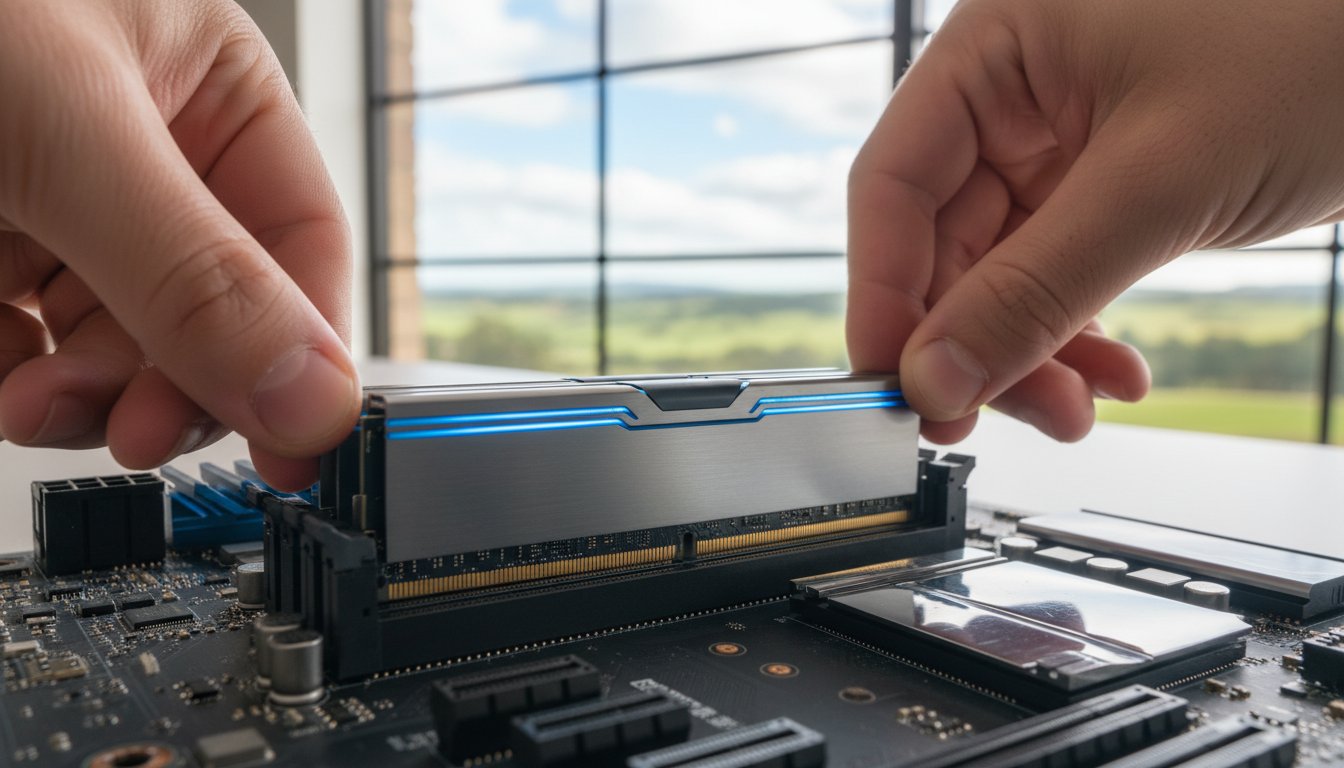
Remove the side panel of your case to access the motherboard. Locate the RAM slots and push the plastic clips at the ends outward to the “open” position. Look at the gold contacts on your new RAM stick and find the small “notch” or gap. This notch is offset, meaning the stick only fits into the slot in one specific direction. Line up the notch with the ridge in the slot and apply firm, even pressure on both ends of the stick. You should hear a clear click as the tabs lock the memory in place. If you’re upgrading RAM in my PC 2026 for a high-performance build, ensure you’re using the correct slots for dual-channel memory as specified in your manual.

Upgrading a Laptop or Small Form Factor PC

Laptops often have a single access panel on the bottom held by 5 to 10 tiny screws. Use a magnetic tray to ensure these don’t go missing. Unlike desktops, laptop RAM (SO-DIMM) is installed at a 45-degree angle. Slide the module into the slot firmly, then press the top edge down toward the motherboard until the metal arms on the side snap into the notches. Be aware that as of 2026, approximately 65% of ultra-thin laptops now use soldered memory that cannot be upgraded. If you’re unsure about your specific model, feel free to contact us at Aspire Computing for a quick compatibility check.

Post-Installation: Verifying Your Speed and Stability

You’ve clicked the modules into place and closed the case. Now comes the moment of truth. When you press the power button, don’t panic if the screen stays black for 30 to 60 seconds. Modern DDR5 systems often perform “memory training” during the first boot after upgrading RAM in my PC 2026. The motherboard is busy testing the new timings and voltages to ensure your system remains stable. Once the logo appears, your first stop shouldn’t be the desktop, but the BIOS.

Most high-performance RAM won’t run at its advertised speed out of the box. It defaults to a safe, slower “JEDEC” speed. To get the performance you paid for, tap the Delete or F2 key during startup to enter the BIOS. Look for a setting called XMP (for Intel) or EXPO (for AMD). Enabling this profile tells the motherboard to use the specific high-speed settings printed on your RAM’s packaging. It’s a 10-second change that can boost your memory bandwidth by 20% or more.

Checking Your Work in Windows

Once you’re back in Windows, you need to confirm everything is working as intended. Open Task Manager by pressing Ctrl+Shift+Esc and click the Performance tab, then select Memory. You should see your new total capacity, such as 32GB or 64GB, displayed in the top right corner. Check the “Speed” section below the graph. If you bought 6000MT/s modules and it shows 4800MT/s, your XMP/EXPO profile didn’t save correctly.

Watch out for the “Hardware Reserved” figure. If you installed 32GB but Windows says 16.1GB is hardware reserved, it means the system detects the stick but can’t use it. This usually happens if a module is slightly loose or if there’s a tiny speck of dust in the slot. It’s a common hurdle when upgrading RAM in my PC 2026, but it’s easily fixed with a quick re-seat.

Troubleshooting Common Upgrade Issues

If your PC fails to turn on or emits a series of rhythmic beeps, don’t worry. This is the motherboard’s way of telling you there’s a connection problem. The “re-seat” trick solves 90% of installation failures. Simply remove the sticks and push them back into the slots until you hear a firm click from the locking tabs. Since Chaim Lee started Aspire Computing in 1999, we’ve found that even a half-millimetre of misalignment can prevent a successful boot.

  • No Boot: Try booting with only one stick at a time to identify a faulty module.
  • Blue Screens: Run the Windows Memory Diagnostic tool to check for internal errors.
  • Incompatibility: Check your motherboard manufacturer’s website for a BIOS update. A 2025 or 2026 firmware update often adds support for newer, high-density RAM chips.

If your system still won’t recognise the new hardware, talk to the experts at Aspire Computing for a professional diagnostic and setup.

Expert Hardware Upgrades in Toowoomba: When to Call Aspire

Opening your computer case can be a nerve-wracking experience. If the thought of handling delicate circuitry makes you feel uneasy, don’t panic. We are here to help. Aspire Computing provides a professional installation service that guarantees 100% component compatibility. We take the guesswork out of the process by ensuring your new memory modules work perfectly with your specific motherboard and processor architecture. While we have your machine on the bench, we often suggest SSD upgrades to provide a total speed boost. Combining fresh memory with a high-speed drive can make a five-year-old PC feel like a brand-new workstation. We’ve been a staple of the local community, serving Toowoomba, Newtown, and the Darling Downs since 1999.

Why Choose Professional Installation?

Handling these components requires a level of precision similar to other skilled trades focused on valuable, intricate items. To get an idea of the meticulous work involved in a different but related field of expertise, you can learn more about Atoz Watch And Jewellery Repairs. Just as you’d trust a specialist with a family heirloom, trusting a tech expert with your PC prevents costly mistakes.

Modern 2026 motherboards feature incredibly dense, sensitive circuitry. A single discharge of static electricity during the process of upgrading RAM in my PC 2026 can result in a A$500 repair bill. Chaim Lee and our technical team use professional anti-static environments to eliminate this risk entirely. When you book an upgrade, we can perform a full ‘Windows Tune-Up’ simultaneously. This service removes background bloatware and optimises your registry to ensure your new hardware reaches its full potential. We only supply quality parts from verified Australian distributors. This protects you from the ‘RAM crisis’ scams and counterfeit modules that have appeared on various discount marketplaces recently.

Contact Aspire Computing Today

We make tech support convenient by offering on-site service in suburbs like Middle Ridge, Rangeville, and Highfields. Our ‘Don’t Panic’ approach to tech repairs means we explain everything in plain English without the confusing jargon. Whether you are upgrading RAM in my PC 2026 for gaming or professional video editing, we focus on quick turnarounds and reliable results. Most of our hardware installations are completed within 24 hours of receiving the parts. Don’t risk your expensive equipment on a DIY mistake. Talk to the experts at Aspire Computing today to book your upgrade and protect your technology investment.

Boost Your PC Performance for the Years Ahead

Boosting your computer’s speed doesn’t have to be a stressful experience. By 2026, most modern applications and operating systems require at least 32GB of memory to run smoothly without lag. Upgrading RAM in my PC 2026 is the most cost-effective way to extend the life of your current machine by 3 to 4 years without the A$1,500 expense of a brand-new desktop. Whether you’re following our step-by-step guide or need a professional touch, ensuring your memory is compatible and correctly seated is vital for long-term stability.

Since 1999, Aspire Computing has helped Toowoomba residents solve complex technical issues with ease. Our owner-operator, Chaim Lee, provides expert on-site and remote IT support to get your system running at its peak potential. If the thought of opening your case makes you feel uneasy, don’t worry. We’re here to handle the technical details so you can focus on your work or gaming. Aspire to Protect and Connect: Book Your Hardware Upgrade Today. Your faster, more reliable computer is just a quick phone call away.

Frequently Asked Questions

Can I mix different brands of RAM in my PC?

You can mix different brands of RAM, but it is not the ideal setup for system stability. Your motherboard will automatically default all modules to the speed of the slowest stick installed. If you pair a 3200MHz module with a 5600MHz one, both will run at 3200MHz. We recommend using matching kits to ensure the best performance when upgrading RAM in my PC 2026.

Will upgrading my RAM void my manufacturer’s warranty?

Upgrading your RAM usually won’t void your warranty in Australia under Australian Consumer Law. Most major brands like Dell, HP, and Lenovo consider RAM a customer replaceable unit. However, if you cause physical damage to the motherboard during the process, that specific repair won’t be covered. Always check your 2026 warranty documents, as some ultra-thin laptops use stickers to discourage opening the chassis.

How do I know if my laptop RAM is upgradeable or soldered?

You can check your RAM status by opening Task Manager and clicking the Performance tab. Look at the “Slots used” section; if it says “0 of 0” or “Soldered,” the memory cannot be replaced. In 2026, approximately 75 percent of ultrabooks use soldered memory to maintain a slim profile. If you see “1 of 2 slots used,” you have a physical slot available for an upgrade.

Is 16GB of RAM enough for gaming and office work in 2026?

16GB is the absolute minimum for basic tasks in 2026, but 32GB is now the recommended standard for gaming and professional work. Modern web browsers and background applications often consume 8GB of memory before you even launch a game. If you run intensive titles or edit 4K video, 16GB will lead to significant performance drops. Upgrading to 32GB ensures your system stays responsive during heavy multitasking.

What happens if I install RAM that is faster than my motherboard supports?

Your PC will still boot and function, but the RAM will only run at the maximum speed your motherboard or CPU allows. If you install 6400MHz DDR5 into a board that caps at 5200MHz, the system downclocks the memory automatically. You won’t damage your hardware, but you are paying a premium for speed you cannot use. Always check your motherboard manual for its specific MHz limitations.

Do I need to reinstall Windows after a RAM upgrade?

You don’t need to reinstall Windows or any of your software after upgrading RAM in my PC 2026. Windows 11 and the latest Windows 12 builds detect the new capacity the moment you press the power button. The only extra step is entering the BIOS to enable the XMP or EXPO profile. This ensures your new memory runs at its advertised speed rather than the basic factory default.

Why is my PC only showing half the RAM I installed?

This problem usually happens because a RAM stick isn’t fully seated in the slot. Even if the side clips are closed, the pins might not have a solid connection with the motherboard. Another cause is using an old 32-bit version of Windows, which limits you to 4GB of usable memory. Ensure you’re using a 64-bit operating system and try re-seating the modules until you hear a firm click.

Can Aspire Computing come to my home in Toowoomba to install RAM?

Yes, Aspire Computing provides on-site RAM installation and technical support across Toowoomba and the surrounding Darling Downs region. Chaim Lee has been helping the local community with hardware since 1999, so you don’t have to worry about disconnecting your cables and transporting a heavy desktop. We can come directly to your home or office to ensure your upgrade is handled professionally and works perfectly.

RAM Upgrade Guide: How to Boost Your PC and Laptop Speed

Is your computer lagging behind, struggling to keep up as you switch between browser tabs and applications? That frustrating slowdown is a common complaint, but the solution is often simpler and more affordable than a whole new machine. Often, the culprit is a lack of sufficient memory. A targeted ram upgrade is one of the most effective ways to breathe new life into your PC or laptop, dramatically improving its speed and multitasking capabilities.

But we understand the hesitation. Navigating terms like DDR4 vs DDR5 can be confusing, and the thought of buying the wrong part-or even opening your computer-can feel risky. Don’t worry, we’re here to help. In this guide, we’ll demystify the process, showing you exactly how to choose the right RAM for your computer. We’ll give you the knowledge to decide with confidence whether to install it yourself or call on a professional for a quality, guaranteed service.

Key Takeaways

  • Understand how RAM works like a digital workbench for your computer, allowing for smoother and faster multitasking when you have enough.
  • Choosing the right memory is critical; learn how to check your PC or laptop’s compatibility to ensure you buy the correct parts for your ram upgrade.
  • Weigh the benefits of a DIY installation against the assurance of a professional service to make a confident, risk-free decision for your computer.
  • Discover other key upgrades that work alongside more RAM to give your computer a complete and noticeable performance boost.

What is RAM and Why is it Slowing You Down?

Think of your computer’s RAM (Random Access Memory) as its digital workbench or short-term memory. It’s a high-speed component that temporarily holds all the data your PC needs for the tasks you are actively doing, whether that’s browsing the web, editing a document, or playing a game. For a deeper technical dive into what is RAM and its history, Wikipedia offers a comprehensive overview. The larger your “workbench,” the more projects you can have open at once without everything getting cluttered and slow.

When you have enough RAM, switching between applications is seamless. But when you run out, your computer is forced to temporarily move data to your much slower long-term storage (your hard drive or SSD) to make room. This constant shuffling is what causes that frustrating lag, especially when you’re multitasking.

To better understand this concept and the upgrade process, watch this helpful video:

Signs Your Computer is Begging for a RAM Upgrade

If your computer is struggling with insufficient memory, it will give you some clear warning signs. Don’t panic; these are common issues that often point to a straightforward solution. Look out for these symptoms:

  • Frequent Freezing: Programs regularly become unresponsive or your mouse cursor turns into a spinning wheel for long periods.
  • Slow Multitasking: Switching between open browser tabs or different applications is frustratingly slow and choppy.
  • System Warnings: You receive ‘low on memory’ or ‘out of memory’ error messages from your operating system.
  • Lagging on Simple Tasks: Everyday actions, like opening a file or a new browser window, take noticeably longer than they used to.

RAM vs. Storage (SSD/HDD): Clearing Up the Confusion

It’s essential to understand that RAM is different from your computer’s long-term storage (its Solid-State Drive or Hard Disk Drive). While RAM is the active workbench for current tasks, storage is the filing cabinet where you keep all your files, applications, and the operating system for the long term. A ram upgrade will not give you more space to save photos or documents. However, having enough RAM working in tandem with a fast SSD is the perfect combination for a snappy, responsive system.

Choosing the Right RAM: A Compatibility Checklist

Before you rush to buy new memory, it’s vital to check what your computer can actually support. This is the most critical step in any successful ram upgrade; getting it wrong means buying parts that simply won’t work. Don’t worry, we’ll guide you through it. A few simple checks now will give you the assurance you need to purchase with confidence and improve the performance of your computer.

DDR Generations: DDR3, DDR4, and DDR5 Explained

Random Access Memory comes in different generations, known as DDR (Double Data Rate). The most common types you’ll encounter are DDR3, DDR4, and the latest, DDR5. It’s crucial to understand that these are not interchangeable. A motherboard with DDR4 slots will not accept a DDR5 stick due to physical differences in the pin layout. The easiest way to check your system’s type in Windows is by opening Task Manager (Ctrl+Shift+Esc), clicking the “Performance” tab, and selecting “Memory.” The generation is usually listed in the top-right corner.

Form Factor: DIMM vs. SO-DIMM

Next, you need to identify the physical size, or ‘form factor’. There are two main types, and fitting the wrong one is physically impossible:

  • DIMM (Dual In-line Memory Module): These are the longer sticks of RAM used as standard in desktop PCs.
  • SO-DIMM (Small Outline DIMM): These are roughly half the length of DIMMs and are designed for laptops, all-in-one PCs, and some compact systems where space is tight.

Capacity and Speed: How Much Do You Really Need?

Finally, consider how much memory you need and how fast it should be. While more is often better, your motherboard has firm limits on both total capacity and maximum speed. Before purchasing, it’s essential to verify these specifications with your computer or motherboard manufacturer. This is a key part of the process for upgrading computer RAM and ensures you don’t overspend on memory your system can’t use. Here’s a general guide for 2026:

  • 8GB: The absolute minimum for web browsing and basic office tasks.
  • 16GB: The sweet spot for most users. Ideal for multitasking, smooth general use, and mainstream gaming.
  • 32GB+: Recommended for serious gamers, video editors, and professionals running demanding software.

A final word of advice: for optimal stability and performance, avoid mixing RAM sticks of different speeds or brands. While it can sometimes work, it often forces the faster module to slow down to match the weaker one, or worse, can cause system instability. Matching your existing RAM or replacing all modules at once is the safest path for a quality ram upgrade.

RAM Upgrade Guide: How to Boost Your PC and Laptop Speed

The Upgrade Process: DIY Installation vs. Professional Service

Once you’ve decided how much RAM your computer needs, the next step is getting it installed. This presents a common choice for many users: should you attempt it yourself or trust a professional? The answer often comes down to your comfort level with computer hardware and your tolerance for risk. While a DIY ram upgrade can be a rewarding project, a small mistake with sensitive components can lead to bigger problems.

A Quick Look at the DIY Method

For the tech-savvy and confident user, installing RAM is a relatively quick process. It involves opening your computer’s case and carefully handling its internal parts. Here’s a simplified overview of what’s involved to help you decide if it’s a task you want to tackle:

  1. Power Down Completely: Shut down your computer, switch it off at the wall, and unplug all cables to ensure there is no electrical charge.
  2. Ground Yourself: Before touching anything inside, touch an unpainted metal part of the computer case to safely discharge any static electricity from your body.
  3. Locate and Open Slots: Open the computer’s side panel and find the RAM slots on the motherboard. Push down the small clips at either end of the existing RAM sticks to eject them.
  4. Install the New RAM: Align the notch on your new RAM module with the ridge in the slot and press down firmly and evenly until the clips on both sides click securely into place.

Why Choose a Professional Upgrade Service?

If the steps above sound daunting, or if you simply want absolute peace of mind, a professional service is the safest and most reliable option. An expert handles the entire process, eliminating guesswork and preventing potential damage to your system. It’s the ideal choice for anyone who values their time and wants a guaranteed, hassle-free outcome.

  • Guaranteed Compatibility: We take the guesswork out of the equation. A professional will source the exact RAM type and speed that is fully compatible with your specific computer model.
  • Risk-Free Installation: Static discharge or improper installation can damage your motherboard. Our technicians handle your hardware with expert care, ensuring a safe and successful ram upgrade.
  • Time-Saving and Convenient: Skip the research and potential troubleshooting. We get the job done quickly and correctly, so you can enjoy a faster, more responsive computer.

For residents in and around Toowoomba, our expert computer repair service is here to help. We ensure your upgrade is handled professionally from start to finish, giving you the performance boost you need without the risk.

Beyond RAM: Other Upgrades to Consider for a Faster PC

While a ram upgrade is one of the most effective and affordable ways to breathe new life into a sluggish computer, it’s important to remember that RAM is just one part of a complex system. For a truly transformative performance boost, taking a holistic approach and considering other key components can make all the difference.

Think of your PC as a team-if one component is creating a bottleneck, the whole system suffers. Below are a few other high-impact upgrades that work alongside more memory to make your computer faster, more efficient, and more enjoyable to use.

Upgrading to a Solid-State Drive (SSD)

If your computer still uses a traditional mechanical hard drive (HDD), upgrading to a Solid-State Drive (SSD) is the single biggest speed boost you can give it. An SSD has no moving parts, allowing it to read and write data at incredible speeds. This translates to:

  • Dramatically reduced boot times (often from minutes to seconds).
  • Near-instant program and file loading.
  • A much snappier feel across your entire operating system.

Pairing a new SSD with a RAM upgrade is a powerful combination that can make an older machine feel brand new again.

Graphics Card (GPU) and Processor (CPU) Upgrades

While an SSD benefits almost everyone, GPU and CPU upgrades are more specialised and target specific performance bottlenecks. A new Graphics Card (GPU) is essential for gamers wanting smoother frame rates or creative professionals working with high-resolution video, graphic design, and 3D models. A Processor (CPU) upgrade provides a major boost in raw processing power for intensive tasks, but it’s a far more intricate procedure.

Both CPU and GPU upgrades have strict compatibility requirements with your motherboard and power supply. To ensure you get the best value and avoid costly mistakes, professional advice is highly recommended. We can assess your whole system and recommend the best value hardware upgrades for your specific needs and budget.

Ready for a Faster, More Responsive PC?

Navigating the world of computer hardware can feel complex, but as this guide has shown, upgrading your RAM is one of the most powerful and cost-effective ways to revitalise a sluggish PC or laptop. The key takeaways are simple: understanding what RAM does is the first step, ensuring you choose a compatible module is critical for success, and weighing the pros and cons of DIY versus professional installation will lead you to the best outcome for your needs.

If you’re ready to feel the difference but want to skip the technical hassle, our team is here to provide a professional, risk-free installation. At Aspire Computing, we’ve been the trusted local experts for Toowoomba and the surrounding areas since 1999. We pride ourselves on providing honest advice, ensuring you get the best value solution for your specific needs-whether that’s a simple ram upgrade or another targeted enhancement to boost your system’s performance.

Talk to our experts about a fast, reliable RAM upgrade today!

Don’t let a slow computer hold you back any longer. A faster, more efficient digital experience is just one simple step away.

Frequently Asked Questions

Can I mix different brands or sizes of RAM?

While you technically can mix brands and sizes, we strongly advise against it for optimal performance. Your system will always run at the speed of the slowest installed module. Mismatched sizes, such as an 8GB stick with a 16GB stick, can sometimes lead to system instability. For quality assurance and the best results, always use a matched set of RAM modules with the same capacity, speed, and brand to ensure perfect compatibility.

How much does a professional RAM upgrade cost?

In Australia, a professional RAM upgrade typically involves the cost of the parts and labour. The RAM itself can range from A$50 for a single 8GB module to over A$200 for a high-performance 32GB kit. Our professional installation service, which includes fitting and testing, generally costs between A$80 and A$150. This ensures the hardware is installed correctly and your system runs smoothly, giving you complete peace of mind.

Is 8GB of RAM still enough in 2025?

By 2025, 8GB of RAM is the bare minimum for light use like web browsing and email. You will likely notice slowdowns when multitasking or using modern software. For a smooth and responsive experience without frustrating lag, we recommend 16GB as the new standard for most everyday users. This provides enough memory for current operating systems and applications to run efficiently and ensures better performance for the years ahead.

Will upgrading RAM make my games run faster?

Upgrading your RAM can certainly improve your gaming experience, but not always by increasing frames-per-second (FPS). More RAM primarily helps by reducing stuttering, eliminating in-game lag, and speeding up loading times, especially if you’re upgrading from 8GB or less. It allows your computer to handle large game worlds and textures more effectively. For a direct boost in FPS, a graphics card upgrade is usually more impactful.

How do I check how much RAM I currently have?

Checking your installed RAM is straightforward. On a Windows PC, right-click the Start menu, select ‘System’, and look for the ‘Installed RAM’ entry. On a Mac, click the Apple logo in the top-left corner and choose ‘About This Mac’. The memory amount is listed on the overview screen. Knowing this is the first step in deciding if a ram upgrade is the right choice to improve your computer’s performance.

What happens if I install the wrong type of RAM?

Thankfully, installing the wrong generation of RAM (like DDR4 into a DDR5 slot) is physically prevented by different notches on the modules. However, if you install RAM that is technically the right type but has an incompatible speed or timing for your motherboard, your computer will likely fail to boot. In other cases, it may lead to frequent system crashes and instability. It is crucial to check compatibility before purchasing to protect your system.

PC Hardware Upgrades: A Complete Guide to a Faster Computer

Is that spinning loading icon becoming a familiar, frustrating sight? When your once-speedy PC or laptop starts to lag, it can feel like you’re stuck in the digital slow lane. You know it needs a fix, but the world of computer components can be confusing. You might be wondering if it’s time for a costly new machine, or if a few smart hardware upgrades could bring it back to life. The good news is that a targeted upgrade is often the most cost-effective way to get a significant performance boost.

But where do you start? And how do you avoid buying an incompatible part? Don’t panic. In this complete guide, we’ll demystify the process. We’ll walk you through the most impactful upgrades-from speedy solid-state drives (SSDs) to extra RAM-that deliver the biggest bang for your buck. You will learn how to identify the real bottleneck in your system and make an informed, confident decision, revitalising your computer’s performance without the hefty price tag of a brand-new machine.

Key Takeaways

  • Understand when it’s more cost-effective to upgrade your existing PC rather than buying a new one, potentially saving you hundreds of dollars.
  • Identify the three key hardware upgrades that provide the most significant performance boost, solving common slowdown issues for most users.
  • Recognise the signs that indicate you need more advanced upgrades and why supporting components are vital for long-term system stability.
  • Learn how a professional assessment takes the guesswork out of upgrading, ensuring you get the right parts for your needs and budget in Toowoomba.

Is It Worth Upgrading Your Computer in 2026?

As your PC starts to feel sluggish, the big question arises: should you upgrade it or replace it entirely? For many people in Australia, targeted hardware upgrades are the most cost-effective way to get a significant performance boost. Instead of spending over A$1,000 on a new machine, a strategic A$200-$400 investment in the right component can make your old computer feel new again. The key is to identify the “bottleneck”-the specific piece of your computer hardware that is slowing everything else down. Think of it like a traffic jam; clearing the one blockage gets everything moving smoothly again.

To help you visualise the process, this video from PC Builder provides a great overview of common upgrades:

Key Signs It’s Time for an Upgrade

If your computer is showing its age, don’t panic! You may not need a whole new system. If you’re experiencing any of the following frustrations, a component upgrade is likely the most direct and affordable solution to improve performance.

  • Slow startup and loading: Your computer takes several minutes to boot up, and applications open at a snail’s pace. This often points to an old hard drive.
  • Difficulty multitasking: Switching between browser tabs, a document, and another app causes freezing or stuttering. This is a classic sign you need more RAM.
  • Poor performance in demanding tasks: You notice low frame rates in modern games or long rendering times when editing videos, suggesting your graphics card or CPU is struggling.
  • Running out of storage: You constantly see “low disk space” warnings and can’t install new programs. A larger, faster storage drive is an easy fix.

When Buying a New PC Makes More Sense

While strategic hardware upgrades offer great value, sometimes a fresh start is the more practical choice. A new machine is a smarter long-term investment if your situation matches one of these points:

  • Your technology is obsolete: If your PC uses very old standards, like DDR2 or DDR3 RAM, finding compatible parts is difficult and not cost-effective. The performance gains will be minimal.
  • The costs add up: If you need a new processor, motherboard, and RAM, the total cost could easily exceed A$800. At that point, a modern pre-built PC offers better value and a full warranty.
  • You need modern features: Your current motherboard may lack support for faster storage (like NVMe SSDs), Wi-Fi 6, or the latest USB ports that you need for new peripherals.
  • Repairs are too extensive: If the computer has multiple failing components, a faulty power supply, or significant physical damage, a full replacement is often safer and more reliable.

Once you’ve decided to replace your old machine, the next question is what to do with it. Proper disposal is crucial for both data security and environmental responsibility. For a comprehensive overview of how to handle old equipment, the guide on IT asset disposition at surplustechnologysolution.com offers valuable insights for businesses and individuals alike.

The 3 Most Impactful Hardware Upgrades for a Slow PC

If your computer is grinding to a halt, don’t panic. You often don’t need a brand-new machine. For most slow PCs, a targeted component replacement can make it feel fast and responsive again. These three hardware upgrades deliver the most noticeable performance boost, and chances are, one of them is the perfect solution for you.

Upgrade 1: Solid State Drive (SSD) – The Single Best Speed Boost

This is, without a doubt, the most effective upgrade for almost any slow computer. A traditional Hard Disk Drive (HDD) is like a record player, with a physical arm that moves to find your data. An SSD, on the other hand, is all-digital, like a bank of light switches, accessing data instantly. The real-world benefits are dramatic:

  • Lightning-Fast Boot Times: Your PC will start up in seconds, not minutes.
  • Instant Application Loading: Programs like your web browser, Microsoft Office, or photo software will open almost immediately.

Even a basic SATA SSD will transform your user experience. For newer systems, an even faster NVMe SSD can offer another leap in performance.

Upgrade 2: More RAM – For a Smooth Multitasking Experience

Think of RAM (Random Access Memory) as your computer’s desk space. The more RAM you have, the more programs and browser tabs you can have open at once without everything slowing down. If your PC struggles when you multitask, you’re likely running out of “desk space.” Here are some simple guidelines:

  • 8GB: Suitable for light, everyday use like browsing and email.
  • 16GB: The “sweet spot” for most people, allowing for smooth multitasking with many tabs and applications open.
  • 32GB: Recommended for serious gamers, video editors, and professionals running memory-intensive software.

It’s crucial to ensure the new RAM is compatible with your computer’s motherboard.

Upgrade 3: Graphics Card (GPU) – Essential for Gaming and Creative Work

This upgrade isn’t for everyone. If you use your computer for web browsing, office tasks, and watching videos, your PC’s built-in graphics are likely sufficient. However, a dedicated Graphics Card (GPU) is a game-changer for:

  • Gamers: A better GPU means smoother gameplay at higher resolutions and visual quality settings.
  • Creative Professionals: Video editors, graphic designers, and 3D artists will experience much faster rendering and processing times.

Keep in mind that powerful GPUs can draw a lot of power, so this upgrade may also require a check of your Power Supply Unit (PSU).

PC Hardware Upgrades: A Complete Guide to a Faster Computer

Deeper Upgrades: When to Consider a New CPU or Motherboard

If you’ve already upgraded your RAM and storage but your PC still feels sluggish, it might be time for a deeper dive into its core components. Think of the Central Processing Unit (CPU) as the ‘brain’ and the motherboard as the ‘nervous system’ of your computer. They work hand-in-hand to manage every task you perform. Tackling these more advanced hardware upgrades provides a fundamental performance uplift that can make an old PC feel brand new. However, this is a significant step up in complexity from simpler installs, and they are often performed together.

Upgrading Your CPU (The Brain)

Your CPU is the engine of your PC, processing millions of calculations every second to run your operating system and applications. A faster, more powerful CPU means everything from opening programs to editing videos and browsing the web happens more quickly and smoothly. This upgrade is ideal when you feel a general slowness across your entire system, not just in one specific task. It’s important to know that a CPU upgrade is limited by your motherboard’s ‘socket type’-you can’t just fit any new processor into an older board. Navigating compatibility can be tricky, so if you’re unsure, it’s always best to get professional advice to ensure a worthwhile investment.

Upgrading Your Motherboard (The Foundation)

A motherboard upgrade is usually necessary to support a new generation of CPU, but its benefits go much further. As the foundation of your PC, a modern motherboard unlocks access to the latest technology, future-proofing your machine and improving overall system responsiveness. Key advantages include:

  • Support for faster and more efficient RAM (e.g., DDR5)
  • Newer connection standards for graphics cards and ultra-fast SSDs (e.g., PCIe 5.0)
  • More high-speed USB ports and improved onboard Wi-Fi and audio.

Replacing a motherboard is one of the most involved hardware upgrades you can perform, as it requires a near-complete disassembly and rebuild of your computer. This complex task requires expert hands to ensure every component is compatible and correctly installed for stable, long-term performance.

Essential Supporting Upgrades: Power Supply and Cooling

When planning to speed up your PC, it’s easy to focus on the flashy components like a new processor or graphics card. However, the unsung heroes of any stable, high-performance computer are its power supply and cooling system. These crucial parts ensure your new investments run correctly and safely.

Ignoring them after major hardware upgrades can lead to frustrating instability, random crashes, and even permanent damage to your components. A small investment in a quality power supply and effective cooling is a smart move that protects your PC and guarantees its long-term reliability.

Power Supply Unit (PSU): The Heart of Your PC

The Power Supply Unit, or PSU, is the heart of your PC. It draws power from your wall outlet and delivers the precise voltage needed for every single component to function. When you install a more powerful graphics card or CPU, you also increase your system’s power demand.

An old or underpowered PSU can’t keep up, leading to system crashes, especially under heavy load. A quality PSU not only provides enough wattage but also delivers clean, stable power that protects your sensitive electronics from damaging fluctuations. If you’re unsure what your system needs, our experts can help you choose the right unit to power your machine safely.

Cooling Systems: Keeping Your Components from Overheating

High-performance parts generate more heat-it’s a simple fact. If that heat isn’t efficiently removed from the case, your components will automatically slow down (a process called “thermal throttling”) to protect themselves, which defeats the purpose of your upgrade. Proper cooling is crucial for maintaining peak performance.

Watch for these common signs of poor cooling:

  • Your PC’s fans are constantly spinning loudly.
  • The computer case feels unusually hot to the touch.
  • Your system suddenly shuts down during intensive tasks like gaming.
  • Performance seems to drop after the PC has been on for a while.

Solutions can be as simple as installing better case fans for improved airflow or upgrading to a more capable CPU cooler. These supporting hardware upgrades ensure your components run at their best, stay reliable, and last longer.

Our Professional Hardware Upgrade Process in Toowoomba

Understanding which components to upgrade is one thing, but installing them correctly is another. While a DIY approach can be tempting, professional hardware upgrades take the guesswork and risk out of the equation, guaranteeing compatibility and performance. At Aspire Computing, we’ve refined a straightforward process to give your PC the speed boost it needs with complete peace of mind, right here in Toowoomba.

Step 1: Diagnosis and Consultation

Every great upgrade starts with a clear understanding of the problem. We don’t just sell you parts; we find the right solution. Our process begins by listening to the issues you’re facing and what you want to achieve with your computer.

  • Our experts perform a full diagnostic check to pinpoint the exact performance bottleneck.
  • We assess your system’s architecture to determine which upgrades are possible and will be most effective.
  • This ensures our recommendations are tailored to give you the best performance boost for your budget.

Step 2: Clear Recommendations and Quoting

We believe in total transparency. Once we’ve identified the ideal upgrade path, we explain our findings in simple, jargon-free language so you know exactly what’s needed and why. You’ll receive a detailed, no-obligation quote covering both quality parts and labour.

  • We only recommend and source reliable components from trusted brands like Kingston, Samsung, and Western Digital.
  • Your quote will be clear and transparent, with no hidden fees.
  • The friendly team at Aspire Computing is always here to answer any questions you have.

Step 3: Professional Installation and Testing

This is where our experience makes all the difference. Our technicians handle the physical installation with meticulous care, ensuring every component is seated, connected, and configured correctly within your system. We treat your computer as if it were our own.

  • All work is carried out by experienced technicians in a static-safe environment.
  • After installation, we run a series of stress tests to ensure system stability and performance gains.
  • You get your computer back faster, more reliable, and ready to handle your tasks with ease.

Don’t let a slow computer frustrate you. If you’re ready to unlock your PC’s true potential, talk to our Toowoomba experts for a professional hardware upgrade service you can trust.

Unlock Your PC’s True Potential with Expert Guidance

Breathing new life into a slow computer doesn’t always mean buying a brand new one. As we’ve explored, strategic upgrades can deliver a massive performance boost for a fraction of the cost. Focusing on high-impact components like a Solid-State Drive (SSD) and additional RAM can solve most common slowdowns, while more complex changes to your CPU and motherboard unlock even greater potential.

Navigating the world of PC hardware upgrades can feel complex, but you don’t have to do it alone. At Aspire Computing, our local, trusted Toowoomba technicians have been helping people speed up their computers since 1999. We take the guesswork out of the process, providing expert advice and professional installation, with both on-site and remote support available to ensure a seamless experience.

Ready to experience a faster, more responsive computer? Talk to our Toowoomba experts about a hardware upgrade today! Let us help you unlock the performance you deserve.

Hardware Upgrades: Your Questions Answered

How much do typical hardware upgrades cost?

The cost of hardware upgrades in Australia can vary depending on the component. For example, a RAM upgrade to improve multitasking might range from A$100 to A$250, including the part and our professional installation. Upgrading to a much faster Solid-State Drive (SSD) typically costs between A$150 and A$400. At Aspire Computing, we provide a clear, upfront quote to help you make an informed decision for your computer’s performance.

Can my laptop be upgraded, or just desktop PCs?

While desktop PCs offer the most flexibility, many laptops can also receive significant performance boosts. The most common and effective laptop upgrades are increasing the RAM (memory) and replacing an old hard drive with a modern Solid-State Drive (SSD). Components like the processor or graphics card are often permanent, but we can assess your specific model to see what quality improvements are possible to speed it up.

How long will a hardware upgrade take?

We pride ourselves on a fast and efficient service. A straightforward upgrade like installing new RAM can often be completed in under an hour. A more involved process, such as upgrading to an SSD which includes cloning your data, typically takes a few hours to complete thoroughly. Our goal is to ensure a smooth transition and get your improved computer back to you with minimal downtime.

Will upgrading void my computer’s warranty?

This is a common concern. Generally, under Australian Consumer Law, user-serviceable upgrades like adding RAM or a new storage drive should not void your entire warranty. However, any damage caused during the installation would not be covered. Using an experienced professional provides assurance that the job is done correctly, protecting your investment and minimising any risk to your warranty coverage.

Do I need to back up my data before an upgrade?

Absolutely, yes. While we take the utmost care with your device, backing up your data is a critical safety step before any hardware is changed. Think of it as essential insurance for your photos, documents, and important files. As part of our mission to “Aspire to Protect and Connect,” we can assist with a secure data backup as part of the upgrade service, giving you complete peace of mind.

What’s the difference between upgrading hardware and just tuning up my software?

A software tune-up optimises your current system by cleaning out unnecessary files and adjusting settings for better efficiency. In contrast, hardware upgrades involve physically replacing components like your RAM or hard drive with newer, faster parts. While a tune-up can help, a hardware upgrade provides a much more significant and lasting boost to your PC’s overall speed, power, and capability for modern tasks.

How to Speed Up a Slow Computer: 10 Proven Tips for a Faster PC

Is there anything more frustrating than a computer that moves at a snail’s pace? The endless startup time, the spinning wheel when you open a program, and the productivity lost while you wait. Before you start worrying about the A$1,000+ cost of a new machine, take a deep breath. Learning how to speed up a slow computer is often simpler than you think, and you don’t need to be a tech expert to make a real, noticeable difference.

This straightforward guide is here to help. We’ll walk you through 10 proven tips to diagnose and fix the lag, from easy software tweaks you can safely do yourself to simple hardware advice. You’ll gain a faster, more responsive PC and understand how to prevent it from slowing down again. We’ll also give you the assurance to know when a DIY fix is the answer and when it’s time to call a local expert for a professional tune-up, getting you back to work, frustration-free.

Key Takeaways

  • Start with simple, no-cost software adjustments that can make an immediate and noticeable difference to your PC’s responsiveness.
  • Learn the essential maintenance steps for how to speed up a slow computer, addressing the common underlying causes of sluggish performance.
  • Discover when software tweaks aren’t enough and which two hardware upgrades provide the most powerful performance boost for an ageing PC.
  • Recognise the clear warning signs that point to a deeper issue, helping you decide when it’s best to contact a trusted expert for professional help.

Quick Software Fixes: Your First Steps to a Faster PC

When your computer slows to a crawl, it’s easy to feel frustrated. Before you worry about complex issues, the best first step is some simple digital housekeeping. These quick software fixes are free, safe, and can make a significant difference by reducing the unnecessary load on your system. Think of it as decluttering your computer’s digital workspace to improve its efficiency. By clearing out the junk, you directly improve key computer performance metrics and get back to working smoothly.

For a visual guide on some of these quick fixes, watch this helpful video:

Tame Your Startup Programs

One of the most common reasons for a slow boot-up is the sheer number of applications trying to launch at once. Many programs configure themselves to start with Windows, consuming memory and processing power before you’ve even opened a file. Here’s how to take back control:

  • Press Ctrl+Shift+Esc to open the Task Manager.
  • Navigate to the ‘Startup’ tab (or ‘Startup Apps’ in Windows 11).
  • Review the list of programs. You can sort by ‘Startup impact’ to see the worst offenders.
  • Right-click on any non-essential application (like chat clients, music apps, or software updaters) and select ‘Disable’.

Uninstall Unused Software (Bloatware)

Over time, your computer accumulates programs you no longer use, along with pre-installed ‘bloatware’ from the manufacturer. These applications take up valuable disk space and can run background processes that slow you down. Go to the Windows ‘Add or remove programs’ feature and sort the list by ‘Install date’ to find old software you’ve forgotten about. Be ruthless with programs you haven’t used in months, but be cautious-if you don’t recognise something, it’s best to leave it alone.

Clean Up Your Web Browser

Your web browser is often the most resource-hungry application on your PC. To lighten its load, regularly clear your browsing data, including the cache and cookies. More importantly, review your browser extensions or add-ons. Disable or remove any you don’t actively use, as many run in the background. Finally, try to limit the number of tabs you have open simultaneously; each one consumes memory. This is a simple but effective part of how to speed up a slow computer.

Essential System Maintenance for Peak Performance

To truly fix a slow computer, we need to move beyond a simple cleanup and establish a routine of proactive system health checks. These essential maintenance tasks address the common underlying causes of poor performance, from cluttered hard drives to hidden security threats. By keeping your system healthy, you not only boost its current speed but also help prevent future slowdowns. Think of it as a regular tune-up that’s crucial for both performance and your digital security.

Free Up Critical Disk Space

Your computer’s hard drive needs “breathing room” to operate efficiently. When your main drive has less than 15% free space, Windows struggles to manage temporary files and virtual memory, causing a significant performance drop. A great first step is using the built-in Disk Cleanup tool. To run it, simply search for “Disk Cleanup” in your Start Menu.

You can safely delete:

  • Temporary Internet Files
  • Files in your Recycle Bin
  • Windows Update Cleanup files
  • Thumbnails

For a bigger impact, consider moving large personal files like photos, videos, and documents to an external hard drive or a secure cloud storage service.

Scan for Viruses and Malware

One of the most common culprits behind a suddenly sluggish PC is malicious software. Viruses, spyware, and other malware can run silently in the background, consuming your computer’s memory, CPU power, and network bandwidth. If you’re wondering how to speed up a slow computer that was recently fast, a malware infection is a strong possibility. We recommend running a full system scan using Windows Security or your trusted third-party antivirus software. While many threats can be removed automatically, some persistent infections may require professional tools to eradicate completely.

Keep Windows and Drivers Updated

Software updates are not just about adding new features; they are vital for system health. Microsoft regularly releases Windows updates that include critical security patches, bug fixes, and performance improvements that keep your system running smoothly and securely. You can check for updates by going to Settings > Update & Security > Windows Update.

Equally important are your hardware drivers. Drivers are small pieces of software that allow Windows to communicate correctly with your hardware (like your graphics card or printer). Following a guide with detailed performance boosting tips is always useful, and ensuring drivers are current is a key part of that process. Outdated drivers can lead to instability, crashes, and performance bottlenecks, so it’s important to keep them up-to-date through Windows Update or the manufacturer’s official website.

How to Speed Up a Slow Computer: 10 Proven Tips for a Faster PC

The Ultimate Speed Boosts: Hardware Upgrades Explained

You’ve cleaned up your files and tweaked your settings, but your computer still feels sluggish. When software fixes aren’t enough, it’s often a sign that your machine’s physical components are the bottleneck. Before you consider the high cost of a brand-new computer, a couple of targeted hardware upgrades can provide a massive performance boost for a fraction of the price. This is the most effective long-term solution for how to speed up a slow computer that’s a few years old.

Focusing on the right parts is key. For the vast majority of PCs and laptops, two upgrades deliver the most dramatic and noticeable improvements in day-to-day speed.

The SSD vs. HDD Difference: A Game-Changer

Think of your old Hard Disk Drive (HDD) as a large filing cabinet. To find a file, a mechanical arm has to physically move and locate it. A modern Solid-State Drive (SSD), on the other hand, is like a digital library with an instant search function. It has no moving parts, allowing it to access data almost instantly. As detailed in Intel’s guide to speeding up your PC, your storage drive is a critical performance component. Upgrading to an SSD is the single best investment you can make, resulting in dramatically faster boot times, quicker program loading, and a much more responsive feel overall.

Why More RAM (Memory) Matters

If your storage drive is the library, then RAM (Random Access Memory) is your workshop bench. The more bench space you have, the more projects you can work on at the same time without everything becoming cluttered and slow. RAM allows your computer to run multiple applications-like your web browser, email, and music player-simultaneously without lagging. If you find your computer stutters when you have many tabs or programs open, a RAM upgrade is the answer. For most users, 8GB is a good minimum, but upgrading to 16GB is ideal for smooth multitasking.

Choosing and installing the right parts can be daunting, but you don’t have to do it alone. A professional PC tune-up service can assess your system, recommend the best value-for-money components, and handle the installation for you, ensuring a seamless and effective upgrade.

When to Call a Professional: Signs You Need Expert Help

You’ve worked through the software tweaks and hardware checks, but what if your computer is still lagging? While many performance issues can be resolved with the tips in this guide, some problems signal a deeper fault that requires an expert touch. Knowing when to stop troubleshooting and call a professional can save you hours of frustration, protect your valuable data, and provide a lasting solution.

If you’re still wondering how to speed up a slow computer after trying everything, look for these critical warning signs. They indicate it’s time to let an expert take over.

Persistent Slowness After Trying Everything

When you’ve cleaned up your files, optimised your startup, and scanned for malware but see no improvement, the problem is likely not superficial. This persistent sluggishness can point to a failing hardware component, such as your hard drive or RAM, or a deeply corrupted operating system. A professional can run advanced diagnostic tools to pinpoint the root cause quickly, getting you back up and running without the guesswork.

Strange Noises or Overheating

Your computer’s physical symptoms are often the most urgent warnings. Pay close attention to these red flags:

  • Clicking or grinding noises: These sounds almost always indicate that your hard drive is physically failing. Continued use risks complete data loss. Power down your computer and seek immediate help.
  • Excessive heat or a constantly running fan: While computers get warm, excessive heat can force your system to “throttle” or slow itself down to prevent damage. This could be caused by a failing fan or blocked vents.

Ignoring these signs can lead to permanent hardware failure. An expert can safely diagnose the issue and replace the failing parts.

Frequent Crashes or Error Messages

Is your computer randomly shutting down or displaying the infamous ‘Blue Screen of Death’ (BSOD)? These events are clear signs of system instability. They can be triggered by software conflicts, driver issues, or failing hardware that can be difficult to diagnose. If your computer is unreliable and prone to crashing, it’s no longer just a matter of speed-it’s about stability and protecting your work. Don’t struggle alone. For fast, reliable computer repairs in Toowoomba, our team is ready to help.

Your Path to a Faster, Frustration-Free PC

You’ve now explored a range of powerful solutions, from quick software fixes and essential system maintenance to the significant impact of hardware upgrades. These steps can breathe new life into a sluggish machine, restoring the speed you depend on for work and play.

While these tips provide a great roadmap for how to speed up a slow computer, sometimes a persistent issue requires an expert eye. If you’ve tried everything and are still facing delays, or you simply want a guaranteed solution from a trusted professional, we’re here to help.

Aspire Computing has been the go-to local Toowoomba service for PC performance since 1999. We offer professional on-site and remote support to diagnose and resolve issues quickly, saving you time and frustration. Tired of the lag? Talk to our Toowoomba experts for a fast fix! Let us help you get back to a seamless, responsive computing experience.

Frequently Asked Questions

How often should I perform these maintenance tasks on my computer?

A good rule of thumb is to perform software-based tasks monthly. This includes running disk cleanup, checking for system updates, and clearing your browser cache to keep things running smoothly. For physical maintenance, like cleaning dust from internal fans and vents, an annual check-up is usually sufficient. Regular, simple maintenance is one of the best ways to ensure your computer remains fast and reliable, preventing small issues from becoming bigger problems.

Will speeding up my old computer make it last longer?

Yes, it often can. When you optimise your computer, you reduce the workload on its processor (CPU) and storage drive. This efficiency means components run cooler and with less strain, which can help prevent overheating and premature failure. While it won’t reverse natural ageing, reducing this daily operational stress is a practical way to extend the useful life of your machine and get the most from your investment.

Is it cheaper to upgrade my PC or just buy a new one?

This depends on your computer’s age and what needs upgrading. For many machines, a targeted upgrade like installing a Solid-State Drive (SSD) or adding more RAM is a highly cost-effective solution, often costing between A$150 and A$300. However, if core components like the processor or motherboard are outdated, the combined cost can approach that of a new budget-friendly PC. We can help you assess which option provides the best value.

Can a virus make my computer slow even if my antivirus scan comes back clean?

Absolutely. Not all malicious software is a “virus” in the traditional sense. Spyware, adware, and other potentially unwanted programs (PUPs) can run in the background, consuming system resources without being detected by standard antivirus software. These programs are a common cause of mysterious slowdowns. If your computer is slow despite a clean scan, a professional deep-dive diagnostic is often required to find and remove these hidden culprits.

What is the single most effective way to speed up an old computer?

Without a doubt, the most impactful upgrade is replacing an old mechanical hard disk drive (HDD) with a modern Solid-State Drive (SSD). This one change provides a massive boost, dramatically reducing the time it takes for your computer to start up and for applications to load. For anyone wondering how to speed up a slow computer with a single, high-value upgrade, switching to an SSD is our number one recommendation.

Can you speed up a computer that has run out of storage space?

Yes, and it’s a critical fix. Your operating system requires free space on your primary drive to use as “virtual memory” and for temporary files. When a drive is more than 85% full, the system can’t operate efficiently, resulting in significant slowdowns. Freeing up space by deleting unnecessary files or moving data to an external drive is an essential first step. Upgrading to a larger drive is another excellent long-term solution.

Graphics Card Upgrade: Your Complete Guide to a Faster PC

Is stuttering gameplay turning your favourite titles into a slideshow? Are slow video renders and sluggish creative software holding you back? This kind of frustration is a clear signal that your PC is due for a performance boost. For many, a graphics card upgrade is the single most effective way to breathe new life into their machine. However, the path to a faster PC can seem filled with technical hurdles, from choosing a compatible card to understanding power requirements and the fear of making a costly mistake during installation.

Don’t worry, we’re here to help. This guide is designed to give you complete confidence in your upgrade. We will walk you through how to choose the perfect graphics card for your needs and budget, how to check compatibility with your system, and the step-by-step process for a safe and successful installation. You’ll gain the knowledge to do it yourself or recognise when calling on our experts is the best choice for a flawless result. Let’s get your PC running faster than ever.

Is It Time for a Graphics Card Upgrade? Key Signs to Look For

Before investing in new hardware, it’s essential to confirm that your graphics card is the true performance bottleneck in your system. The Graphics Processing Unit (GPU) is the dedicated engine that handles everything from gaming visuals to complex design rendering. If you’re unfamiliar with the component, understanding what a graphics card is provides a helpful foundation. A powerful GPU can dramatically improve your computer’s capabilities, but how do you know if you need one? If you’re experiencing any of the following issues, it might be time for a graphics card upgrade.

To check if your GPU is the cause, you can monitor its usage during demanding tasks. On Windows, simply open Task Manager (Ctrl+Shift+Esc), go to the “Performance” tab, and select your GPU. If its usage is consistently at 99-100% while your CPU is lower, it’s a clear sign your graphics card is holding you back.

Poor Gaming Performance

For PC gamers, the graphics card is the heart of the experience. An underpowered GPU will quickly become apparent. Key symptoms include:

  • Low Frame Rates (FPS): Modern games feel choppy, stutter, or are simply unplayable at your monitor’s native resolution.
  • Reduced Quality Settings: You have to turn down textures, shadows, and resolution just to achieve a smooth frame rate, sacrificing visual quality.
  • Visual Glitches & Crashes: You may see strange visual errors, known as “artifacts” (e.g., odd colours or distorted shapes), or the game might crash to the desktop frequently.

Slow Creative & Professional Software

A graphics card upgrade isn’t just for gamers. Professionals and creators rely on GPU acceleration for a smooth and efficient workflow. Watch for these signs:

  • Long Rendering Times: Exporting videos in software like Adobe Premiere Pro or DaVinci Resolve takes an excessively long time.
  • Laggy Viewport Performance: Navigating complex 3D models in programs like Blender, AutoCAD, or SolidWorks is slow and unresponsive.
  • Slow AI Processing: Machine learning or AI-driven tasks that leverage the GPU take far too long to complete, hindering your productivity.

System & Hardware Limitations

Sometimes, the need for an upgrade comes from other changes to your setup or the age of the card itself. Consider these factors:

  • Lack of Modern Features: Your current card doesn’t support new technologies like Ray Tracing for realistic lighting or DLSS/FSR for AI-powered performance boosts.
  • Failing Hardware: The graphics card fan is constantly running at maximum speed, making excessive noise, or has stopped spinning altogether, leading to overheating.
  • New High-Resolution Monitor: You’ve upgraded your display to 1440p or 4K, but your old GPU can’t deliver a smooth experience at that higher resolution.

Before You Buy: The Essential 4-Point Compatibility Check

The excitement of a new graphics card is often followed by a nagging question: “Will it actually work with my PC?” It’s the most common fear, and for good reason-an incompatible part can turn an exciting upgrade into a costly mistake. Don’t panic! This simple 4-point check is designed to give you peace of mind. Taking a few minutes to confirm these details ensures your chosen graphics card upgrade will be a perfect fit for your system.

Power Supply Unit (PSU): Do You Have Enough Wattage?

Modern graphics cards are powerful, and they need plenty of electricity to perform at their best. Your Power Supply Unit (PSU) is the engine that provides this power. To check its capacity, you’ll need to power down your PC, unplug it, and open the side panel. The PSU is the boxy component where the power cord connects, and it will have a large sticker detailing its maximum wattage (e.g., 550W, 750W). Compare this number to the “recommended PSU wattage” on the new card’s specification sheet. Also, check that you have the correct power cables, typically one or two 8-pin PCIe connectors.

Physical Size: Will the New Card Fit in Your Case?

Graphics cards have grown significantly over the years. Before you buy, grab a tape measure. You need to measure the internal clearance inside your case, from the rear expansion slots where the card is installed to the front of the case where fans or hard drive cages might be. Compare this measurement to the new card’s dimensions (Length, Height, and Width), which are always listed on the manufacturer’s website. Also, check how many slots it occupies (e.g., a “2-slot” or “3-slot” card) to ensure you have enough room.

Motherboard & CPU: Avoiding Bottlenecks

Nearly all modern motherboards have the required PCIe x16 slot for a graphics card, but it’s worth a quick check. More importantly, you need to consider balance. A “CPU bottleneck” occurs when a powerful new GPU is paired with a much older, slower processor. Think of it like putting a V8 engine in a car with bicycle wheels-you have all that power, but the rest of the system can’t keep up. To get the full value from your graphics card upgrade, your CPU should be reasonably modern.

Feeling Overwhelmed? Let Us Check for You

We understand that checking technical specifications can feel a bit daunting. If you’re not confident about opening your PC or just want a professional second opinion, we’re here to help. The team at Aspire Computing can quickly assess your system’s compatibility and recommend the perfect upgrade for your needs and budget. Bring your PC in for a quick compatibility check!

The Upgrade Process: A Safe, Step-by-Step Installation Guide

You’ve chosen your new component, and now it’s time for the most hands-on part of the process. Don’t worry, this isn’t as complex as it sounds. By following these steps methodically, you can ensure your graphics card upgrade is a safe and successful one. We have broken the installation down into three simple stages: software prep, the physical swap, and final testing.

Step 1: Software Preparation (Before You Open the Case)

A clean start is the key to avoiding driver conflicts. Before you touch any hardware, prepare your system on the software side. This ensures a smooth transition and prevents performance issues down the line.

  • Download New Drivers: Go to the manufacturer’s website (NVIDIA, AMD, or Intel) and download the latest driver for your new card. Save it to your desktop for easy access later.
  • Uninstall Old Drivers: We highly recommend using a free tool called Display Driver Uninstaller (DDU). It completely removes all traces of old drivers. Run it in Safe Mode for the best results.
  • Power Down: Once the old drivers are gone, shut down your PC completely. Switch off the power supply at the back and unplug the power cable from the wall outlet.

Step 2: The Physical Swap (Handling with Care)

With the PC powered off, it’s time to open the case. Your main enemy here is static electricity, which can damage sensitive components. Always handle parts by their edges and avoid touching the gold connectors or circuitry.

IMPORTANT: Before you touch anything inside, ground yourself by touching a large metal part of the computer case for a few seconds. This discharges any static buildup. Now, locate your old graphics card. It’s a long circuit board plugged into a slot on your motherboard.

  1. Unplug any power cables connected to the card.
  2. Unscrew the metal bracket holding the card to the back of the case.
  3. Press down on the small plastic clip at the end of the motherboard slot (the PCIe slot) to release the card.
  4. Gently pull the old card straight out.
  5. Align your new card with the slot and press it in firmly until you hear and feel it click into place. The clip will lock automatically.
  6. Screw the new card’s bracket to the case and plug in the required power cables from your power supply.

Step 3: Final Setup and Testing

You’re on the home stretch! Close up your computer case and move to the final software setup. A common mistake here can prevent your PC from displaying anything, so pay close attention to where you plug in your monitor.

  • Connect Your Monitor: Plug your monitor cable directly into one of the ports on your new graphics card, not the ports on your motherboard.
  • Install Drivers: Plug the power cable back in, turn on the PC, and boot into Windows. Your resolution might look low, which is normal. Find the driver file you downloaded earlier and run the installer.
  • Restart and Test: Follow the on-screen prompts and restart your computer when the installation is complete. To confirm everything is working perfectly, run your favourite game or a free benchmarking tool like FurMark to test for stability and performance.

Graphics Card Upgrade: Your Complete Guide to a Faster PC

Common Problems After Upgrading and How to Fix Them

You’ve installed your new hardware, and you’re ready for a superior gaming or creative experience. But what happens when your PC doesn’t cooperate? Don’t panic. Most issues that pop up after a graphics card upgrade are common and can be solved with a few simple checks. This guide will walk you through the most frequent problems and how to get your system running smoothly.

My PC Won’t Turn On or Has No Display

That moment of silence when you press the power button and nothing happens can be stressful, but the fix is often straightforward. Before assuming the worst, run through these essential checks:

  • Check Power Connections: Modern graphics cards require dedicated power. Ensure all 6-pin or 8-pin PCIe power cables are firmly and securely connected from your power supply to the graphics card. You should hear a ‘click’ as they lock in.
  • Confirm Proper Seating: Make sure the graphics card is fully seated in the motherboard’s PCIe slot. The locking tab at the end of the slot should be engaged. Sometimes it takes a bit of firm, even pressure.
  • Verify Monitor Cable: This is a classic mistake. Your monitor’s display cable (HDMI or DisplayPort) must be plugged into a port on your new graphics card, not the motherboard’s built-in video outputs.

My Computer is Crashing or Unstable

If your computer boots up but then crashes during games or demanding tasks, it points to an instability issue. This is usually related to power, heat, or software conflicts. Here’s what to investigate:

  • Insufficient Power Supply (PSU): Your previous power supply might not have enough wattage to handle the new card. Check the recommended PSU wattage for your specific GPU model and ensure yours meets or exceeds it.
  • Overheating: A new, powerful card generates more heat. Check that your case fans are spinning and that airflow isn’t blocked. You can use monitoring software to watch your GPU temperatures.
  • Driver Conflicts: Old graphics drivers can cause major conflicts. It’s best to perform a clean driver installation. Use a tool like Display Driver Uninstaller (DDU) to completely remove old drivers before installing the new ones from the manufacturer’s website.

Performance is Not as Good as Expected

Sometimes the system runs fine, but the performance boost you paid for just isn’t there. A successful graphics card upgrade depends on the whole system working together. If your frame rates are disappointing, consider these factors:

  • CPU Bottleneck: If you’ve paired a high-end GPU with an older, slower CPU, your processor may not be able to keep up, limiting the graphics card’s potential.
  • Check Your RAM Speed: Ensure you have enabled XMP (or DOCP for AMD systems) in your computer’s BIOS. Without it, your RAM may be running at a much slower default speed, holding back performance.
  • Optimise Game Settings: Dive into the in-game graphics settings. Make sure the resolution is set correctly and that features like ray tracing or higher texture quality are enabled to take advantage of your new hardware.

If you’ve worked through these steps and are still facing issues, don’t hesitate to seek professional help. Sometimes a problem requires an expert eye. For quality assurance and expert hardware support, talk to the experts at Aspire Computing to get your system protected and connected.

When to Call a Professional for Your Graphics Card Upgrade

While a DIY installation can be a rewarding project, a graphics card upgrade isn’t always straightforward. For a process that is safe, efficient, and guaranteed to work, calling a professional is often the smartest move. At Aspire Computing, we ensure your investment is protected and your PC is running at its peak potential, saving you time and preventing costly mistakes.

If You’re Not Confident Opening Your PC

It’s perfectly understandable to be hesitant about opening up your computer. PC components are delicate and sensitive to static electricity, and a simple slip can lead to damage. A professional service eliminates that risk. We handle the entire process for you-from recommending the best card for your system and budget to the final driver installation and performance testing. You get all the benefits of the upgrade with complete peace of mind.

If You Have a Complex or Custom-Built PC

Specialised builds require expert handling. If your computer has any of the following, we highly recommend professional installation:

  • Custom water-cooling loops: These systems must be carefully drained and refilled to avoid leaks and damage.
  • Small form-factor (SFF) cases: Working in tight spaces with intricate cable routing requires patience and experience to ensure proper airflow and prevent components from overheating.

Our technicians have extensive experience with all types of PC builds, ensuring your unique system is treated with the care it deserves.

If You’ve Tried and Run Into Problems

You’ve installed the new card, but your screen is blank, the PC won’t boot, or games keep crashing. Don’t waste hours battling frustrating driver conflicts or troubleshooting cryptic error messages. Our team uses professional diagnostic tools to quickly identify the root cause, whether it’s a power supply limitation, a software conflict, or an incorrect BIOS setting. We can turn a frustrating afternoon into a fast, successful fix. Talk to our experts in Toowoomba for a hassle-free upgrade.

Since 1999, Aspire Computing has provided trusted hardware support in the Toowoomba region. A professional graphics card upgrade from our team saves you time and guarantees a perfect result, letting you get back to what you love doing.

Unlock Your PC’s Full Potential

Armed with this guide, you now understand the key signs that it’s time for an upgrade and the crucial compatibility checks to perform before you buy. Following the step-by-step installation process is the final piece of the puzzle to boosting your PC’s performance for gaming, creating, and everything in between.

While a DIY approach is rewarding, we understand it’s not for everyone. If you want to ensure your graphics card upgrade is handled with expert care, don’t hesitate to reach out. At Aspire Computing, we provide friendly, local, and professional service, backed by our experience serving Toowoomba and the Darling Downs since 1999. We handle the expert diagnostics and hardware installation so you can get back to what you love, faster. Need help with your graphics card upgrade? Contact Aspire Computing today!

Get ready to enjoy smoother frame rates and a faster, more responsive PC!

Frequently Asked Questions About Graphics Card Upgrades

Do I need to reinstall Windows after a graphics card upgrade?

In most cases, no. After a graphics card upgrade, you do not need to reinstall your entire operating system. The correct procedure is to completely uninstall the old graphics drivers from your system before you physically remove the old card. Once the new card is installed, you can then install the latest drivers for it. This ensures a clean transition and prevents software conflicts, helping your new hardware perform at its best from the start.

Can I put any graphics card in any computer?

No, compatibility is crucial when choosing a new graphics card. You must check three key factors: physical size (will it fit in your PC case?), power supply unit (does it provide enough wattage and have the necessary connectors?), and motherboard compatibility (does it have a free PCIe x16 slot?). We always recommend measuring your case and checking your power supply’s specifications before making a purchase to ensure a successful and stress-free installation.

How much does it cost to have a graphics card professionally installed?

In Australia, the cost for a professional graphics card installation typically ranges from A$80 to A$150. This service usually includes the physical installation of the card, connecting the power cables correctly, and installing the necessary drivers to ensure everything runs smoothly. The final price can depend on your location and the complexity of your computer’s build, but it provides peace of mind that the job is done right.

Will upgrading my graphics card void my PC’s warranty?

Upgrading a component like a graphics card in a pre-built PC generally does not void the entire system’s warranty, thanks to Australian Consumer Law. However, if you cause damage to another part of the computer during the installation, that specific damage will not be covered. Your new graphics card will come with its own manufacturer’s warranty, separate from the warranty of your original PC.

How long should a modern graphics card last?

A modern graphics card can physically function for over five years, but its useful lifespan for gaming is different. A high-end card might handle the latest games at maximum settings for 2-3 years before you need to lower them. A mid-range card may need settings adjusted sooner. For general productivity, video, and non-demanding tasks, a quality card can easily last until you decide it’s time for a major system overhaul.

Is it better to buy a new NVIDIA or AMD graphics card?

Both NVIDIA and AMD produce excellent graphics cards, and the best choice depends on your budget and primary use. NVIDIA often leads in high-end performance and features like ray tracing and DLSS. AMD is highly competitive, frequently offering great value and performance with its own upscaling technology, FSR. We recommend checking current benchmarks and reviews for cards within your specific price range to see which offers the best performance for the games you play.