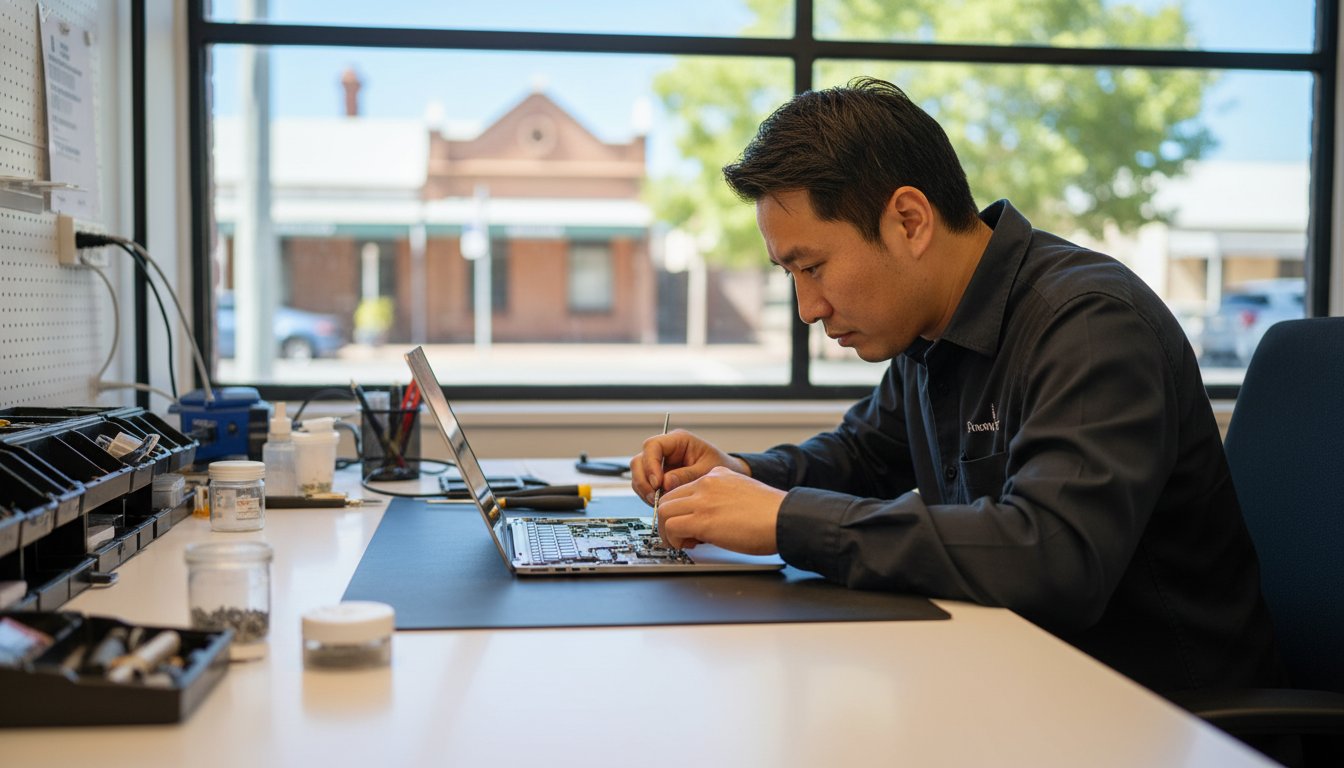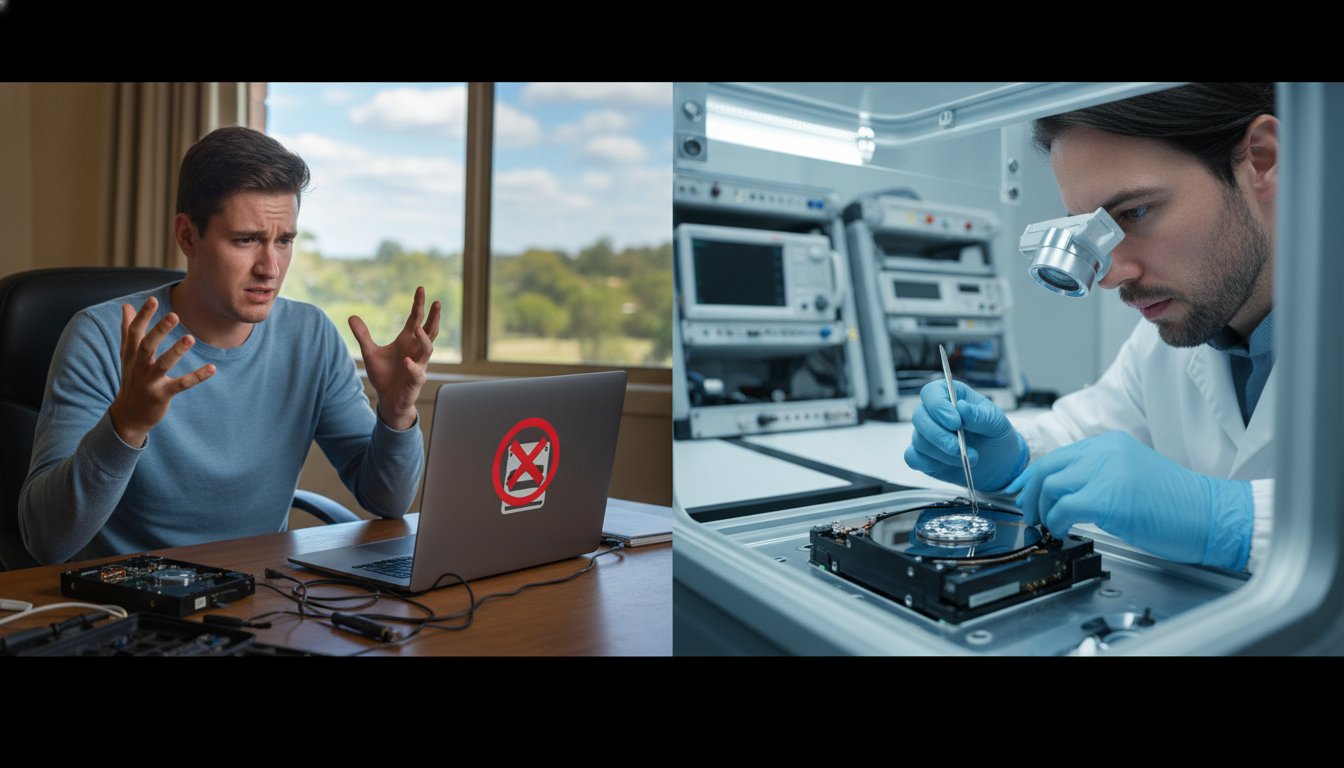
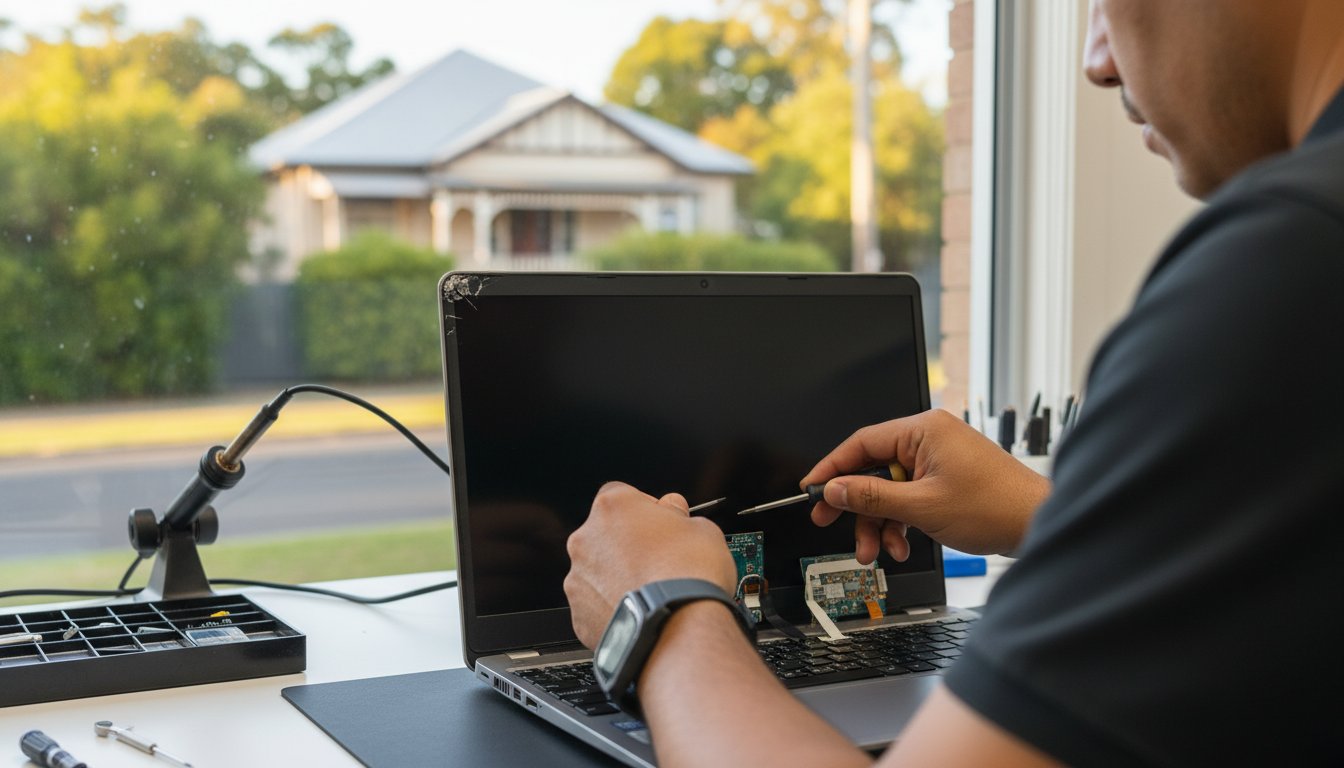
Last Tuesday, a Toowoomba professional went to open their laptop for a morning meeting and heard a sharp “crack” as the screen hinge seized. It’s a moment that causes instant worry, especially when you see the plastic casing begin to pull apart. You know that if you try to force it, you might end up with a shattered LCD. When you need to fix broken laptop hinge Toowoomba experts like Chaim Lee can help you avoid a total hardware failure. We understand that your laptop is essential for your daily life, and seeing it in pieces is incredibly frustrating.

The good news is that you don’t have to panic or start shopping for a new machine just yet. You’ll learn why these mechanical parts fail and how acting early prevents the internal screen cable from snapping. We’ll walk through the warning signs of total destruction and how our team, which has served the local community since 1999, provides the professional, fast-return service you need to get back to work with a sturdy, functional lid. Our goal is to protect your data and connect you back to your routine without the stress of A$1,000 replacement bills.

Key Takeaways

  • Understand why hinge failure is more than just a cosmetic issue and how dust and repetitive stress lead to structural breakdowns.
  • Discover why a “crunchy” sound is a warning sign that could lead to a severed video cable or a shattered screen if left unaddressed.
  • Learn why DIY fixes like superglue often result in permanent damage and why professional high-tension repairs are essential for laptop longevity.
  • Find out how to safely transport your device and get a professional to fix broken laptop hinge Toowoomba to ensure your screen stays protected.
  • Get to know Chaim Lee’s expert approach at Aspire Computing, providing reliable, local repairs for residents from Highfields to the Lockyer Valley.

Understanding Laptop Hinge Failure: Why Laptops Break in Toowoomba

Laptop hinge failure is a common structural breakdown where the physical connection between your screen and the main body of the device fails. While it might feel like a sudden snap, it is usually the result of months or years of repetitive stress. Every time you open your lid, you apply force to a small area designed to manage the mechanical principles of a hinge while resisting friction. Over time, the factory-set “hinge tension” increases as internal lubricants dry out, making the lid harder to move and putting immense pressure on the surrounding casing.

To see how these components often fail in real-world scenarios, watch this repair demonstration:

Modern “thin and light” laptops are particularly vulnerable to these issues. Manufacturers often prioritize aesthetics, using slim plastic housings that lack the reinforcement found in older, bulkier models. If you need to fix broken laptop hinge Toowoomba experts at Aspire Computing often see devices where the metal hinge has actually outlasted the plastic it was bolted into. A single accidental drop or even just a layer of dust can be the final straw for a weakened frame.

The Anatomy of a Laptop Hinge

A laptop hinge consists of a high-tension metal mechanism screwed into the laptop’s chassis. The weak point is rarely the metal itself, but the mounting “bosses” in the plastic casing. The boss is the threaded plastic anchor point where the hinge screws are secured. In many cases, the hinge becomes seized due to debris, causing the metal to leverage itself entirely out of the plastic anchors. This creates a “snapped” appearance, even if the metal hinge is technically still intact.

Environmental Factors in the Darling Downs

The Hidden Dangers: Why a “Crunchy” Hinge is a Ticking Time Bomb

It starts with a small click or a bit of resistance when you lift the lid. You might think it’s just a sign of an ageing device, but a stiff hinge is actually a mechanical failure in progress. When you need to fix broken laptop hinge Toowoomba specialists often find that the internal metal mounts have already begun to tear away from the plastic chassis. This puts immense pressure on delicate components that weren’t designed to handle structural stress. If you ignore these warning signs, you risk a total hardware failure that could have been avoided with an early adjustment.

The Chain Reaction of Structural Damage

  • Stage 1: You feel resistance when opening the lid or hear slight clicking sounds. This usually means the factory grease has dried up or the hinge tension nut has tightened, causing the metal to seize.
  • Stage 2: The bezel, which is the plastic frame around your screen, starts to separate. You’ll see a gap forming near the bottom corners every time you move the lid.
  • Stage 3: Visible cracks appear in the palm rest or the top lid casing. At this stage, the hinge is no longer anchored to the frame, and the laptop is literally pulling itself apart.

The financial impact of waiting is significant. A standard hinge service or reinforcement might cost a fraction of the price of a full screen replacement. If the stress eventually causes the LCD panel to crack, repair costs can jump from a manageable A$150 to well over A$500 for high-end Ultrabooks or MacBooks. Taking action early is the best way to protect your investment.

Data and Component Risks

A broken hinge does more than just ruin the look of your machine. The LVDS cable, which carries the video signal from the motherboard to your screen, often runs directly through or alongside the hinge mechanism. If that hinge snaps or shifts, it can pinch or sever this cable instantly. This leads to flickering displays, distorted colours, or a completely black screen. Beyond the screen, physical trauma to the chassis can lead to the dangers of damaged laptops, where internal components like Wi-Fi antennas or the battery are put under unnecessary pressure.

Internal short circuits are another major concern. When a hinge breaks, tiny metal fragments from the screw housings can fall onto the motherboard. If these fragments touch a live circuit, they can cause a short that kills the entire laptop. This makes data recovery much more difficult and expensive. Additionally, many laptops house the “lid-sensor” near the hinge. If this fails, your computer won’t wake up from sleep mode, leaving you unable to access your files. Since 1999, Chaim Lee at Aspire Computing has helped locals identify these risks before they turn into disasters. If your laptop feels “crunchy,” don’t panic, but do consider a professional hardware assessment to keep your device safe.

DIY vs. Professional Hinge Repair: The Superglue Trap

When a laptop hinge snaps, the first instinct for many is to reach for a bottle of superglue or a two-part epoxy. It seems like a quick, cheap fix, but this is often a costly mistake. Laptop hinges are high-tension moving parts. Every time you open or close the lid, the plastic mounts must withstand significant mechanical stress. Superglue is brittle. It doesn’t bond well to the smooth plastics used in modern chassis, and it will almost certainly crack within 24 to 48 hours of use.

Worse yet, we often see laptops where the glue has seeped into the bezel, the display cable, or even the motherboard components. This can literally glue your laptop shut permanently or short-circuit the internal electronics. If you need to fix broken laptop hinge Toowoomba residents should trust professional reinforcement over home remedies. A professional repair typically costs between A$150 and A$250. When you compare that to the A$1,500 or more for a brand-new replacement laptop, the value of a professional repair becomes clear.

Why DIY Repairs Often Void Warranties

Most manufacturer warranties are immediately voided the moment an unauthorized user opens the casing or applies non-spec adhesives. Modern laptops, especially thin ultrabooks, are often held together with hidden clips and internal adhesives rather than just standard screws. Opening them requires specialized suction and prying tools to avoid cracking the delicate LCD screen. Even if you manage to replace a hinge yourself, incorrect screw torque is a common failure point. If the screws are too tight, the plastic mounts will shatter again. If they’re too loose, the hinge will wobble and eventually snap. Professional technicians use manufacturer-spec replacement parts and calibrated tools to ensure the tension is exactly right for your specific model.

The Aspire Computing Professional Advantage

Choosing a local expert like Aspire Computing means you benefit from over 25 years of technical experience. Since 1999, we’ve seen every type of structural failure across brands like Dell, HP, Lenovo, and ASUS. We don’t just patch the problem. We access genuine parts and reinforce the internal chassis mounts to ensure the repair lasts for the life of the machine. When we fix broken laptop hinge Toowoomba devices, we also include a full hardware tune-up. We check your internal fans for dust buildup and ensure your thermal paste hasn’t dried out. This comprehensive approach means your laptop doesn’t just look better; it runs cooler and faster than when you brought it in.

First Aid for Your Laptop: What to Do Right Now

Hearing a sharp crack or feeling sudden resistance when you open your device is a sinking feeling. Don’t panic. Taking the right steps in the first few minutes can prevent a simple hinge issue from turning into a permanent screen failure. The moment you notice the casing pulling apart or the lid feeling stiff, stop moving the display. Forcing a compromised hinge often snaps the internal plastic mounts, which makes the eventual repair more complex. If you need to fix broken laptop hinge Toowoomba services, acting quickly and gently is your best strategy for a fast recovery.

If your screen is already flickering or showing lines, the hinge might be pinching the delicate video cable. Stop adjusting the angle immediately. To access your data safely, plug the laptop into an external monitor or your TV using an HDMI cable. This lets you see your files without moving the damaged mechanical parts. When you’re ready to transport the device to our workshop, place it in a padded sleeve or wrap it in a soft towel. Avoid putting heavy books or chargers in the same bag, as any pressure on the lid can crush the LCD panel against the broken hinge components.

Safe Handling Techniques

The way you interact with your laptop over the next 24 hours is critical. Always open and close the lid from the exact centre of the top edge. Many people habitually grab the top right or left corner, but this creates an uneven lever effect. This habit puts 100% of the torque on a single hinge, which is likely how the damage started. If you must keep working before your appointment, leave the lid open in a fixed position on a flat desk.

You might be tempted to reach for the superglue to hold the plastic casing together. Please don’t. Glue often seeps into the internal hinges or onto the motherboard, making it impossible for a technician to disassemble the laptop without causing further breakages. A small piece of painter’s tape or electrical tape is a much better temporary hold. It keeps the components in place without leaving a permanent, destructive residue.

Preparing for Your Repair Appointment

We want to get you back online as fast as possible. You can help speed up the process by following a few simple preparation steps. First, back up your vital data to a cloud service or an external drive while you have the laptop connected to a monitor. While hinge repairs are mechanical, it’s always best practice to protect your files before any hardware service.

  • Find your model number: Look at the sticker on the bottom of your laptop. It usually features a string of characters like “Inspiron 15-5000” or “A2337.” This helps us source the exact parts for your fix broken laptop hinge Toowoomba request.
  • Check your warranty: If your device was purchased within the last 12 months, have your receipt ready.
  • Clear a workspace: If you’ve booked an on-site repair in Newtown or surrounding suburbs, please clear a small table or desk area. Our technicians need a clean, flat surface to safely manage the small screws and delicate internal cables.

Since 1999, we’ve helped Toowoomba residents recover from hardware failures with professional, local expertise. We understand that your laptop is essential for your work and daily life, so we focus on repairs that last. If your hinge is failing, reach out to Aspire Computing for a professional assessment.

Choosing Aspire Computing for Hinge Repairs in Toowoomba

When your laptop screen starts wobbling or the plastic casing begins to separate, don’t panic. Chaim Lee and the team at Aspire Computing have supported the local community since 1999. We understand that a broken hinge is more than just a cosmetic issue; it is a major disruption to your productivity and peace of mind. Our “Protect and Connect” philosophy ensures your device stays functional and secure for the long term. Whether you live in Newtown, Wilsonton, Highfields, or out in the Lockyer Valley, we provide the expert care needed to fix broken laptop hinge Toowoomba issues quickly and professionally.

Our approach is built on personal accountability. You won’t be dealing with a distant call centre or a revolving door of junior technicians. Instead, you get direct access to Chaim’s decades of technical expertise. We focus on providing a fast return on all repairs because we know how much you rely on your technology for work, study, and staying in touch with family.

Local Expertise You Can Trust

Experience matters when dealing with delicate internal components. With over 25 years of computer repairs in Toowoomba, Aspire Computing has seen every possible variation of hardware failure. Local residents consistently praise our service for being thorough and professional. Dealing with a local owner means you get honest advice and a repair that lasts. We don’t just glue things back together; we reinforce the structure to prevent future damage. Our clients in the Garden City value this level of quality assurance and the personal touch that comes with a community-focused business.

Comprehensive Tech Support

We take a holistic view of your device’s health. While your laptop is open for a hinge repair, it’s the perfect time to consider other improvements. We frequently handle hardware upgrades, such as installing faster SSDs or increasing RAM, while the machine is already on the workbench. This saves you time and money on future service fees. Our “no-panic” approach ensures that even complex mechanical failures are handled with methodical care. We aim to improve the overall performance of your computer so it returns to you better than it was before the break.

  • Fast Quotes: We provide clear, upfront information so you can make an informed decision.
  • Wide Coverage: Serving all suburbs from the Range to the western plains.
  • Expert Calibration: We adjust hinge tension to ensure smooth movement and longevity.

If you need to fix broken laptop hinge Toowoomba services that you can rely on, contact us today. You can visit our workshop at 46 Brigalow St, Newtown, or call us to arrange a remote assessment. Let us help you protect your investment and stay connected without the stress of hardware failure.

Restore Your Laptop’s Strength and Mobility

Don’t let a stiff or clicking hinge turn into a shattered screen. When you notice that “crunchy” sound, it’s a clear signal that the internal mounts are failing and putting your display at risk. Trying a DIY fix with superglue often leads to permanent casing damage or severed cables, making a simple repair much more costly. To safely fix broken laptop hinge Toowoomba locals can trust, professional intervention is the only way to ensure your device remains structurally sound for years to come.

Since 1999, Aspire Computing has provided reliable, local support to the community. As an owner-operated business, Chaim Lee brings decades of hands-on experience with all major brands, including Dell, HP, Apple, and Lenovo. We understand how vital your computer is for work and home life, which is why we focus on efficient, high-quality repairs that stand the test of time. Our goal is always to protect your technology and keep you connected without the stress of a failing machine.

Talk to the Toowoomba Laptop Experts at Aspire Computing

Your laptop still has plenty of life left in it. Reach out today and let us handle the technical side so you can get back to what matters most with a device that works perfectly.

Frequently Asked Questions

Is a broken laptop hinge worth fixing in 2026?

Repairing a broken hinge is definitely worth the investment because a new mid-range laptop in 2026 typically costs between A$1,200 and A$2,500. If your internal components like the processor and SSD are still performing well, a structural repair extends the life of your machine for a fraction of the replacement cost. It’s a sustainable choice that prevents electronic waste while maintaining your digital continuity.

How much does it typically cost to fix a laptop hinge in Toowoomba?

The cost to fix broken laptop hinge Toowoomba residents usually encounter depends on whether we need to replace the metal hinges, the plastic housing, or both. While we don’t provide flat rates because every model is different, we always provide a clear quote after a physical inspection. Most professional repairs in the Australian market fall within a range that is far more affordable than buying a brand new computer.

Can I still use my laptop if the hinge is wobbly?

You should avoid using a laptop with a wobbly hinge because it puts immediate stress on the delicate internal display cables. Continuing to open and close a damaged lid can lead to a cracked LCD or a short circuit in the motherboard. We’ve seen minor hinge issues turn into A$400 screen replacements because the user waited too long to seek professional help. Don’t panic, but do stop using it.

How long does a professional hinge repair take at Aspire Computing?

Most professional hinge repairs are completed within 2 to 5 business days, depending on the availability of specific parts for your laptop brand. We understand you need to stay connected, so we work quickly to source high quality components. Our goal is a fast return so you can get back to work or study without a long delay. Chaim and the team prioritize efficiency without compromising on the quality of the fix.

Will fixing the hinge also fix my flickering screen?

Fixing the hinge often resolves screen flickering if the issue is caused by a pinched or loose video cable. The cable runs directly through the hinge area, so structural damage frequently impacts the display signal. However, if the flickering is due to a cracked LCD panel, we’ll need to replace the screen as well. We’ll perform a full diagnostic to ensure we protect and connect your device properly.

Do you provide on-site hinge repairs in Highfields or Westbrook?

We provide on-site technical support throughout Highfields and Westbrook, but we typically perform hinge repairs in our specialized Toowoomba workshop. These repairs often require specific adhesives to cure for 24 hours or delicate disassembly that is best handled in a controlled environment. You can drop your device off, or we can arrange a convenient time to collect it from your home or office.

What happens if the plastic casing is also snapped?

If the plastic casing is snapped, we use industrial strength structural adhesives or replace the affected panels entirely. In many modern laptops, the hinge mounts are anchored into thin plastic that fails over time. We don’t just glue it back; we reinforce the area to ensure the repair lasts. This comprehensive approach is why we are a trusted choice to fix broken laptop hinge Toowoomba wide.

Does Aspire Computing offer a warranty on hardware repairs?

Yes, Aspire Computing provides a 12 month warranty on all new hardware parts used in our repairs. We’ve been established since 1999, so you can trust that we stand behind our workmanship and the quality of our components. This guarantee ensures your peace of mind and reflects our commitment to providing a reliable, professional service for every customer in the Toowoomba region.

The Australian Signals Directorate reported that cybercrime cost small businesses an average of A$46,000 per incident in 2023. For a family business in Toowoomba, that is a devastating figure that goes beyond just money; it is about losing the hard earned trust of your neighbors. While we provide technical “Active Protection” for your systems, your biggest security gap isn’t your router. It is the person opening an email. Implementing consistent cybersecurity awareness training for employees is the only way to ensure your team doesn’t accidentally hand over the keys to your digital kingdom.

It is exhausting to worry about client data or feel overwhelmed by technical jargon that seems to change every week. We agree that keeping up with Australian privacy standards shouldn’t feel like a second job. This 2026 guide provides a simple, repeatable training plan to turn your staff into a human firewall. We will show you how to build a culture of security that protects your business and gives you back your peace of mind, so you can focus on what you do best.

Key Takeaways

  • Transform your staff from a liability into a “human firewall” by addressing the leading cause of data breaches in 2026.
  • Identify the evolution of digital threats, including AI-perfected phishing and the specific risks Business Email Compromise poses to local Toowoomba invoice payments.
  • Evaluate different training models to determine whether automated monthly simulations or incident-based learning provides the best ROI for your small business.
  • Follow a clear, 5-step roadmap to implement effective cybersecurity awareness training for employees and establish a robust security culture.
  • Discover how Aspire Computing’s “Active Protection” philosophy helps local firms stay both secure and connected through Chaim Lee’s expert, personal approach.

What is Cybersecurity Awareness Training for Employees?

Cybersecurity awareness isn’t just about passing a mandatory quiz once a year. It’s the combination of technical knowledge and daily habits that keep your business safe from digital threats. At Aspire Computing, we believe true Security awareness involves every staff member understanding their role in protecting company data. It’s a mindset where security becomes second nature, rather than an afterthought.

In 2026, human error remains the primary cause of data breaches, contributing to over 82% of successful attacks. Hackers have moved away from trying to break through sophisticated software firewalls because it’s much easier to trick a person. This is why cybersecurity awareness training for employees is no longer optional for small businesses in Toowoomba and across the Darling Downs.

To better understand this concept, watch this helpful video:

Ongoing training creates a genuine security culture rather than a “tick-a-box” compliance exercise. While one-off sessions provide a temporary boost, a true culture of safety requires regular updates to keep pace with evolving threats. For local firms, the stakes are high. A single breach can lead to reputational damage that takes years to recover from in a tight-knit community like ours. If you need help setting up these protections, Aspire Computing provides the local expertise you need to stay secure.

The Role of the ‘Human Firewall’ in 2026

Technology fails eventually. When a malicious email bypasses your filters, your staff become the final line of defence. Hackers use social engineering to exploit trust, urgency, or fear. They want your team to click before they think. By investing in cybersecurity awareness training for employees, you turn your team into a defensive asset. The ‘Human Firewall’ is an empowered, observant workforce that acts as a conscious, resilient barrier against digital threats.

Why Small Businesses are the New Primary Targets

Don’t fall for the myth that your business is too small to be hacked. Data from the Australian Cyber Security Centre shows that 43% of all cyber attacks now target small businesses. Many of these are supply chain attacks. This is where hackers use a small vendor as a back door into a larger firm’s network. Additionally, recent updates to the Australian Privacy Act mean small businesses face stricter penalties for data mishandling. Protecting your data is about business continuity and meeting your legal obligations to your customers.

  • Supply Chain Risk: Hackers target you to get to your bigger clients.
  • Legal Compliance: The Australian Privacy Act now carries heavier fines for small firms.
  • Local Reputation: In Toowoomba, word of a data leak travels fast.

The Top Cyber Threats Your Staff Must Recognise

Cyber threats have moved far beyond the obvious scams of the past. In 2024, the Australian Cyber Security Centre (ACSC) received over 94,000 cybercrime reports, which is roughly one every six minutes. By 2026, the complexity has only increased. Scammers now use sophisticated tools to bypass traditional filters, making cybersecurity awareness training for employees a vital shield for Toowoomba businesses. You can’t rely on software alone when the target is the person sitting at the desk.

Phishing has evolved from poorly written emails into AI-generated masterpieces. These messages no longer contain the “bad grammar” red flags we once relied on. Instead, they use large language models to mimic the professional tone of your actual suppliers or clients perfectly. Business Email Compromise (BEC) is a particularly nasty variant of this. A staff member might receive a legitimate looking invoice from a local contractor, but the bank details have been subtly changed to a scammer’s account. These invoice redirection scams cost Australian small businesses millions of dollars every year because they exploit trust rather than software vulnerabilities.

We also see growing risks from “Shadow IT.” This happens when your team uses unauthorised personal apps, like a private Dropbox or a messaging app, to share sensitive work files. While they usually do this to be more efficient, it creates a massive blind spot in your security. Physical security is just as vital. A lost USB drive in a car park or an unlocked laptop left in a local cafe can give a thief direct access to your entire network. Understanding the role of employees in cybersecurity helps your team realise that protection is a shared responsibility, not just a task for the IT department.

Modern Phishing and Smishing Tactics

AI tools now allow hackers to scrape data from LinkedIn or local business directories to create highly personalised scams. They might mention a recent local event or a specific project your company is currently working on. We’ve also seen a sharp rise in “Smishing” (SMS phishing). Your staff might get a text on their work mobile that looks like a delivery update from Australia Post or a security alert from their bank. To stay safe in 2026, use this quick checklist for every message:

  • Verify the sender: Click the sender’s name to see the actual email address or phone number behind it.
  • Inspect the link: Hover over any button to see the destination URL before you click.
  • Confirm via a second channel: If a “supplier” asks for a payment change, call them on a trusted number to confirm.

Social Engineering and Psychological Triggers

Hackers don’t just hack code; they hack people. They use psychological triggers like urgency and authority to make staff bypass common sense. The “CEO Scam” is a classic example. An employee gets an urgent email from “the boss” requesting a quick A$2,500 transfer for an “urgent client gift.” Because the request seems to come from a position of authority, the staff member might act without thinking. It’s a high-pressure tactic designed to stop you from asking questions or following standard procedures.

Effective cybersecurity awareness training for employees teaches your team to pause when they feel that sense of panic. If you think a device has already been compromised by a suspicious link, check out our Virus and Malware Removal: Your Complete Guide for the next steps. If you want to ensure your business stays resilient, we can help you protect and connect your systems with a professional security audit.

Comparing Training Methods: What Actually Works?

Choosing the right delivery method determines if your team remembers how to spot a threat or if they forget the lesson by the time they finish their coffee. Traditional “Lunch and Learn” sessions often fail because they treat security as a one-time event. Research shows that people forget 70% of new information within 24 hours if it isn’t reinforced. Automated monthly simulations work better because they focus on frequency rather than duration. A 10-minute module every month is far more effective for long-term retention than a three-hour seminar once a year.

Gamified training is also proving superior to traditional video modules. By using quizzes, badges, and leaderboards, you turn a chore into a challenge. This engagement is vital for cybersecurity awareness training for employees to actually stick. We also recommend “Incident-Based Training,” which provides a teachable moment right after a mistake. If an employee clicks a simulated phishing link, they immediately get a 60-second refresher on what they missed. This real-time feedback loop changes behavior much faster than a generic classroom setting.

DIY Training vs. Managed Security Awareness Programs

Many owners try the DIY route to save money, but the hidden costs add up quickly. You’ll spend hours searching for current info, and by the time you present it, the threats have already changed. Managed programs take this weight off your shoulders. They provide automated phishing simulations that test your staff in the real world without you lifting a finger. For a deeper look at how professional help scales your business, check out our IT Support for Business: A Small Business Owner’s Guide. It’s about having an expert partner to ensure your protection is always up to date.

Measuring the ROI of Employee Training

You can’t manage what you don’t measure. Effective cybersecurity awareness training for employees should provide clear data on “Click Rates” and “Reporting Rates.” You want to see your click rates drop below 5% while your reporting rates (employees flagging suspicious emails) go up. This data is essential for your bottom line. In 2023, the average cost of a cybercrime report for an Australian small business was approximately A$46,000. This makes the cost of a training program look like a bargain compared to a ransomware payout. Additionally, most Australian insurers now require a documented training program before they’ll issue a policy or offer lower premiums. It’s a simple way to protect your cash flow and your reputation at the same time.

A 5-Step Roadmap to Build Your Security Culture

Building a resilient business isn’t a one-time event; it’s a continuous process of improvement. Effective cybersecurity awareness training for employees follows a clear, logical path that turns your team from a liability into your strongest line of defence. According to the 2023 Verizon Data Breach Investigations Report, 74% of all breaches include a human element. Here is the roadmap we recommend for small businesses to change those odds.

  • Step 1: Baseline Testing. You need to know your starting point. Use a simple, unannounced phishing test to see how many staff members click a suspicious link. This provides the data you need to tailor your training to specific weaknesses.
  • Step 2: Policy Creation. Set clear, written rules. This includes requirements for complex passwords and strict guidelines on using personal devices for work tasks. These policies shouldn’t be long documents; they should be easy to read and follow.
  • Step 3: Interactive Training. Move away from technical jargon and long slide decks. Use relatable, short modules that show how a real-world scam looks, such as a fake SMS from a delivery company or a spoofed email from a supplier.
  • Step 4: Phishing Simulations. Regularly send safe, simulated “scam” emails. This builds the muscle memory required for staff to spot red flags in a split second.
  • Step 5: Ongoing Reinforcement. Security should be a monthly conversation. Share a quick tip in your staff newsletter or during a team meeting to keep the topic fresh.

Implementing Basic Cyber Hygiene Habits

Simple habits often provide the best protection. A “Clean Desk” policy ensures that sensitive client information or login credentials aren’t left visible to visitors or unauthorised staff. We always recommend using a dedicated password manager rather than Post-it notes stuck to monitors. It’s a small change that makes the right choice the easiest one for your team. If your office equipment is struggling to keep up with modern security software, consider how Hardware Upgrades: A Guide to a Faster, Safer Computer can support your team’s efficiency and protection.

Creating a ‘No-Blame’ Reporting Culture

Mistakes happen. If a staff member clicks a malicious link, they must feel safe reporting it immediately without fear of punishment. Rapid reporting is the difference between a minor incident and a total network shutdown. In a small office, you can appoint a “Security Champion.” This is a non-technical staff member who encourages safe practices and acts as a friendly first point of contact for security questions. When people feel supported, they become active participants in your cybersecurity awareness training for employees.

For expert help setting up your team’s security roadmap, talk to the experts at Aspire Computing today.

How Aspire Computing Secures Toowoomba Businesses

Chaim Lee has been helping Toowoomba businesses since 1999. His “Protect and Connect” approach isn’t just a catchy slogan; it’s a personal commitment to keeping local firms running safely and efficiently. We believe in an “Active Protection” philosophy that moves beyond basic antivirus software. We look at your business as a whole, combining robust hardware and smart software with the most critical security layer: your people. Comprehensive cybersecurity awareness training for employees is the bridge between a secure network and a devastating data breach.

Every industry in our region faces unique threats. A medical clinic in East Toowoomba dealing with sensitive patient records has different compliance requirements than a local non-profit managing donor databases. We don’t believe in generic, one-size-fits-all training. We tailor our education programs to address the specific risks your staff encounter in their daily workflows. By focusing on real-world scenarios relevant to Toowoomba industries, we ensure the lessons actually stick.

Local Support When Things Go Wrong

Even the best training can’t stop every single mistake. When a staff member accidentally clicks a sophisticated phishing link, you don’t want to be stuck on hold with a call centre in another time zone. We’re local experts who can be on-site at your office in Newtown or the CBD quickly. If a breach occurs despite your best efforts, we’re here to help with the cleanup. Our Data Recovery Services Toowoomba team works tirelessly to retrieve lost files and restore your business continuity as fast as possible.

Get Started with a Professional IT Health Check

Knowing exactly where your vulnerabilities lie is the first step toward a more secure 2026. During an Aspire Computing security audit, we perform a deep dive into your current systems. We help you align with the Australian Cyber Security Centre (ACSC) “Essential Eight” framework. This is the gold standard for Australian small businesses to mitigate cyber threats. Our audit identifies technical gaps and highlights where your team needs more cybersecurity awareness training for employees.

  • We check your backup frequency and reliability.
  • We review user access levels to ensure the “principle of least privilege.”
  • We assess your current patch management for all software and devices.
  • We identify high-risk staff groups who need immediate training.

Don’t wait for a cyber attack to find out your back door is open. It’s much easier to prevent a crisis than it is to fix one. Contact Chaim and the team for a security consultation today to protect your business and your reputation.

Secure Your Toowoomba Business for the Years Ahead

Building a resilient business in 2026 starts with your team. Cyber threats aren’t just technical glitches. They’re sophisticated social engineering attempts that target human error. Implementing regular cybersecurity awareness training for employees ensures your staff can spot a phishing attempt before it costs your business thousands in recovery fees. Practical, consistent education is the most effective way to reduce risk and protect your daily operations. A five step roadmap makes this process manageable for any small team.

Since 1999, Aspire Computing has helped local businesses navigate the changing IT landscape. Chaim Lee and our team specialize in small business IT security. We provide the personalized support you need to stay safe. You don’t have to face these digital challenges alone. We’re here to help you protect and connect your business with confidence. Let’s make sure your data stays where it belongs. Our goal is to replace your tech anxiety with genuine peace of mind.

Talk to the Experts: Get a Cyber Security Consultation Today

Frequently Asked Questions

Is cybersecurity awareness training mandatory for Australian small businesses?

There’s no single law that makes cybersecurity awareness training for employees mandatory for every small business. However, under the 2024 Privacy Act reforms, Australian businesses must take reasonable steps to protect personal data from misuse or loss. The Office of the Australian Information Commissioner (OAIC) frequently identifies staff education as a core component of these reasonable steps. Failing to provide training can lead to significant regulatory penalties if a data breach occurs.

How often should my employees undergo cybersecurity training?

Employees should participate in security training at least every four to six months to keep their skills sharp. Research shows that 90 percent of information is forgotten within 30 days if it isn’t reinforced through regular practice. Short, quarterly micro-learning sessions are much more effective than a single annual presentation. We recommend a quick refresher whenever you introduce new software or after a major industry threat is identified in the news.

What is the most common cyber threat for employees in 2026?

AI-driven social engineering is the most common threat facing Australian staff in 2026. Scammers now use generative AI to create flawless, error-free emails and deepfake audio that perfectly mimics a manager’s voice. These sophisticated attacks are designed to trick employees into transferring funds or sharing passwords. Training helps your team identify the subtle psychological triggers these criminals use, ensuring your business stays safe from increasingly realistic scams.

Can training really prevent a sophisticated ransomware attack?

Yes, effective training acts as a critical barrier because human error contributes to 82 percent of successful data breaches according to recent industry reports. Most ransomware requires a user to click a link or download a malicious attachment to enter your system. By teaching your team to pause and verify suspicious requests, you stop the attack before it can encrypt your files. It’s a vital part of our mission to protect and connect your business.

How much does employee cybersecurity training typically cost?

Professional cybersecurity awareness training for employees typically costs between A$50 and A$120 per user each year in Australia. This price often depends on the complexity of the platform and whether it includes simulated phishing tests to measure progress. Small businesses find this a small investment compared to the A$46,000 average cost of a cybercrime report for small firms cited by the Australian Cyber Security Centre (ACSC). It’s a practical way to avoid devastating financial losses.

What should an employee do if they accidentally click a suspicious link?

If an employee clicks a suspicious link, they must immediately disconnect the device from the internet and notify their IT manager or provider. Don’t let them panic or try to hide the mistake, as fast action allows us to isolate the machine before malware spreads through your entire network. We always prefer a false alarm over a delayed report. Establishing a no-blame culture ensures that your team feels comfortable reporting issues the moment they happen.

Does cybersecurity training help with Australian Privacy Act compliance?

Training is a fundamental part of staying compliant with the Australian Privacy Act and the Notifiable Data Breaches (NDB) scheme. The OAIC expects businesses to prove they’ve taken active steps to prevent unauthorized access to customer records. Documenting your training sessions provides a clear audit trail for regulators if an incident occurs. This shows that you’re committed to protecting the privacy of the local community you serve and take your legal responsibilities seriously.

What is the ‘Essential Eight’ and do my employees need to know it?

The Essential Eight is a set of baseline strategies developed by the ACSC to protect Australian organizations against cyber threats. While some parts are technical, your employees need to understand the practical concepts like multi-factor authentication (MFA) and why they shouldn’t have administrative privileges on their daily accounts. When your team knows why these security rules exist, they’re more likely to follow them. This shared understanding forms the backbone of a secure and resilient workplace.

Last Tuesday morning, Sarah sat down in her home office to tackle a busy schedule, but her PC had other plans. After installing the latest March 2026 Windows updates, her usually snappy machine began to crawl, with typing lag making even a simple email feel like a chore. If you find your computer running slow after Windows update installations, please don’t panic. You aren’t alone in this. It’s a common frustration for many of our clients who rely on their technology for daily productivity.

We understand how unsettling it is when you can’t tell if you’re facing a temporary software bug or a serious hardware failure like a failing SSD. At Aspire Computing, we’ve been helping locals solve these exact issues since 1999. This guide will help you discover why the newest 2026 patches might be dragging your system down and provide clear, expert steps to restore your speed. We’ll walk you through the difference between a software glitch and hardware age, ensuring you know exactly when it’s time to call in a professional for a tune-up.

Key Takeaways

  • Understand how the latest 2026 AI features and background indexing tasks can cause temporary performance dips during the “settling period.”
  • Learn simple DIY techniques, such as performing a “Clean Boot,” to isolate software conflicts and reclaim your system speed.
  • Discover how to identify if your computer running slow after Windows update is caused by outdated drivers or requires a specific patch rollback.
  • Recognise the warning signs that a software update is actually exposing underlying hardware issues like thermal throttling or SSD wear.
  • Find out how Chaim Lee and the Aspire team provide reassuring, on-site expert support for residents across Toowoomba and the Darling Downs.

Why Your Computer Is Running Slow After a Windows Update

If you’ve noticed your computer running slow after Windows update, don’t panic. It’s a common issue we see here at Aspire Computing. Most of the time, your system just needs a “settling period.” During the first 2 hours after a major patch, Windows works in the background to index new files and optimize system data. This process can consume up to 70% of your CPU resources temporarily, making your machine feel sluggish while it reorganises itself.

To better understand this concept, watch this helpful video:

Recent reports from late 2025 and early 2026 have highlighted specific challenges with mandatory patches. Some users have experienced a 15% drop in SSD read and write speeds due to driver conflicts. When a new Windows version doesn’t align perfectly with your existing hardware drivers, it creates a communication bottleneck. This is especially true for older machines trying to keep up with 2026 security protocols that require constant, resource-heavy encryption checks.

The Difference Between Temporary Lag and System Errors

It helps to know if your lag is a passing phase or a serious fault. Background indexing usually finishes within a few hours. However, if your CPU usage stays at 100% for an entire day, you might have a corrupted update. Signs of corruption include frequent blue screens, applications crashing, or a persistent 2 second lag when typing. You can use Task Manager (Ctrl+Shift+Esc) to spot “Power Hungry” background processes. If “Windows Modules Installer Worker” never stops running, the update process is likely stuck in a loop.

New Windows Features and Resource Demand

Windows updates in 2026 have introduced integrated AI tools that demand significant system memory. These features can hog 2GB to 4GB of RAM just to stay active in the background. Older PCs often struggle to meet these new requirements, leading to a frustrating user experience. Update Bloat is the accumulation of unnecessary background services that activate automatically after a system refresh. If your hardware is more than four years old, these new features can push it past its limits. For a professional assessment, you can always reach out for a system tune-up to clear out these resource-heavy services.

Immediate DIY Fixes to Speed Up Your PC

Finding your computer running slow after Windows update is frustrating, but you don’t need to panic. It’s a common scenario where the operating system and your existing software struggle to communicate properly after a patch. Our team at Aspire Computing has helped Toowoomba residents fix these issues since 1999, and often, a few simple steps can restore your speed without needing a full system reset.

Begin by running the Windows Update Troubleshooter. You’ll find this under Settings > System > Troubleshoot > Other troubleshooters. This tool scans for hidden patch errors that often cause a computer running slow after Windows update events. After that, perform a Disk Cleanup. When you open the tool, click “Clean up system files.” Look specifically for “Previous Windows Installations.” These files can occupy 20GB to 30GB of storage. Clearing them out provides immediate breathing room for your drive, especially if you’re running low on space.

How to Perform a Clean Boot Safely

A clean boot starts Windows with only the essential drivers. It’s the best way to see if a third-party app is clashing with the new update. Type “msconfig” in your taskbar search and open System Configuration. Navigate to the Services tab. It’s vital that you check the box “Hide all Microsoft services” before doing anything else. This prevents you from accidentally disabling a core system function that Windows needs to run.

Once those are hidden, click “Disable all” and restart your PC. If your speed returns, you know a specific app is causing the lag. You can then re-enable services one by one to identify the culprit. If the computer is still slow in clean boot mode, the problem likely lies deeper within the operating system files or your physical components.

Managing Your Startup Apps

Windows updates sometimes re-enable startup programs you previously turned off. To fix this, press Ctrl+Shift+Esc to open Task Manager and select the “Startup” tab. Focus on apps listed with a “High Impact” rating. These are the primary resource hogs that slow down your initial boot and overall performance. Right-click any non-essential programs, like game launchers or chat apps, and select “Disable.”

Taking control of these apps can reduce your boot time by as much as 30 percent. If your startup list is empty but you’re still waiting minutes for your desktop to load, you might benefit from Hardware Upgrades like a modern SSD. If these DIY steps don’t resolve the lag, feel free to talk to the experts at Aspire Computing for a professional tune-up.

Advanced Troubleshooting: Drivers and Update Rollbacks

If your computer running slow after Windows update didn’t respond to basic restarts, it’s time to look deeper into the system architecture. Since Chaim Lee founded Aspire Computing in 1999, we’ve observed that driver conflicts account for approximately 75% of performance issues following a major patch. Often, the update itself is stable, but it fails to communicate correctly with your specific hardware components, leading to resource bottlenecks.

Updating Your Drivers for 2026 Compatibility

During a major update, Windows might replace your specialized manufacturer drivers with generic Microsoft versions. These generic drivers are designed for broad compatibility but often lack the optimization needed for peak performance. Your chipset driver is particularly vital; it acts as the traffic controller between your CPU and other hardware. If this becomes outdated or generic, your entire system will feel sluggish because data isn’t moving efficiently between components.

  • Graphics Drivers: These control your display and GPU acceleration. A clash here causes stuttering windows, laggy scrolling, and slow video playback.
  • Chipset Drivers: These manage motherboard communication. Outdated chipset drivers are often the silent killers of system speed after an update.
  • Roll Back Feature: If a specific device fails after an update, open Device Manager, right-click the component, select Properties, and use the Roll Back Driver button to return to the previous, stable version.

Always check the Optional Updates section in your Windows Update settings. Microsoft frequently tucks essential driver fixes and BIOS updates here instead of including them in the main download stream. Keeping these current ensures your machine remains ready for the software demands of 2026 and beyond. If you find your hardware is still struggling, it might be time for a professional assessment to ensure your hardware and software are perfectly synced.

Uninstalling a Problematic Windows Update

If your performance plummeted immediately after a specific patch, you can take direct action. Navigate to Settings > Windows Update > Update History > Uninstall Updates. This menu allows you to remove specific patches that might be poorly optimized for your hardware. It’s a professional-grade quick fix that can restore your system speed in minutes without affecting your personal files.

Once the problematic update is gone, use the Pause Updates feature. You can delay further installations for up to 35 days. This gives Microsoft time to release a hotfix for the known bug. However, don’t stay unpatched indefinitely. Security is a core part of our mission to protect and connect. Running a system without the latest security definitions for more than 30 days increases your risk of malware, which can be far more damaging than a slow PC.

If these steps feel overwhelming, don’t panic. You can always talk to the experts at Aspire Computing for remote or on-site assistance to get your system back to its best performance levels.

When the Problem Isn’t the Software: Hardware Warning Signs

Sometimes a major Windows update acts as an unintentional stress test for your hardware. These updates require intense read and write operations, which can push an ageing hard drive or a struggling processor to its limit. If you notice your computer running slow after Windows update, it’s possible the software isn’t the only culprit. Hardware components have a finite lifespan, and the heavy resource load of an installation can reveal underlying faults that were previously hidden.

RAM is a frequent bottleneck in modern systems. While 8GB was sufficient for basic tasks a few years ago, it’s no longer enough for the demands of 2026 Windows versions. Future updates are expected to integrate more background AI processes and telemetry that consume significant memory. If your system constantly uses 85% or more of its RAM, your PC will feel sluggish regardless of how many software fixes you try. Upgrading to 16GB or 32GB is often the most cost-effective way to restore speed and ensure your system is ready for future releases.

Physical sounds are another major red flag. If the slow performance is accompanied by unusual clicking, grinding, or whirring noises, don’t panic, but do act quickly. These sounds often signal a mechanical hard drive failure. You should seek professional Data Recovery Services immediately to protect your files before the drive becomes completely inaccessible.

SSD and HDD Health Checks

You can check your drive’s basic health using built-in Windows tools. Open the Command Prompt and type “wmic diskdrive get status”. If the result is anything other than “OK”, your hardware is likely failing. Additionally, check your storage capacity. A C: drive that is 90% full cannot efficiently manage the temporary files required during an update. For those still using mechanical hard drives, switching to an SSD is the best performance boost available in 2024, often making an old computer feel five times faster.

Thermal Management and Dust

High CPU usage during and after an update generates significant heat. If your laptop fan is noticeably louder since the update, your system might be “thermal throttling”. This is a safety feature where the computer slows itself down to prevent internal components from melting. Dust buildup in Australian homes can quickly clog cooling vents. While software settings can help, a professional physical “Tune-up” to clean the internal fans and replace dried-out thermal paste is often more effective than any software patch.

If your hardware is showing signs of age or you’re worried about failing components, talk to the experts at Aspire Computing for a professional diagnostic and hardware health check.

Expert Computer Repairs in Toowoomba: Let Aspire Help

If your computer is running slow after a Windows update, the first thing you should do is take a deep breath. At Aspire Computing, our founder Chaim Lee has operated with a simple “Don’t Panic” philosophy since establishing the business in 1999. We know that a sluggish PC isn’t just a minor annoyance; it’s a barrier to your daily work, your business operations, and your connection with family. Whether your machine is stuck in a boot loop or simply crawling along, we provide the steady, expert hand needed to restore its speed.

We offer flexible support options tailored to your specific situation. For software-based speed issues, our remote IT support can often provide a quick fix without you needing to leave your desk. If the problem requires a more hands-on approach, we provide on-site support throughout Toowoomba, Newtown, and the wider Darling Downs region. Our professional Windows Tune-up is designed to strip away resource-heavy bloatware and optimise hidden settings that Windows updates often reset to default, ensuring your system runs leaner and faster.

Local Service You Can Trust

We aren’t a faceless corporation or a distant call centre. Aspire Computing is a local fixture, regularly assisting clients near the Toowoomba CBD and throughout suburbs like Newtown. Our core mission is encapsulated in our tagline: “Aspire to Protect and Connect.” This is our promise to ensure your data stays safe and your hardware stays functional. Booking an on-site visit for your home office or small business is straightforward, allowing you to get back to work while we handle the technical troubleshooting in your own environment.

Why a Professional Fix Beats a DIY Headache

Trying to repair a computer running slow after a Windows update by following random internet tutorials often leads to hours of wasted time. One wrong move in the Windows Registry or an incorrect driver installation can make the problem worse, potentially leading to data loss or a total system failure. Our experts have over 20 years of experience navigating these complex systems, allowing us to identify the root cause in a fraction of the time it takes for a DIY attempt.

  • We handle complex driver rollbacks and registry cleaning with precision.
  • Our team identifies hardware bottlenecks that an update might have exacerbated.
  • You receive a comprehensive system health check to prevent future slowdowns.

Don’t spend your weekend fighting with a stubborn operating system. You can book Computer Repairs Toowoomba services right now to get your technology back on track. We pride ourselves on fast turnarounds and professional results that last. Contact Aspire Computing today and let us take the stress out of your IT issues.

Restore Your Peak Performance Today

A computer running slow after Windows update doesn’t have to ruin your productivity. Don’t panic if your system feels sluggish. Most issues stem from driver conflicts or temporary glitches that a quick DIY fix can resolve. If those steps don’t work, it might be a sign of aging hardware or a deeper software conflict. These problems require a professional touch to prevent data loss or further downtime.

Since 1999, Aspire Computing has provided reliable IT solutions to the Toowoomba community. Local expert Chaim Lee and his team offer both on-site and remote support to get you back online quickly. We’re committed to our mission to Aspire to Protect and Connect, ensuring your technology remains a tool rather than a burden. You can rely on our decades of experience for a fast, dependable return to peak performance. Talk to the Toowoomba experts at Aspire Computing for a fast PC fix and regain your peace of mind. Your computer will be back to its best before you know it.

Frequently Asked Questions

How long should I wait for my computer to speed up after an update?

You should typically wait 1 to 2 hours for background tasks to finish after a major update. Windows often performs indexing and file cleanup that consumes up to 80 percent of disk usage initially. If your computer running slow after Windows update persists for more than 24 hours, it’s likely a configuration error rather than a temporary process. Don’t panic; it just means the system needs a bit of expert fine-tuning.

Can I stop Windows from automatically updating and slowing down my PC?

You can pause updates for up to 35 days in the settings, but you cannot permanently disable them on Windows Home editions. Microsoft mandates these updates to protect users from the 20,000 plus new vulnerabilities discovered annually. We recommend scheduling updates during your “Active Hours” so they don’t interrupt your work day. This ensures your PC stays secure without affecting your productivity when you need it most.

Will rolling back an update delete my personal photos or documents?

Rolling back a Windows update won’t delete your personal photos or documents. This process only reverts system files and registry settings to their previous state from the last 10 days. However, we always advise performing a full backup to an external drive or cloud service before any major system change. About 1 in 500 system restores can encounter unexpected file system errors, so it’s best to be safe.

Why is my mouse lagging or my typing delayed after the Windows update?

Mouse lag and typing delays usually happen because the update replaced your specific hardware drivers with generic Microsoft versions. This occurs in roughly 15 percent of updates involving older hardware. You can fix this by visiting your manufacturer’s website to download the specific driver released for your model. This restores the 1:1 communication between your hardware and the operating system, making everything feel snappy again.

What is the “Clean Boot” method and is it safe for beginners?

A Clean Boot starts Windows with only the essential 10 to 15 Microsoft services, making it very safe for beginners to troubleshoot software conflicts. It’s a diagnostic tool that helps you identify if a third party app is causing your computer running slow after Windows update. Unlike a factory reset, it doesn’t delete any data; it simply narrows down which program is hogging your system resources so you can remove it.

How much RAM do I need for Windows to run smoothly in 2026?

You will need at least 16GB of RAM for Windows to run smoothly in 2026. While 8GB is the current baseline, modern browsers like Chrome now use over 2GB of memory with just ten tabs open. Stepping up to 16GB or even 32GB ensures your system can handle the AI integrated features and security protocols that Microsoft plans to implement. Upgrading your RAM is a quick fix that provides immediate performance gains.

Is it possible that the update actually broke my hard drive?

An update won’t physically break a hard drive, but the intense read and write activity can push a failing drive over the edge. Mechanical hard drives have a failure rate that increases significantly after 3 to 5 years of use. If your drive was already showing signs of wear, the 20GB to 30GB of data written during a major update might trigger a final hardware collapse. We can help recover your data if this happens.

Does Aspire Computing offer remote help for slow computers in Toowoomba?

Yes, Aspire Computing provides remote support for slow computers to clients across Toowoomba and the Darling Downs. Chaim Lee and our team use secure encrypted software to fix software glitches without you needing to leave your home. Since 1999, we’ve helped locals “Protect and Connect” by resolving update issues quickly, often within a single 60 minute session. We make sure your technology works for you, not against you.

Imagine it’s 9:00 AM on a busy Monday and two of your key staff members are stuck staring at spinning icons on aging laptops. You know a refresh is overdue, but writing a single cheque for A$10,000 to replace every workstation feels impossible for your current cash flow. It’s a common frustration for local business owners who want to stay competitive without draining their bank accounts.

You likely agree that technology should help you grow, not hold you back with sudden repair bills or slow performance. This is why hardware as a service (HaaS) for small business is becoming the go-to solution for Australian companies in 2026. This guide shows you how to eliminate those massive upfront costs and trade your old, slow gear for enterprise-level equipment on a manageable budget. We’ll break down how HaaS provides a single point of contact for support and ensures your team always has the reliable tools they need to protect and connect your business.

Key Takeaways

  • Stop the “break-fix” cycle and discover how to access enterprise-grade equipment without the heavy upfront A$ price tag.
  • Learn how hardware as a service (HaaS) for small business eliminates tech obsolescence by including maintenance and automatic hardware refreshes in one monthly fee.
  • Understand the financial benefits of shifting IT costs from CapEx to OpEx, potentially making your technology 100% tax-deductible under Australian business regulations.
  • Follow a practical 5-step roadmap to audit your current fleet and identify which devices are costing you the most in lost productivity.
  • See how local, accountable support from the Aspire Computing team in Toowoomba ensures your business stays “protected and connected” with a personalised hardware strategy.

The Hardware Cycle Headache: Why Small Businesses are Moving to HaaS

Managing IT used to mean waiting for something to break and then panicking to fix it. This “break-fix” trap is a silent profit killer for local firms. By the time a hard drive fails or a server overheats, you’ve already lost billable hours and potentially sensitive data. In the 2026 business environment, smart owners are moving away from the stress of ownership toward the reliability of access. This shift is part of a global move toward everything being delivered as a service, where you pay for a functional outcome rather than a depreciating box of wires.

To better understand this concept, watch this helpful video:

For regional businesses in Toowoomba, staying competitive means having the same digital horsepower as firms in Brisbane or Sydney. Hardware as a service (HaaS) for small business levels the playing field. It allows a local family-owned practice to use the exact same high-end, secure workstations as a multinational corporation. Instead of finding A$15,000 for a fleet refresh every three years, you simply subscribe to the technology you need. It turns a volatile capital expense into a predictable, monthly operating cost that scales with your headcount.

The True Cost of a ‘Slow’ Computer

A slow computer is more than just a nuisance; it’s a drain on your payroll. If a team of five people each loses just 15 minutes a day to freezing screens or slow reboots, that totals 6.25 hours of lost productivity every single week. Over a standard work year, that’s 300 hours of paid time wasted on tech frustrations. While targeted hardware upgrades can sometimes act as a temporary band-aid, they don’t solve the underlying problem of an aging fleet. Reliable tech also boosts staff morale. Employees feel valued when they have tools that actually work, which directly impacts your staff retention rates.

Why Buying ‘Cheap’ is Getting Expensive

It’s tempting to pick up a A$900 laptop from a big-box retailer when a staff member joins. These consumer-grade machines aren’t built for 40-hour work weeks or complex office multitasking. Industry data from 2024 indicates that consumer laptops have a 25% higher failure rate within the first 18 months of heavy office use compared to business-grade models. Business-grade hardware features better cooling systems, sturdier chassis, and professional versions of operating systems that offer better security. While a one-off hardware upgrade might extend a machine’s life, hardware as a service (HaaS) for small business ensures you always have the right tool for the job without the risk of “cheap” tech failing when you need it most.

What is Hardware as a Service (HaaS)? A No-Nonsense Definition

Hardware as a service (HaaS) for small business is a procurement model that changes how you acquire and manage technology. Instead of paying a large upfront sum to own your office equipment, you pay a predictable monthly fee. This fee doesn’t just cover the physical device. It includes the installation, ongoing maintenance, and a guaranteed refresh cycle. It’s a shift from owning a depreciating asset to paying for a guaranteed outcome: functional, up-to-date technology that just works.

To understand the technical foundation, What is Hardware as a Service (HaaS)? provides a great breakdown of how these models function similarly to utility services. You wouldn’t buy a power plant to turn on your lights; you pay for the electricity you use. HaaS applies that same logic to your workstations and servers. It forms a core part of a modern IT support for business strategy by removing the “break-fix” cycle and replacing it with proactive continuity.

Many owners confuse HaaS with a standard bank lease. While they both involve monthly payments, the similarities end there. A lease is a financial product designed to help you buy gear over time. If a leased laptop fails, you still owe the bank, and the repair cost is your problem. With HaaS, the service provider owns the equipment and is responsible for its uptime. If the hardware fails, the provider replaces it at no extra cost to you. This creates a partnership where your IT provider is incentivised to keep your systems running perfectly.

HaaS vs. DaaS: Understanding the Terminology

You might hear the term Device as a Service (DaaS) used interchangeably with HaaS. While they are similar, DaaS usually focuses specifically on end-user devices like laptops, tablets, and PCs. HaaS is a broader category. It covers everything from high-end servers and networking gear to printers and complex workstations.

For most Toowoomba SMEs, a hybrid approach works best. You might own your basic office furniture but use hardware as a service (HaaS) for small business to manage your critical infrastructure. This ensures your most vital components, like your firewalls and backup servers, are always current. If you’re unsure which gear fits your budget, talk to our experts for a clear assessment.

What’s Included in a Typical HaaS Agreement?

A comprehensive HaaS agreement covers the entire lifecycle of the technology. You aren’t just getting a box delivered to your door. The process includes:

  • Installation and configuration: Professionals handle the setup to ensure you are ‘connected’ and secure from day one.
  • Security and maintenance: This includes ongoing virus and malware removal, security patches, and firmware updates.
  • Hardware Refresh: Every 3 or 4 years, your old equipment is swapped for brand-new models.
  • Compliant Disposal: When equipment reaches its end-of-life, the provider handles data wiping and eco-friendly disposal.

This model ensures you never deal with “zombie” computers that are too slow to run modern software but too expensive to replace all at once. It keeps your team productive and your data protected.

CapEx vs. OpEx: The Financial Case for HaaS in 2026

Managing a business budget shouldn’t feel like a high-stakes gamble. For most owners, the biggest financial hurdle is the “CapEx” trap. Capital Expenditure (CapEx) is the traditional way of buying tech; you pay a large sum upfront for equipment that starts losing value the moment you unbox it. Operating Expenditure (OpEx) flips this model. Instead of a massive A$20,000 bill for new infrastructure, you pay a predictable monthly fee. Understanding What is Hardware as a Service (HaaS) helps clarify why this shift matters. It turns your IT from a volatile debt into a manageable utility bill, much like your electricity or internet.

The tax benefits are a significant draw for Australian companies. When you buy a server outright, you generally have to depreciate that asset over several years. With hardware as a service (HaaS) for small business, the monthly payment is typically treated as a business expense. This often makes it 100% tax-deductible in the same financial year you pay it. By preserving your cash flow, you can reinvest that capital into core growth areas like staff training or local marketing rather than sinking it into depreciating hardware. You also get the peace of mind that comes with predictable budgeting. You’ll never have to face a surprise A$3,000 bill because a critical server decided to quit on a Tuesday morning.

The 3-Year Cost Comparison

If you buy 10 high-end PCs outright, you might spend A$15,000 today. Over three years, you’ll also pay for setup, software licensing, and inevitable computer repairs when warranties expire. In a HaaS model, these maintenance costs are bundled into your subscription. By the end of year three, a purchased PC is often worth less than 15% of its original price. It becomes an “obsolescence cost” that clogs up your balance sheet. With HaaS, you simply swap the old units for new ones without the headache of disposal or asset write-offs.

Scalability: Paying for What You Use

The hardware as a service (HaaS) for small business model is built for flexibility. If your team grows from five to eight people, you simply add three seats to your plan. If you scale back, you remove them. This is particularly helpful for seasonal businesses across the Darling Downs. You don’t have to risk “over-buying” expensive laptops that sit in a cupboard for six months of the year. You only pay for the technology that is actively helping your business stay connected and protected right now.

Implementing HaaS: A 5-Step Transition for Your Team

Moving your operations to a hardware as a service (HaaS) for small business model is a strategic shift that requires a clear roadmap. It’s not just about swapping old boxes for new ones. It’s about creating a sustainable technology cycle. Follow these five steps to ensure your Toowoomba team stays productive during the switch.

  • Audit your current fleet: Categorise your devices into “urgent” and “stable.” In 2024, industry data showed that 35% of small business workstations were over four years old. Identify the machines causing the most downtime first.
  • Determine your performance needs: Avoid the “one size fits all” trap. Your graphic designer requires a high-end machine, while your front-of-house staff might only need a reliable terminal for cloud-based software.
  • Select the right partner: Choose a local Toowoomba provider rather than a national corporation. Local experts understand the specific connectivity challenges in regional Queensland and provide on-site support without the 48-hour wait time.
  • Plan the rollout: Don’t replace every device on a Monday morning. A staggered rollout, perhaps floor by floor or department by department, keeps your business running.
  • Staff training: Ensure every team member knows the new support protocol. They should know exactly how to lodge a ticket so issues are resolved before they impact your bottom line.

The Data Migration Hurdle

The biggest fear during any hardware swap is losing critical files. We recommend a “cloud-first” approach where files are synced to a secure environment before the old hardware is decommissioned. If a drive fails during the transition, having access to professional data recovery services provides an essential safety net. This ensures your business continuity remains intact even if the unexpected happens.

Customising Your Hardware Stack

Your hardware as a service (HaaS) for small business agreement should be as unique as your workflow. You can mix mobile laptops for your sales team with robust desktops for administration. Many businesses also choose to include printer supply and repair in their bundle. This consolidates your tech costs into one predictable monthly payment. Don’t forget ergonomic essentials like dual monitors and docking stations to keep your team comfortable and efficient.

Ready to modernise your office without the upfront cost? Talk to the experts at Aspire Computing to design your custom hardware plan today.

Why Aspire Computing is Toowoomba’s Trusted HaaS Partner

Choosing the right hardware as a service (HaaS) for small business isn’t just about the equipment. It’s about who answers the phone when a workstation fails on a Monday morning. At Aspire Computing, we provide local accountability. You won’t get stuck in a loop with a chatbot or a call centre in another time zone. Instead, you’ll speak directly to Chaim Lee and our local team of experts who understand the Toowoomba business landscape.

Our core philosophy is simple: we “Aspire to Protect and Connect.” This isn’t just a tagline; it’s how we approach your hardware. We don’t just deliver a laptop; we ensure it’s secured against threats and perfectly integrated into your network. For businesses across Toowoomba, the Darling Downs, and the Lockyer Valley, we offer fast on-site response times. We know that every minute of downtime costs your business money. Our proximity means we can be at your office while larger, national providers are still categorising your support ticket.

Personalised Service from a Local Expert

Since 1999, Chaim Lee has been a fixture in the local IT community. With over 25 years of experience, we’ve seen technology trends come and go, but our commitment to personalised service remains. We don’t believe in “one size fits all” hardware. Your small business has unique needs that differ from a massive enterprise. We design hardware as a service (HaaS) for small business packages that fit your specific workflow and budget. Our focus is on keeping your operations running without interruption, providing the quality assurance you need to stay productive.

Ready to Refresh Your Tech?

Upgrading your office technology shouldn’t be a source of panic. We’ve developed a straightforward onboarding process to make the switch to HaaS as smooth as possible. It begins with a comprehensive hardware audit. We’ll evaluate your current fleet, identify devices at risk of failure, and show you how a refresh can improve performance. We handle the heavy lifting, from initial configuration to secure data migration. There are no hidden surprises, just reliable tech that works when you need it.

  • Step 1: Book your free hardware audit with our team.
  • Step 2: Review a custom HaaS quote designed for your business goals.
  • Step 3: Professional on-site installation and setup.
  • Step 4: Continuous local support and proactive maintenance.

Don’t let aging computers slow your team down. Contact Chaim at Aspire Computing for a custom HaaS quote today and see why local businesses have trusted us for over two decades.

Take Control of Your Technology for 2026 and Beyond

The shift toward hardware as a service (HaaS) for small business represents a vital move from unpredictable capital expenses to a stable, monthly operating model. By 2026, staying competitive requires hardware that works without the constant cycle of aging equipment and sudden repair costs. You get to focus on your core operations while your IT infrastructure remains modern, secure, and fully managed. This approach eliminates the panic of sudden hardware failure and keeps your team productive with the latest tools.

Aspire Computing has been a staple of the Toowoomba community since 1999, providing the stability and experience your business needs. Chaim Lee offers personal expert accountability, ensuring you aren’t just another ticket number in a distant database. Whether you need on-site support across the Darling Downs or remote assistance to keep your team connected, the goal is always to protect your data and maintain continuity. It’s about having a reliable partner who understands the local landscape and your specific business goals.

Ready to stop worrying about your next server crash or laptop failure? Talk to Chaim about a HaaS solution for your Toowoomba business today. Let’s make sure your technology helps you grow instead of holding you back.

Frequently Asked Questions

Is Hardware as a Service (HaaS) cheaper than buying computers?

Hardware as a Service (HaaS) for small business is often more cost-effective because it removes the need for large upfront capital. Instead of spending A$2,000 per laptop today, you pay a predictable monthly fee that fits your cash flow. This model also covers maintenance and support costs that typically account for 70% of a computer’s total cost of ownership according to industry data.

What happens if a piece of HaaS hardware breaks?

We handle the repair or replacement as part of your service agreement so you don’t have to worry about unexpected bills. If a device fails, our team provides a quick fix or a replacement unit to keep you working. This ensures your staff stays productive without the 3 to 5 days of downtime often associated with standard manufacturer warranties or retail repair shops.

Can I choose specific brands or models with a HaaS agreement?

You have the flexibility to select specific professional-grade brands and models that suit your specific workflow. Most Australian providers offer business-class hardware from major manufacturers like Dell, HP, or Lenovo. We help you select the right specifications to ensure your software runs smoothly. This isn’t a one-size-fits-all solution; your hardware is tailored to your specific business requirements and performance needs.

Is my data safe if I return the hardware at the end of the term?

Your data is protected through a certified data sanitisation process before any hardware leaves your premises. Aspire Computing follows strict data destruction protocols that meet Australian privacy standards to ensure your security. You’ll receive a certificate of destruction for your records. This process ensures that 100% of your sensitive client information remains confidential and cannot be recovered by any future users.

What is the difference between HaaS and a standard equipment lease?

The main difference is that Hardware as a Service (HaaS) for small business includes ongoing support and maintenance, whereas a lease is strictly a financing tool. A standard lease leaves you responsible for repairs and updates. HaaS bundles the hardware with proactive monitoring, security updates, and technical support. It ensures your technology is always functional and up to date without any hidden service fees.

Is HaaS suitable for a business with only 2 or 3 employees?

HaaS is highly effective for micro-businesses with as few as 2 staff members because it provides enterprise-level support without the cost of an internal IT person. It allows a small team to access high-end equipment and professional security for a fixed monthly cost. This predictable budgeting helps small businesses manage cash flow while ensuring their technology doesn’t fail at a critical moment.

Can I include printers and scanners in my HaaS plan?

You can include a wide range of office equipment in your plan, from multifunction printers to high-speed scanners and networking gear. This creates a single point of accountability for all your technology. If your scanner stops working or your printer has a hardware fault, it’s covered under the same support agreement as your computers. This keeps your entire office connected and functional.

What happens at the end of the HaaS contract term?

When your term ends, which is usually after 36 months, you can swap your old devices for the latest models. This ensures your business never runs on obsolete technology. You can also choose to extend your current agreement at a reduced rate or simply return the items. We handle the entire transition to ensure there’s no disruption to your daily operations during the hardware refresh.

The Australian Signals Directorate’s 2023 report revealed that a cybercrime is now reported every 6 minutes, with small businesses facing average recovery costs of over A$46,000 per incident. When you’re running a local shop or office, these numbers represent the very real fear of losing your hard-earned customer data or facing days of silence during a sudden power outage. You likely feel that a single hardware failure or a severe storm could stop your operations in their tracks. It’s completely normal to feel anxious about complex terms like business continuity vs disaster recovery, but you don’t need to panic.

We understand that you want to keep your business running no matter what happens. This guide breaks down the essential differences between these two concepts to give you total clarity. You’ll discover a straightforward framework to build resilience and gain the peace of mind that comes with knowing your systems are protected. We’ll show you how to ensure your business stays connected and functional, even when the unexpected occurs in 2026.

Key Takeaways

  • Understand the vital distinction between business continuity vs disaster recovery to ensure your entire organisation remains operational during an unexpected crisis.
  • Learn how to calculate RTO and RPO metrics so you can set realistic expectations for data protection and system uptime in your local business.
  • Discover a practical checklist for identifying your critical assets and conducting a Business Impact Analysis to safeguard your business against future downtime.
  • Find out how partnering with a Toowoomba expert like Chaim Lee allows you to offload technical IT recovery while you focus on leading your team.

The Core Definitions: What are Business Continuity and Disaster Recovery?

Understanding business continuity vs disaster recovery is the first step toward protecting what you’ve built. Business Continuity (BC) acts as your broad umbrella strategy. It’s about keeping the whole operation alive while a crisis is unfolding. This involves Business continuity planning to ensure your staff know exactly what to do when things go wrong. Disaster Recovery (DR) is a specific part of that plan. It focuses on the technical side, such as getting your servers back online and restoring lost data.

Think of BC as being proactive and DR as being reactive. BC plans for the “during” phase of an event; DR plans for the “after.” In 2026, BCDR functions as a unified risk management strategy that bridges the gap between immediate survival and long-term technical resilience.

To better understand how these two concepts work together, watch this helpful video:

Business Continuity: The Broad Perspective

BC isn’t just about computers. It covers your people, your physical office, and how you communicate. It includes manual workarounds that keep the doors open when technology fails. For example, if a local Toowoomba shop loses its NBN connection, a BC plan might involve switching to a pre-configured 5G backup or using mobile EFTPOS terminals to keep sales moving. It’s about the practical “how-to” of staying operational. The goal is to maintain a minimum level of service so your customers stay happy and your revenue doesn’t stop.

A solid BC strategy usually addresses several key areas:

  • Alternative locations: Where staff work if the office is inaccessible.
  • Communication: How you notify staff and customers about the situation.
  • Manual processes: How to take orders or manage inventory without the primary software.
  • Safety: Ensuring the immediate physical security of all team members.

Disaster Recovery: The Technical Backbone

DR is the engine that powers your return to normal operations. It focuses on the restoration of servers, laptops, cloud data, and software. While BC keeps you moving, DR ensures you have a destination to return to. It involves the heavy lifting of rebuilding databases and syncing cloud files after a hardware failure or cyber attack. It’s the technical insurance policy that protects your digital life’s work.

If you find yourself in a situation where files are missing or systems are corrupted, professional Data Recovery Services are often the first step in that technical journey. DR is what happens behind the scenes to make sure your “business as usual” state is actually achievable. Without it, the manual workarounds used in your BC plan would eventually become unsustainable, leading to long-term financial loss.

Key Differences: Scope, Objectives, and Timelines

Understanding the distinction between business continuity vs disaster recovery helps you allocate resources where they matter most. Think of Business Continuity (BC) as your “Plan B” for staying open, while Disaster Recovery (DR) is the technical engine that gets your systems back online. They work together, but they serve different masters within your company.

The scope of Business Continuity is broad and organizational. It focuses on people, communication, and logistics. If your office in Toowoomba becomes inaccessible, BC dictates how your staff will work from home and how you will notify your clients. The objective is operational resilience. You want to keep the doors open, even if the building is gone.

Disaster Recovery has a narrower, technical scope. It focuses on your infrastructure: servers, backups, hardware, and networks. The objective is data integrity and system uptime. While BC keeps the business moving, DR focuses on the IT Disaster Recovery Plan to ensure your digital assets are safe and accessible. Execution timelines also differ significantly:

  • BC Execution: Starts the moment a disruption is detected. It is your immediate response to keep operations running.
  • DR Execution: Usually begins once the immediate threat is contained and the extent of the technical damage is known.
  • BC Responsibility: Involves your whole team, from management to front-line staff.
  • DR Responsibility: Typically handled by your IT support partner who manages the “heavy lifting” of data restoration.

How the Timelines Overlap

Visualise a timeline starting at the moment of impact. BC starts at second zero. You’re redirecting phones and checking on staff safety. DR starts shortly after, once your IT team can assess the servers. A gap between these two can lead to business failure. If your team is ready to work (BC) but the systems are still down (DR), you’re losing money every minute. We’ve seen that local businesses often struggle to sync these phases. Investing in reliable IT support for business is the best way to bridge this gap and ensure your tech recovery keeps pace with your staff’s needs.

Why Small Businesses Often Confuse the Two

A common misconception is that “having a backup” means you have a full business continuity plan. It doesn’t. A working backup is a vital part of DR, but it’s useless if you have no staff or office to use it. If a major storm hits and your hardware is destroyed, having data in the cloud is great, but you still need a plan for how your team will access that data without their usual workstations. DR restores the files; BC restores the function. Don’t panic if you only have one or the other right now. We can help you protect and connect every part of your operation so you’re ready for anything 2026 throws at you.

RTO and RPO: The Two Metrics Every Small Business Must Understand

When you sit down to plan your business continuity vs disaster recovery strategy, you’ll encounter two technical terms that define your entire approach: RTO and RPO. These aren’t just IT jargon; they are the financial guardrails for your business. Think of it this way: your RTO is your stopwatch, and your RPO is your safety net.

If a server fails or a ransomware attack locks your files, these metrics tell you how quickly you’ll be back in business and how much work you’ll have to redo. Balancing these two determines the cost and complexity of your setup. A “zero downtime” goal sounds great, but it requires significant investment. For most local firms, finding the “sweet spot” is about managing risk without breaking the bank.

Setting Your RTO (Recovery Time Objective)

RTO answers the question: “How long can we afford to be offline?” This is the duration between the moment a disaster strikes and the moment your services are operational again. Every hour of downtime has a literal price tag. For a retail store in Grand Central Toowoomba, an RTO of 4 hours might be the limit before customers head elsewhere. Losing a full day of trade could cost upwards of A$2,500 in lost revenue and staff wages.

In contrast, a local tradie might manage with a 24 hour RTO. Since they spend most of their time on-site and handle admin in the evenings, they don’t need immediate server access to keep working. To calculate your RTO, add up your hourly operating costs, lost sales, and potential late fees. This total helps you decide if you need a “quick-fix” solution or a more robust failover system.

Setting Your RPO (Recovery Point Objective)

RPO focuses on data: “How much data can we afford to lose?” It defines the maximum age of the files you recover from backup. If you back up your data at 5:00 PM every day and your system crashes at 4:00 PM the next day, you’ve lost 23 hours of work. For a law firm or an accounting practice, losing a day of billable entries is a nightmare.

Your RPO dictates your backup frequency. Modern systems allow for “near-continuous” data protection, backing up every 15 minutes. Achieving these tight windows often depends on your local infrastructure. Investing in Hardware Upgrades like NVMe SSDs and high-speed networking can drastically reduce the time it takes to push data to the cloud or a local NAS. When your hardware is fast, your RPO can be much shorter, ensuring that a business continuity vs disaster recovery event doesn’t result in weeks of re-keying data.

Building Your Plan: A Practical Checklist for Small Businesses

Creating a strategy for business continuity vs disaster recovery doesn’t have to be an overwhelming task. At Aspire Computing, we’ve helped Toowoomba businesses stay online since 1999 by focusing on practical, actionable steps. A 2024 report by the Australian Cyber Security Centre (ACSC) highlighted that small businesses are targets for cybercrime every 6 minutes, making a clear plan essential for your survival. Use this five-step checklist to protect your livelihood.

  • Step 1: Conduct a Business Impact Analysis (BIA). Identify which functions are the heartbeat of your company. If your main server fails, how many hours can you operate before losing significant revenue? For a small AU retailer, downtime can cost upwards of A$450 per hour in lost sales and wages.
  • Step 2: Inventory your critical assets. Create a detailed list of every laptop, software license, and customer database. You can’t recover what you haven’t tracked. Include serial numbers and warranty details for all hardware.
  • Step 3: Assign roles. Confusion is the enemy of recovery. Decide exactly who calls the IT experts at Aspire and who handles customer communications. Clear ownership prevents tasks from falling through the cracks during a crisis.
  • Step 4: Implement redundant systems. Relying on a single point of failure is risky. Set up automated cloud backups and a secondary 5G internet connection. Redundancy ensures that when one system fails, another takes over immediately.
  • Step 5: Test and Revise. A plan that sits in a drawer isn’t a plan; it’s a piece of paper. Conduct a “fire drill” every six months. Statistics show that businesses that test their recovery plans reduce their eventual downtime by 40%.

The “Don’t Panic” Approach to Documentation

You don’t need a 50-page manual that nobody will read. For most home offices and small teams, a simple 2-page “cheat sheet” is much more effective. This document should list emergency contacts, login procedures for cloud backups, and the first three steps to take when things go wrong. It’s vital to store a physical copy in a fireproof safe and a digital version in a secure cloud folder. If your office computer crashes, your plan needs to be accessible from your phone or a tablet.

Local Risks in the Toowoomba Region

Our region faces specific challenges like sudden summer storms and frequent power surges that can fry sensitive motherboards. Business continuity vs disaster recovery planning here must include high-quality surge protection and uninterruptible power supplies (UPS). Physical damage isn’t the only threat, though. Cyber-attacks often spike during regional disruptions. Integrating a robust virus and malware removal strategy into your plan ensures that a small infection doesn’t turn into a total data wipeout during a storm recovery.

Ready to secure your business against the unexpected? Talk to the experts at Aspire Computing today to build a resilient tech setup that keeps you connected.

Aspire to Protect: How Professional IT Support Secures Your Future

Managing a small business is a full-time job. You shouldn’t have to be an IT expert on top of that. Aspire Computing steps in to handle the technical heavy lifting so you can stay focused on your clients. Since 1999, Chaim Lee has provided reliable, approachable support to the Toowoomba community. We understand that while you focus on the broader strategy of business continuity vs disaster recovery, you need a partner who can execute the technical recovery side perfectly.

Our “Active Protection” model is built on prevention. We don’t just wait for things to break. We use proactive monitoring to catch hardware failures or security gaps before they turn into emergencies. Industry data suggests that proactive maintenance can prevent up to 70% of common IT issues. By stopping disasters before they require a full-scale recovery, we save you time, money, and significant stress. It’s about keeping you connected without the panic of unexpected downtime.

  • 24/7 monitoring of critical systems to catch errors early.
  • Regular, verified data backups that actually work when needed.
  • Security updates and patch management to block cyber threats.
  • Fast local support that understands the Toowoomba business landscape.

Personalised BCDR Solutions

One size never fits all in IT. A solo consultant working from a home office in Newtown has different requirements than a multi-staff accounting firm in the CBD. We tailor every plan to your specific goals and budget. Because we’re local, we can be on-site anywhere in Toowoomba quickly. You get the peace of mind that comes from having a trusted expert just a phone call away, rather than a distant, anonymous help desk.

Get Started with an IT Health Check

The best time to test your plan is when everything is running smoothly. Don’t wait for a system crash or a ransomware demand to find out your backups are six months out of date. We invite you to contact Aspire Computing for a baseline IT Health Check. We’ll look at your current setup and identify any weak points in your security. It’s all part of our commitment to help you Aspire to Protect and Connect. Let’s ensure your business is resilient and ready for 2026.

Secure Your Business Future for 2026 and Beyond

Navigating the landscape of business continuity vs disaster recovery doesn’t have to be a source of stress for Darling Downs business owners. You now understand that while disaster recovery focuses on the technical restoration of data, business continuity ensures your entire operation stays functional during a crisis. Industry research indicates that 40% of small businesses fail to reopen after a major data loss event. This makes your RTO and RPO targets the most important numbers in your 2026 strategy.

Since 1999, Aspire Computing has helped Toowoomba businesses build these resilient frameworks. Chaim Lee, a qualified IT expert, provides the personal service you need to bridge the gap between technical jargon and practical protection. Whether you require on-site support in the Garden City or remote assistance across the region, we’re here to help you stay connected. It’s about more than just backups; it’s about your peace of mind and long term stability.

Talk to the Experts at Aspire Computing about your Business Continuity Plan

You’ve worked hard to build your business. Let’s make sure it’s ready for anything the future holds.

Frequently Asked Questions

Is business continuity the same as disaster recovery?

No, they are different but related parts of your protection strategy. Business continuity is the broad plan to keep your entire business running during a crisis, while disaster recovery focuses specifically on the technical process of restoring your IT systems and data. Understanding business continuity vs disaster recovery helps you see that one is about your people and processes, while the other is about your technology and backups.

What are the 4 elements of business continuity?

The four core elements include risk assessment, business impact analysis, strategy development, and plan testing. You start by identifying potential threats like floods or cyber attacks. Next, you determine which business functions are most critical to your survival. Then you create a practical roadmap for staff to follow. Finally, you must test the plan to ensure it works before a real emergency happens.

What is an example of a disaster recovery plan for a small business?

A solid example is the 3-2-1 backup strategy combined with a clear restoration guide. You keep three copies of your data on two different media types, with one copy stored offsite in a secure Australian data centre. If your office hardware fails, the plan provides a step-by-step checklist for your IT provider to restore those files onto a temporary machine so you can keep working.

Do I need both BC and DR if I only have one laptop?

You definitely need both to stay protected. Your disaster recovery plan is the backup you use to get your files back if the laptop dies or is stolen. Your business continuity plan is the “Plan B” for how you’ll answer client emails or process invoices while that laptop is being repaired or replaced. Without both, a single hardware fault could stop your income for several days.

How often should a small business test its disaster recovery plan?

You should test your recovery plan at least every six months. The Australian Cyber Security Centre suggests regular testing because hardware fails and software updates can sometimes break older backup routines. A quick test twice a year ensures your data is actually recoverable. It gives you the peace of mind that you won’t face a nasty surprise when you’re already stressed by a computer failure.

What is the difference between RTO and RPO in simple terms?

RTO is your “downtime” goal, while RPO is your “data loss” limit. If your RTO is four hours, you need your systems running again within that window. If your RPO is two hours, you’re saying you can’t afford to lose more than two hours of typing or data entry. We use these numbers to build a recovery system that fits your specific budget and business needs.

Can cloud storage like OneDrive count as a disaster recovery plan?

OneDrive is a sync tool rather than a full backup solution. It’s great for sharing, but if a virus deletes a file on your laptop, it usually deletes the cloud version simultaneously. A true disaster recovery plan uses dedicated software to take “point-in-time” snapshots. This allows us to roll your data back to exactly how it looked at 9:00 AM yesterday, even if a disaster happened at noon today.

How much does it cost to set up a basic business continuity plan?

The plan itself costs nothing but your time to document your processes. For the technical tools, basic cloud backup services for Australian small businesses typically start around A$15 to A$40 per month per user based on 2024 market rates. This small monthly investment is a fraction of the A$5,000 or more that a single day of total business downtime can cost a local micro-business.

Imagine it’s 8:00 PM on a Sunday and your laptop suddenly won’t boot, trapping your university thesis or five years of family photos behind a blank screen. This scenario plays out for dozens of residents every month, causing immediate stress about data loss and expensive repair bills. When you’re facing a digital crisis, you need the notebook repairs Toowoomba locals have relied on for over 25 years. At Aspire Computing, we understand that your device is your vital lifeline to the world.

We agree that being without your computer is a massive inconvenience that can stall your career or studies. Our team, led by Chaim Lee, is here to ensure you don’t have to choose between a working device and your household budget. We promise a fast, transparent service that secures your data and returns a machine that performs better than it did before the break. This article explains our proven repair process, our commitment to data security, and how we’ve been helping the community to protect and connect since 1999.

Key Takeaways

  • Understand when to repair or replace your device by applying the “50% Rule” to ensure your tech budget is spent wisely in 2026.
  • Access expert notebook repairs Toowoomba that go beyond surface-level fixes to provide comprehensive hardware and software restoration.
  • Learn how to troubleshoot modern hardware failures, from faulty USB-C ports to cracked screens, with fast local turnaround times.
  • Protect your digital life with a pre-repair security checklist and discover professional options for recovering data when your notebook won’t power on.
  • Find out how Aspire Computing’s 25 years of local experience and “No Fix, No Fee” policy provide total peace of mind for your laptop service.

Professional Notebook Repairs in Toowoomba: Getting You Back Online

When your laptop fails, it’s more than a minor inconvenience. Professional notebook repairs Toowoomba involve a deep dive into both hardware stability and software integrity. This means going beyond a simple reboot to perform comprehensive computer maintenance and restoration. Aspire Computing has provided this level of technical support since 1999, giving us over 25 years of experience in the local market. This longevity means we’ve seen every evolution of mobile computing, from early portable units to the latest high-performance ultrabooks.

Our core message is simple: don’t panic. Whether it’s a blue screen during a business presentation or a liquid spill at home, we handle tech emergencies with a calm, methodical approach. Having a local expert in Toowoomba means you aren’t waiting weeks for a mail-in service centre to look at your device. We prioritize fast turnaround times because we know your digital life can’t stay on hold. We focus on getting you back online quickly, often providing same-day assessments for urgent situations.

To better understand our approach to local service, watch this helpful video:

The Aspire Difference: Local Accountability

Chaim Lee is the face of Aspire Computing, bringing a personal touch to every repair. Unlike large corporate chains where your device is just a ticket number, you know exactly who is working on your machine. We serve the entire Toowoomba region, extending our reach to the Darling Downs and Lockyer Valley with dedicated on-site support. Our “Protect and Connect” philosophy ensures your data stays safe while your hardware maintains peak performance. This approach means we don’t just fix the immediate break; we look at the health of your entire digital ecosystem to prevent future downtime. We provide clear answers and accountable service for every client.

On-Site vs. Remote Notebook Support

Choosing the right support method depends on the nature of the fault. On-site repair is essential for physical hardware failures, power jack issues, or screen replacements where we need to be physically present. It’s also the best choice when your internet connection itself is the problem. For software tune-ups, virus removal, or email configuration, our remote support offers a fast and convenient alternative. We evaluate your specific notebook problem to decide the most efficient path. Remote sessions allow us to start work almost immediately, often resolving complex software glitches in under 60 minutes without you ever leaving your home or office. This flexibility is a key part of our notebook repairs Toowoomba service model.

Common Notebook Hardware and Software Issues We Solve Daily

Dealing with a malfunctioning laptop can be incredibly frustrating. At Aspire Computing, we’ve helped thousands of locals since 1999, so we know exactly how to handle your tech headaches. Whether your device won’t charge or the screen is flickering, our notebook repairs Toowoomba service is designed to be fast and dependable. We focus on getting your digital life back on track without the corporate jargon. Don’t panic if your technology fails; we’re here to provide a calm and professional solution.

Screen replacements are one of our most frequent tasks. Modern LED and OLED displays are thin and fragile, making them prone to vertical lines or “ink spots” after a minor bump. We also see a rise in USB-C charging port failures. These modern ports are convenient but can easily break away from the motherboard. If your laptop only charges at a certain angle, it’s time for a professional look before the port fails completely. We’ve seen a 25% increase in these specific port repairs over the last 18 months as manufacturers move away from traditional barrel connectors.

Liquid spills require immediate action. If you’ve knocked over your coffee, turn the power off instantly. We use specialized techniques to recover motherboards from corrosion. Heat management is another priority. Thin laptops often struggle with airflow, leading to loud fan noise and thermal throttling. We provide deep internal cleans and high-quality thermal paste application to drop your operating temperatures by as much as 15 degrees Celsius, extending the life of your hardware significantly.

Software Performance and Security

Is your laptop lagging? We perform comprehensive Windows tune-ups to eliminate “bloatware” and background processes that drain your RAM. Security is paramount, so we offer thorough virus and malware removal to protect your personal identity. If you’re struggling with Windows 11 compatibility or driver conflicts, we ensure your operating system is stable and fully updated. If you’re worried about your data, talk to our experts today for a quick assessment of your system’s health.

Hardware Failures and Component Repairs

Sticky keys or an unresponsive trackpad can ruin your productivity. We source quality replacement parts for all major brands. Toowoomba’s dust is a silent killer for electronics; it builds up inside the chassis and causes components to bake. We also specialize in hinge and chassis repairs. If your laptop casing is pulling apart when you open the lid, we can often reinforce it to prevent a total structural failure. When a device is truly at the end of its life, we advocate for recycling consumer electronics to ensure hazardous materials are handled responsibly and kept out of our local environment.

Repair or Replace? Making the Smart Choice for Your Notebook in 2026

Deciding whether to invest in a fix or buy a brand-new device is a common dilemma for many locals. At Aspire Computing, we use the 50% rule to help you decide. If the cost of notebook repairs Toowoomba exceeds half the price of a comparable new machine, replacement is usually the logical path. However, this isn’t a hard limit. A high-end laptop from 2021 often features better build quality and a superior display than a budget A$700 model sold today. Keeping a premium machine running is often the smarter financial move.

Choosing repair over replacement also supports our local environment. Australia generates more than 500,000 tonnes of e-waste every year. By extending the life of your device, you help reduce the pressure on Darling Downs landfills. A simple component swap can often provide a 40% boost in efficiency, making an older machine feel snappier than it did on the day you bought it.

When to Choose a Hardware Upgrade

Your notebook might not be broken; it might just be struggling with modern software demands. Upgrading to a Solid State Drive (SSD) is the single most effective way to improve performance. It can reduce boot times from minutes to seconds. Increasing your RAM is also vital for business multitasking and running multiple browser tabs without lag. You can learn more about our hardware upgrades and how we tailor these solutions to your specific needs.

When Replacement is the Better Option

There are times when a new system is necessary. Major motherboard failures or extensive liquid damage often fall into the category of being “beyond economical repair.” We also consider software longevity. If your current processor isn’t compatible with the latest Windows security updates, your data could be at risk.

If we determine a replacement is best, our priority shifts to your data security. Before you retire an old device, it’s essential to erase all personal data to prevent identity theft. Chaim and the team can then manage the entire transition, moving your documents, photos, and emails to a new, reliable system so you don’t miss a beat.

Preparing Your Laptop for a Repair: A Security and Data Checklist

Bringing your device in for notebook repairs Toowoomba doesn’t have to be a stressful experience. While we take every precaution to protect your hardware, you play a vital role in ensuring a smooth service. You should never assume your files are 100% safe when a technician opens the casing. Even a standard hardware fix can involve software updates or configuration changes that might impact your data. If your laptop won’t turn on at all, don’t panic. Our team uses specialized hardware to access the storage drive directly, which is a core part of our recovery process.

Clear communication is the fastest way to get your machine back on your desk. A detailed “symptom list” helps us pinpoint the cause without guessing. If your screen flickers only when the hinge is at a certain angle, or if the fan gets loud only during video calls, tell us. These specifics can save 30 to 60 minutes of diagnostic time, which keeps your costs down and the repair moving forward.

Data Privacy and Backup Steps

Your privacy is our priority, but the best protection is a fresh backup. Before you drop off your laptop, copy your essential documents and family photos to an external hard drive or a secure cloud service. If your system is already unresponsive and you’re worried about losing years of memories, you can explore our data recovery services to understand how we retrieve files from damaged drives. Remember to log out of sensitive accounts like banking or private messaging. If we need your login password to verify a repair, we’ll ask you for it securely during check-in.

What to Provide Your Technician

We always ask that you provide your power adapter. Many laptops use proprietary charging pins, and we need your specific cord to test if the battery is drawing power correctly or if the charging port is loose. Leave your laptop bag and mouse at home; these extra items can get misplaced in a busy workshop. Finally, ensure we have your best contact number. We often find secondary issues during a notebook repairs Toowoomba session, and we need a quick way to reach you for cost authorization so your repair isn’t delayed by a missed call.

Ready to get your technology back in peak condition? Talk to the experts at Aspire Computing today for reliable local support.

Why Aspire Computing is Toowoomba’s Trusted Choice for Laptop Service

Since 1999, Aspire Computing has been a steady hand for locals facing technology hurdles. We’ve spent more than 25 years building a reputation for excellence across the Darling Downs. When you’re looking for notebook repairs Toowoomba experts can handle, experience is the most important factor. Our team has seen the evolution of portable tech from the early days of bulky units to the latest high-performance ultrabooks. This history gives us the insight to diagnose complex faults that newer shops might miss.

We operate with a “No Fix, No Fee” mindset because we believe in fair service. It’s a simple policy that puts the customer first. If we can’t provide a solution for your specific hardware or software issue, you won’t be charged for the labor. This transparency is part of our commitment to honest, local support. We know that small business owners and home office workers depend on their devices for their livelihood. A single day of downtime can be costly. We focus on business continuity, ensuring your systems are resilient and your data is protected during every repair.

A Personal Message from Chaim Lee

Our roots are deep in Newtown and the wider Toowoomba community. I’ve personally overseen the growth of Aspire Computing with a focus on personal accountability and trust. We don’t see ourselves as just another repair shop; we’re your local technology partners. We treat every notebook as if it were our own, ensuring every screw is tightened and every software update is applied correctly. You can view our full range of computer repairs in Toowoomba to learn more about our commitment to quality service.

Ready to Fix Your Notebook?

We’ve made the repair process as easy as possible for busy professionals and families. Our workshop is conveniently located at 46 Brigalow St, Newtown QLD 4350. You can drop your device off during business hours for a thorough assessment by our technicians. If you can’t make it to us, we offer mobile service options for those who can’t leave the home or office. Simply call our team or request a callback through our website to book your slot. We aim for a fast return so your digital life stays on track.

At the end of the day, our goal is to ensure your technology serves you, not the other way around. We invite you to Aspire to Protect and Connect your technology with the help of local experts who care about your results.

Get Your Notebook Back to Peak Performance Today

Dealing with a broken laptop is stressful, but you don’t have to navigate technical glitches alone. Whether you’re weighing up a repair against a new purchase in 2026 or need a quick software fix, making an informed choice protects your budget and your data. Following a security checklist before any service ensures your personal information remains private while the hardware gets the attention it needs. Since 1999, we’ve helped locals secure their digital lives while ensuring their devices run smoothly and efficiently.

When you need reliable notebook repairs Toowoomba residents can trust, Chaim Lee and the team provide the expertise you need. We offer both on-site and remote support to get you back online without the hassle. We’re here to help you protect and connect your technology with professional care that’s been proven for over 25 years. Our goal is to provide a fast return to service with quality assurance you can count on every time.

Talk to the Toowoomba experts; contact Aspire Computing today. We’ll help you find the right solution so you can get back to what matters most with total confidence.

Frequently Asked Questions

How much does a typical notebook repair in Toowoomba cost?

Repair costs depend on the specific hardware issue and the parts required for your device. While we provide custom quotes for every job, industry data suggests computer technicians in Australia typically charge between A$80 and A$150 per hour for labor. We focus on providing a clear assessment before starting any notebook repairs Toowoomba residents can rely on for total pricing transparency.

How long will I be without my laptop during a repair?

Most standard repairs are completed within 24 to 48 hours depending on parts availability. If we have the necessary components in stock, we aim for a fast return to ensure your digital continuity. Complex data recovery or rare replacement screens might extend this timeframe to 5 business days. We always keep you updated on our progress throughout the entire process.

Can you recover my data if my notebook won’t turn on?

We can usually recover your files even if the device fails to power up at all. Our technicians use specialized hardware to bypass the notebook’s power system and access the storage drive directly. Since 1999, we’ve helped over 5,000 local clients protect and connect their digital lives by retrieving photos and documents from damaged hardware. Don’t panic if your screen stays black.

Do you provide on-site notebook repairs in Highfields or Westbrook?

We offer on-site service calls to Highfields, Westbrook, and the greater Toowoomba region for your convenience. Our mobile technicians come to your home or office to resolve software issues and networking problems quickly. For complex hardware failures, we may suggest bringing the unit to our workshop. This ensures we have every professional tool necessary for a quality, long-lasting fix.

Is it worth fixing a notebook screen or should I buy a new one?

Repairing a screen is often more cost-effective if your laptop is less than 4 years old. A high-quality replacement panel typically costs a small fraction of a new A$1,200 mid-range laptop. If the rest of your hardware is performing well, a screen replacement is a sustainable choice that extends the life of your device. We provide honest advice on whether the repair is viable.

Do you repair all brands, including Apple MacBooks and Dell?

We service all major brands including Apple, Dell, HP, Lenovo, and Asus. Our team has the technical specificity to handle MacBook logic board issues or Dell battery replacements with equal expertise. Whether it’s a hardware upgrade or a software glitch, we apply the same professional standards to every brand. We’ve been supporting Toowoomba’s diverse range of devices for over 25 years.

Can you speed up a slow notebook without deleting my files?

We can significantly improve your performance through hardware upgrades and software optimization without touching your personal data. Replacing an old mechanical drive with a Solid State Drive (SSD) can make a notebook up to 10 times faster. We also perform system tune-ups to remove background processes that drain resources. This is a common part of our notebook repairs Toowoomba service.

What should I do if I spilled water on my notebook keyboard?

Turn the device off immediately and unplug the power cable to prevent a short circuit. Do not try to turn it back on, even if it looks dry after an hour or two. Bring it to a professional as soon as possible so we can clean the internal components with isopropyl alcohol. Quick action often prevents permanent corrosion of the motherboard and saves your data.

Imagine it is 9:00 AM on a Monday in your Toowoomba office when your network suddenly drops, leaving your team unable to process a single order. You call for a quick fix, but three days later you are hit with a surprise A$850 invoice that completely derails your monthly cash flow. This happens because many businesses rely on outdated IT support pricing models that prioritise reactive repairs over proactive protection, a cycle that 45 percent of Australian small businesses find difficult to break.

We know how frustrating it is to feel like you are constantly guessing what your technology will cost or paying for services you don’t actually use. You want your systems to work reliably so you can focus on your clients, not on decoding a complex bill. At Aspire Computing, we have helped locals since 1999, and we believe that clear communication is just as important as technical expertise.

This guide provides a straightforward breakdown of how IT costs work in 2026, including the difference between per user and per device rates. You will learn how to secure predictable monthly spending and minimal downtime, ensuring you have the right local support to protect and connect your business.

Key Takeaways

  • Understand why the industry is moving away from reactive “break/fix” services and how the 2026 landscape simplifies your technology planning.
  • Compare the total cost of ownership between A$150/hr emergency repair bills and predictable monthly subscriptions to find the most stable IT support pricing models.
  • Identify the common red flags in “one-size-fits-all” quotes and learn which hidden factors truly determine your business’s unique technology rate.
  • Use our step-by-step audit framework to evaluate your current IT health and discover the essential questions to ask for total pricing transparency.
  • Explore the strategic benefits of choosing a local expert in Toowoomba and the Darling Downs to ensure personal accountability and faster on-site support.

Understanding the 4 Main IT Support Pricing Models in 2026

In 2026, the digital environment for small businesses has shifted from simple hardware maintenance to complex AI-driven security and cloud management. Relying on old-fashioned “wait and see” methods leads to expensive downtime that costs Australian small businesses an average of A$5,000 per hour in lost productivity. Most Toowoomba business owners now look for predictable IT support pricing models that offer stability rather than surprise invoices. At Aspire Computing, we’ve helped locals since 1999 navigate these changes with a focus on reliability. Managed IT Services is a proactive partnership where your provider takes full responsibility for your technology’s health and security.

To better understand how these modern strategies work for your business, watch this helpful video:

The Break/Fix Model (Ad-Hoc Support)

This is the traditional “pay-as-you-go” approach. It remains common for home offices and micro-businesses across the Darling Downs who have very basic needs. You call a technician only when something stops working. While it seems cheap initially, it carries hidden risks. You aren’t a priority client during peak times, and emergency call-out fees can exceed A$250 per hour. It creates a conflict of interest because the provider only makes money when your business suffers a failure, which is the opposite of what a growing company needs.

Managed IT Services (Fixed Monthly Fee)

This model provides all-inclusive support designed to prevent issues before they occur. It’s become the gold standard for small business security because it aligns the goals of the business and the IT provider. A Managed IT services agreement typically covers 24/7 monitoring, automated backups, and unlimited helpdesk support. At Aspire Computing, we’ve seen that businesses using this model experience 60% fewer critical system failures compared to those on ad-hoc plans. It’s about continuity and peace of mind rather than just fixing broken parts.

Per-User vs. Per-Device Pricing

When looking at IT support pricing models, you’ll often choose between paying for each person or each piece of hardware. Per-device pricing was standard when everyone had one desktop. In 2026, the average Toowoomba employee uses 2.5 devices, including laptops, tablets, and smartphones. Per-user pricing scales better because it covers the individual regardless of how many gadgets they use to get the job done. It’s simpler for your accounts department and provides a clearer picture of your true cost per employee. Per-device models can still work for offices with shared workstations, but they often lead to “billing creep” as you add more mobile tech to your fleet.

Break/Fix vs. Managed IT: Which Model Actually Saves You Money?

Choosing between different IT support pricing models often feels like a gamble for local firms. On one hand, the break/fix model involves calling a technician only when something stops working. You might pay a one-off fee of A$150 per hour. On the other hand, Managed IT offers a predictable monthly subscription. While the hourly rate seems cheaper upfront, the Total Cost of Ownership (TCO) tells a different story. When you rely on reactive repairs, you aren’t just paying for the technician’s time. You’re also paying the “Downtime Tax.”

If your team of five people is idle for four hours while waiting for a repair, and your average revenue is A$400 per hour, that single failure just cost you A$1,600 in lost productivity. This is in addition to the repair bill itself. According to Cybersecurity for Small Business guidelines, many small firms struggle because they don’t invest in professional solutions until a breach occurs. It’s a harsh reality that “cheap” IT support often leads to expensive data recovery services that can cost thousands of dollars more than a preventative plan.

The Predictability Factor for Small Business Cash Flow

Many Toowoomba business owners prefer fixed costs because they make budgeting simple. Managed IT eliminates the “bill shock” that occurs when a major server failure or network crash results in a massive, unexpected invoice. By using Active Protection, you ensure your systems are monitored constantly. This shifts the financial risk from your business to the provider. Since the provider receives a flat fee, they’re incentivised to keep your systems running perfectly to avoid extra work. This alignment of interests is a core benefit of modern IT support pricing models.

Proactive Maintenance vs. Reactive Panic

Waiting for a “non-working computer” is a risky strategy for 2026. Managed Service Providers (MSPs) handle software updates and security patches in the background. This silent work prevents the hardware failures that cause reactive panic. A robust plan includes Virus and Malware Removal as a standard feature, ensuring your data stays safe without you having to manually check for threats.

  • Managed IT reduces the frequency of critical failures.
  • Break/fix models reward the technician for the time your systems are broken.
  • Predictable monthly fees allow for better long-term hardware replacement cycles.

If you’re unsure which path fits your budget, talk to the experts at Aspire Computing for a clear breakdown of how we can protect your business continuity.

Beyond the Base Fee: Factors That Influence Your IT Support Quote

If a provider offers a flat rate before they’ve seen your server rack or asked about your software, treat it as a red flag. A one-size-fits-all approach usually means you’ll either pay for services you don’t use or get hit with “out-of-scope” charges later. The most effective IT support pricing models are tailored to the specific weight your technology carries. A small retail shop with one point-of-sale terminal has vastly different needs than a legal firm managing thousands of digital files and strict deadlines.

Technology complexity is a primary driver of your monthly rate. If your business relies on specialised software, local servers, or complex cloud integrations, your support team spends more time on monitoring and updates. Industry requirements also play a massive role. Healthcare providers and financial planners in Australia must adhere to rigorous data handling standards, which requires more frequent auditing and higher-tier security protocols. Additionally, your provider’s ability to supply and maintain quality hardware from trusted brands like Canon or Epson adds significant value. It ensures your printers and peripherals work seamlessly with your network, reducing the “finger-pointing” that happens when multiple vendors are involved.

Cybersecurity and Data Protection Requirements

By 2026, basic antivirus software is no longer a viable defence. Modern security packages now include Endpoint Detection and Response (EDR), mandatory Multi-Factor Authentication (MFA), and advanced encryption. These tools require active management and constant tuning to stay ahead of threats. Following the significant Australian Privacy Act updates in 2024, small businesses face much higher expectations for data protection. Investing in these preventative measures is a strategic choice. While we focus on keeping your systems running, Data Recovery Services are naturally more expensive and time-consuming than preventative backups. It is always more cost-effective to protect your data now than to try and piece it together after a failure.

On-Site vs. Remote Support Logistics

Where your support happens affects what you pay. Remote-only helpdesks often have lower entry prices, but they hit a wall when hardware fails physically. For businesses in regional areas like Newtown or the Lockyer Valley, having access to local technicians is a practical necessity. You can’t fix a blown power supply or a severed internet cable over a Zoom call. We find that a hybrid model works best for most Australian small businesses. Use remote support for quick software fixes and “how-to” questions to keep your IT support pricing models lean. Save on-site visits for physical tasks like Hardware Upgrades or network cabling. This balance ensures you get fast help for minor issues without losing the security of a local expert who can walk through your front door when things get difficult.

How to Audit Your Business Needs Before Signing a Contract

Choosing between different IT support pricing models feels overwhelming if you don’t know exactly what you’re protecting. You shouldn’t pay for a “Gold” plan if your business only needs “Silver” level care. Before you sign any long term agreement, it’s vital to look under the hood of your own operations. This prevents you from buying “shelfware,” which is the industry term for services you pay for but never actually use. For example, if you’re paying for a 50-user security license but only have 35 staff, you’re throwing away hundreds of Australian dollars every month.

Follow this simple framework to evaluate your current IT health:

  • Inventory your assets: List every laptop, desktop, tablet, and server.
  • Check software subscriptions: Identify every monthly fee you pay for cloud apps.
  • Review past invoices: Look at your last six months of technical issues to see where your money went.
  • Analyze staff habits: Do your employees work strictly 9 to 5, or do they need support on weekends?

When you talk to potential providers, ask about their pricing transparency. Don’t be afraid to ask if travel fees to your specific Toowoomba suburb are included. Ask what happens if you need help at 6:00 PM on a Friday. Performing a thorough hardware audit helps you identify aging machines before they fail, preventing the A$2,000 emergency replacement cost that often follows a sudden breakdown.

Assessing Your Downtime Tolerance

You need to decide how long your business can realistically stay offline. Can you survive 4 hours without email? What about 48 hours without your main database? If you’re a professional services firm, your billable hours are your lifeblood. In 2024, industry data suggested that even minor downtime costs Australian small businesses an average of A$500 per hour in lost productivity. Matching your Service Level Agreement (SLA) to these needs is essential. A “Best Effort” support plan might look cheap on paper, but it offers no guarantees on how quickly a technician will respond when things go wrong.

Evaluating Your Existing Infrastructure

Old hardware costs more to support over time. This is often called the “Legacy Tax.” If your fleet is more than four years old, it’s more likely to trigger support tickets. You also need to consider how peripheral equipment like Printer Supply and Repair fits into your total IT budget. If your printers aren’t covered in your main contract, a single breakdown could result in an unexpected A$300 call-out fee.

Planning for the future is just as important as fixing today’s problems. With Windows 10 reaching its end-of-life in late 2025, your 2026 budget must account for hardware that supports Windows 11. If your current provider hasn’t mentioned this transition yet, they aren’t looking out for your long term interests. We can help you map out a plan that keeps your tech modern and your costs predictable.

Finding the Right IT Partner in Toowoomba and the Darling Downs

Choosing a provider for your technology needs shouldn’t feel like calling an anonymous help desk in another time zone. While national chains might offer flashy marketing, they often lack the personal accountability that comes with being a member of the local community. When your server fails or a cyber threat emerges, you need a partner who understands the specific challenges of businesses in regional Queensland. Local experts offer a level of dedication that a distant corporate office simply can’t match.

A local partner means you know your technician by name. You aren’t just a ticket number in a queue; you’re a neighbour whose business success matters to the person fixing your computer. This personal connection ensures that the advice you receive regarding IT support pricing models is honest and tailored to your actual requirements, rather than a one-size-fits-all package designed to meet a corporate sales quota.

The Value of Local On-Site Support

Being just around the corner in Toowoomba is a massive advantage during a crisis. If your office in Newtown or a storefront in the surrounding regional valleys loses connectivity, a remote technician in a capital city can’t physically plug in a replacement router for you. Don’t panic when things go wrong; local support ensures your business continuity remains intact through physical presence. We provide hands-on IT Support for Business that prioritises fast response times and practical solutions. This proximity allows us to recommend IT support pricing models that reflect actual local needs rather than inflated national averages. We serve a wide range of areas, including:

  • Toowoomba City and Newtown
  • Highfields and surrounding suburbs
  • The Lockyer Valley and Darling Downs regions

The Chaim Lee Approach: Personalised IT Care

Chaim Lee has been helping local businesses since 1999. With over 25 years of experience, he’s seen how technology has evolved from basic setups to complex cloud environments. This history allows Aspire Computing to bridge the gap between big-city technical capabilities and the friendly, one-on-one service you expect in the Darling Downs. Our “Aspire to Protect and Connect” philosophy means we don’t just fix what’s broken; we proactively secure your data and keep your team online. Our experience leads to better pricing advice because we know which tools are essential for your industry and which are unnecessary expenses.

Finding the right fit for your budget is easier when you speak directly to the expert who will be doing the work. We provide tailored quotes that match your specific operational goals and local market conditions. Our goal is to provide quality, professional service that keeps your technology running smoothly without hidden costs.

Don’t guess which model is right for your business. Contact us today for a free IT health check to evaluate your current setup. We’ll help you determine the best path forward to ensure your technology is protected, connected, and ready for 2026.

Take Control of Your Technology Budget for 2026

Choosing the right way to pay for your tech shouldn’t feel like a gamble. You’ve seen how auditing your specific business requirements prevents paying for bloated service packages you’ll never use. While the break/fix approach might seem cheaper on a Tuesday morning, most Australian small businesses find that managed IT provides better long term budget stability and security. Finding a partner who understands the local Darling Downs landscape ensures you get help when it counts. Since 1999, we’ve helped hundreds of local firms move away from tech panic and toward reliable, high performing systems.

Navigating the various IT support pricing models is much easier when you have an expert who prioritizes your continuity. Don’t let confusing quotes or hidden fees slow your growth. Talk to Chaim and the team at Aspire Computing for a transparent IT quote today. As local Toowoomba experts specialized in small business and home office setups, we’re here to help you protect and connect your operations. You deserve technology that works as hard as you do.

Frequently Asked Questions

What is the average hourly rate for IT support in Toowoomba for 2026?

The average hourly rate for professional IT support in Toowoomba for 2026 is expected to range between A$160 and A$250 per hour. These rates reflect the rising costs of specialized technical labor and local inflation trends in regional Queensland. While on-site visits might carry a call-out fee, many businesses find that local expertise saves money by reducing travel time and getting systems back online faster than distant providers.

Is Managed IT support more expensive than hiring an in-house tech?

Managed IT support is significantly more affordable for small businesses compared to hiring a full-time in-house technician. In Australia, a qualified IT manager earns an average salary between A$105,000 and A$145,000 plus superannuation and benefits. A managed service agreement for a 15-person office typically costs between A$1,800 and A$3,500 per month. This allows you to access a whole team of experts for a fraction of a single salary.

Do most IT support pricing models include the cost of hardware?

Most standard IT support pricing models do not include the purchase price of hardware like laptops, servers, or printers. These are usually treated as separate capital expenses or one-off procurement projects. However, some providers offer “Hardware-as-a-Service” (HaaS) options where you lease equipment as part of your monthly fee. Standard contracts focus on the labor, monitoring, and maintenance required to keep your existing devices running smoothly without interruptions.

Can I switch from a Break/Fix model to a Managed Service contract later?

You can definitely switch from a Break/Fix model to a Managed Service contract at any time. Many businesses start with on-demand repairs and move to a contract once they realize that unpredictable downtime costs more than a flat monthly fee. We often recommend an initial system audit to ensure your technology meets a baseline standard before the contract begins. This transition helps stabilize your budget and ensures your technology is protected proactively.

What are “hidden fees” I should look for in an IT support contract?

Look for hidden fees such as after-hours surcharges, onboarding costs, and travel fees for on-site visits. Some contracts might also charge extra for major project work like server migrations or setting up a new office location. Always check if your agreement includes a “fair use” policy for remote helpdesk support. Reviewing these details upfront prevents surprise invoices and ensures your chosen IT support pricing models align with your actual business operations.

How many users do I need to make a monthly IT contract worth the cost?

A monthly IT contract usually becomes cost-effective once your business reaches 5 to 10 users. At this size, the complexity of managing updates, security patches, and user permissions across multiple devices outweighs the cost of a managed plan. Businesses with fewer than 5 users might stick to Break/Fix, but they often miss out on proactive security. A flat-fee model provides peace of mind and prevents a single failure from blowing your budget.

Does IT support pricing usually include cybersecurity and backups?

Modern IT support pricing models almost always include basic cybersecurity and backup monitoring as standard features. This typically covers antivirus software, firewall management, and daily cloud backups of your essential data. However, advanced protections like 24/7 Security Operations Centre (SOC) monitoring or specialized ransomware recovery might require a higher-tier plan. It’s vital to confirm exactly what data is being backed up and how quickly the provider can restore it during an emergency.

Why do some IT companies charge “Per Device” instead of “Per User”?

IT companies charge “Per Device” when a business has shared workstations, such as in a retail shop or a medical clinic. If three different staff members use the same computer, a per-device fee is often cheaper for the client. Conversely, “Per User” pricing is better for modern offices where one person uses a laptop, a tablet, and a smartphone. This model covers the individual regardless of how many gadgets they use to get their work done.

Imagine you just plugged in your external drive to find last year’s tax records, but instead of your files, you hear a rhythmic clicking sound. It is a gut-wrenching moment that 46% of computer users experience at least once a year according to 2023 industry reports. You might be tempted to download the first tool you find online, but the choice between data recovery software vs professional service isn’t always about price. We understand the panic that sets in when irreplaceable family photos or vital business documents seem to vanish. It’s natural to want a quick fix, but sometimes a cheap software download can turn a recoverable issue into a permanent data loss.

This article provides a clear “stop/go” framework to help you decide when to trust DIY methods and when calling a professional is the only way to save your files. We’ll explain the true cost of a failed recovery attempt and how to identify physical drive failure before you cause more damage. At Aspire Computing, we’ve supported the Toowoomba community since 1999, so we know exactly how to protect your digital life. We will walk you through the technical risks so you can make an informed decision and get back to work with confidence.

Key Takeaways

  • Understand the critical difference between logical errors and physical drive failure to avoid the “broken leg” mistake of running software on a damaged disk.
  • Learn to identify the specific scenarios where a budget-friendly DIY tool is a safe bet, helping you settle the debate of data recovery software vs professional service before risking your data.
  • Discover why the repeated “stress tests” performed by recovery software can cause permanent mechanical damage to a clicking or beeping hard drive.
  • Explore what happens inside a professional Class 100 Cleanroom and why specialised equipment is often the only way to retrieve data from a physically failed device.
  • Get peace of mind with a local expert diagnostic in Toowoomba to ensure you don’t risk your precious memories or business data with the wrong recovery method.

The Data Recovery Dilemma: Logical vs. Physical Failure

Losing years of family photos or critical business spreadsheets feels like a punch to the stomach. Your first instinct is likely to search for a quick fix online, but your next move determines if those files are gone forever. At Aspire Computing, we’ve helped Australians since 1999 recover from these exact moments. The most vital rule is simple: don’t panic. Panic leads to impulsive DIY attempts that often turn a recoverable situation into a permanent loss. Deciding between data recovery software vs professional service depends entirely on how your drive failed.

To choose the right path, you must understand the two main types of data recovery: logical and physical. Logical failure happens when the drive’s hardware is healthy, but the software or file structure is corrupted. Physical failure means the internal components, like the read/write heads or the motor, have actually broken down. Using software on a physically damaged drive is like running a marathon on a fractured leg. The more you “run” the drive by keeping it powered on, the more the internal parts grind against each other, destroying the data surfaces.

To better understand this concept, watch this helpful video:

Roughly 20% of data loss cases involve physical damage that requires a controlled cleanroom environment. If you suspect hardware damage, software won’t help; it will only make things worse. In Australia, professional lab recovery for mechanical failures can range from A$500 to over A$3,000 depending on the complexity. However, if the issue is purely logical, you might save money by using a data recovery software vs professional service approach. Use the checklists below to self-diagnose your device’s health before you take action.

Signs of Logical Data Loss (Software-Safe)

  • You accidentally deleted files or emptied the Recycle Bin on your PC.
  • A drive was formatted by mistake, but it still sounds smooth and quiet when plugged in.
  • The file system shows as “RAW” in Windows, yet the drive is still detected at its full correct capacity.
  • The drive is visible in Disk Management and doesn’t cause your computer to freeze or lag.

Warning Signs of Physical Drive Failure (Danger Zone)

  • The drive makes audible cues like clicking, rhythmic beeping, or a high-pitched grinding sound.
  • Your computer stops responding or slows down to a crawl the moment the drive is connected.
  • The device is not detected in the BIOS or Disk Management at all.
  • You see frequent “I/O Device Error” messages, which often indicate the hardware is struggling to read basic sectors.

When Data Recovery Software is a Safe and Effective Choice

If you’ve accidentally hit delete on a precious folder, don’t panic. For many logical errors, a DIY approach is quite effective. You can typically find reputable software for between A$75 and A$150. This is often the first crossroad in the data recovery software vs professional service debate. Tools like Recuva or the open-source PhotoRec work by scanning the drive for file headers that the operating system has marked as empty space.

The most vital rule is to never install software on the drive you’re trying to save. Doing so can overwrite the very data you want back. Instead, use a secondary drive or a “Live USB” to run the data recovery process safely. This keeps the original drive in a read-only state, which is the only way to ensure you don’t cause further damage. If you’re unsure about the health of your hardware, it’s always safer to talk to the experts at Aspire Computing before proceeding.

The Best Use Cases for DIY Software

Software is a great choice for healthy hardware. If you’ve accidentally formatted a 64GB SD card from your camera or deleted a Word doc from a functioning HDD, DIY tools usually succeed. These programs are designed to rebuild minor partition table corruption on secondary storage. Since 1999, we’ve seen these tools save thousands of family photos that seemed lost forever. It’s an excellent first step for non-mechanical issues on external media.

The SSD Exception: Understanding TRIM

Modern Solid State Drives (SSDs) are different. They use a command called TRIM, which was introduced around 2010 to maintain drive speed. When you delete a file on an SSD, TRIM tells the controller to immediately wipe those data blocks. This makes data recovery software vs professional service a simpler choice; software rarely works for deleted files on modern laptops. Professional intervention is usually the only way to bypass these hardware-level commands, though even then, the window of opportunity is small. If your SSD has failed or files were deleted, stop using the device immediately to prevent the TRIM command from completing its cycle.

The Fatal Mistake: Why Software Can Destroy a Failing Drive

When your computer stops booting or your external drive starts clicking, the temptation to download a quick fix is high. However, running DIY software on a physically failing hard drive is the most common reason for permanent data loss. Inside a traditional hard drive, platters spin at speeds up to 7,200 RPM while read/write heads hover nanometres above the surface. If a component is failing, the drive’s mechanical balance is compromised. Software works by scanning every single sector on the disk to find lost files. This acts as an unintended stress test, forcing a crippled drive to work at maximum capacity for hours on end.

This intense activity often leads to a “Head Crash,” where the read head makes physical contact with the spinning platter. This doesn’t just delete files; it physically scrapes the magnetic coating off the disk. When evaluating software vs. service, the biggest risk is that a simple A$300 recovery can quickly escalate into a A$3,000 clean-room disaster if the media is physically shredded. At Aspire Computing, we’ve seen many cases where “just trying it once” with a home utility turned a recoverable drive into a paperweight.

The Danger of Continued Power-On

Every second a failing drive spins, it edges closer to total failure. One of the biggest threats to your data is actually Windows “Automatic Repair.” This utility is designed to fix software errors by writing new data to the drive, which can overwrite your deleted files or cause a mechanical breakdown. Media damage is the permanent removal of the magnetic layer from a platter.

Why Free Software Often Lacks Safety Features

Most consumer-grade software is designed for healthy drives with simple file system errors. These tools are often aggressive and try to “repair” the directory structure. In contrast, professional tools are strictly “read-only” to ensure no data is altered. Using the wrong tool for data recovery software vs professional service decisions can lead to the software overwriting the very blocks of data you need to save. Professional technicians always follow a strict protocol:

  • Immediate power-down of the affected device to prevent further wear.
  • Creating a bit-by-bit “clone” of the drive using specialised hardware-level imagers.
  • Performing all recovery attempts on the clone, never the original failing hardware.

Since Chaim Lee founded Aspire Computing in 1999, we’ve prioritised these safety steps to protect our clients’ digital lives. Don’t risk a permanent crash by running unverified software on a drive that’s making unusual noises. It’s always safer to talk to the experts first.

Professional Data Recovery Services: What Happens Behind the Lab Door

If you’ve looked at the price of expert help, you might have felt a moment of sticker shock. It’s common to wonder why a specialist quote is higher than a software subscription. The reality is that professional labs operate more like surgical theatres than IT offices. When we weigh the choice of data recovery software vs professional service, we’re looking at the difference between a basic DIY fix and a high-tech intervention. Professional recovery involves expensive infrastructure and decades of engineering expertise that software simply cannot replicate.

The core of a professional lab is the Class 100 Cleanroom. These environments are strictly controlled to ensure fewer than 100 particles of dust per cubic foot of air. This is vital because a modern hard drive platter spins at 7,200 RPM, with the read/write head hovering just nanometres above the surface. A single microscopic speck of dust, which is about 0.5 microns in size, acts like a boulder on a highway. If dust enters a drive opened in a normal room, it will cause a “head crash,” destroying your data forever. Labs provide the only safe environment for these delicate physical repairs.

Firmware and Component Repair

Many “dead” drives don’t actually have broken parts; they have corrupted internal software called firmware. This is the drive’s own operating system that tells it how to function. When firmware fails, your PC won’t even recognise the device is plugged in. No retail software can reach this level of the hardware. Engineers use specialized hardware imagers to bypass these errors and communicate directly with the drive’s microcode.

If the failure is mechanical, engineers perform a “head swap.” This requires sourcing an identical “donor drive” from the same manufacturing batch to ensure the parts match perfectly. They then transplant the healthy heads into your damaged drive with extreme precision. These labs also use advanced imagers that can skip over bad sectors, saving the healthy data before the drive fails completely. It’s a methodical process designed to get your files back without causing further stress to the hardware.

Security and Confidentiality

For Australian businesses handling sensitive medical records or financial data, security is a non-negotiable factor. Sending a drive to a professional lab ensures a clear chain of custody and high-level encryption protocols. Most reputable specialists also offer a “No Data, No Fee” guarantee. This means you don’t pay the full recovery fee unless they successfully retrieve your critical files, which provides peace of mind during a stressful situation.

Deciding if the investment is worth it often comes down to the value of what’s lost. For a business, the cost of several days of downtime can far exceed the A$800 to A$2,000 typically spent on recovery. For families, the sentimental value of ten years of photos is often priceless. If your data is irreplaceable, skipping the DIY attempts and going straight to a lab is the safest path to success. You can learn more about the technical steps involved by visiting our Data Recovery Services page.

Don’t risk your precious memories or business files with trial and error. Talk to the experts at Aspire Computing for a professional assessment of your drive.

Choosing the Right Path in Toowoomba: How Aspire Computing Helps

When you realise your files are missing, your first instinct might be to download a random tool or ship your drive to a lab in Sydney or Brisbane. For residents across Toowoomba and the Darling Downs, there is a better way. Aspire Computing provides a local, honest first-look diagnostic that cuts through the confusion of data recovery software vs professional service. Chaim Lee brings technical expertise directly to your door, whether you are in Highfields, Westbrook, or the Toowoomba CBD. We come to you, so you don’t have to worry about your sensitive hardware getting lost in the mail.

Our approach is built on personal accountability. Since 1999, Chaim has helped locals recover from digital disasters with a calm, professional manner that takes the panic out of the situation. We don’t just look at the drive; we look at the whole picture. Sometimes the solution is a simple fix that doesn’t require expensive, invasive procedures. By choosing a local expert, you get a face-to-face explanation of what went wrong and a clear path to getting your data back safely.

Local Diagnostic vs. Expensive Mail-In Labs

Large national labs often charge hundreds of dollars just for an initial assessment, and that is before you pay for shipping. Often, the issue isn’t a catastrophic internal failure but a faulty power cable or a failed external enclosure. Our “Don’t Panic” assessment identifies these external hardware failures immediately. If your PC is acting up, a Computer Repairs Toowoomba check-up can often resolve the issue for a fraction of the cost of a lab recovery. We determine the exact failure type before you spend a single cent on software that might not even work for your specific problem.

  • Avoid high shipping costs and the risk of transit damage.
  • Identify simple hardware faults like faulty ports or cables.
  • Receive a transparent quote based on Australian market rates.
  • Get an honest opinion on whether data recovery software vs professional service is the right move for your budget.

Preventing Future Data Loss

Recovery is a last resort; active protection is the real goal. We help Toowoomba small businesses and home offices implement the 3-2-1 backup rule. This means keeping three copies of your data, on two different media types, with one copy stored securely off-site. Moving from aging mechanical hard drives to modern Hardware Upgrades like Solid State Drives (SSDs) also significantly reduces the risk of physical failure. Our “Protect and Connect” philosophy ensures your system is resilient, fast, and always backed up so this nightmare never happens again.

Don’t let a hardware failure ruin your week or your business continuity. Contact Chaim at Aspire Computing today for a professional data assessment and get your digital life back on track with a local expert you can trust.

Secure Your Files With a Toowoomba Expert

Losing your photos or business documents is stressful, but you don’t have to navigate the data recovery software vs professional service debate alone. If your hard drive is making clicking sounds or has suffered a physical drop, stop what you’re doing immediately. Running DIY software on a failing drive often causes permanent data loss by putting too much strain on damaged components. Since 1999, Aspire Computing has provided the reassurance and technical skill needed to rescue lost data for the local community.

Chaim Lee offers a personal touch that big corporate labs can’t match, providing on-site support throughout Toowoomba and surrounding suburbs. We’ve spent over 24 years refining our recovery processes to ensure your hardware receives the highest level of care. Choosing a professional path isn’t just about technical tools; it’s about the peace of mind that comes from experienced local hands. Don’t risk your digital life on a guess when expert help is right around the corner.

Talk to the experts at Aspire Computing for a professional data assessment

Your data is important, and we’re here to help you get it back safely.

Frequently Asked Questions

Is it safe to use free data recovery software?

Free data recovery software is safe only if your storage device is physically healthy and you’re recovering a few accidentally deleted files. If your drive makes unusual noises or freezes your computer, using software can cause permanent data loss by forcing the failing hardware to work harder. You should always install the software on a separate drive to avoid overwriting the very data you’re trying to save.

How much does professional data recovery cost in Australia?

Professional data recovery in Australia typically ranges from A$300 for basic logical fixes to over A$3,000 for complex mechanical repairs. These figures reflect 2023 industry price standards for laboratory work across Queensland and New South Wales. The final price depends on whether your drive needs a cleanroom environment or specific donor parts to function during the extraction process.

Can I recover files from a clicking hard drive using software?

You cannot recover files from a clicking hard drive using software because the sound indicates a physical mechanical failure. A clicking noise usually means the read/write heads are failing or making contact with the platters. Running software on a clicking drive often leads to a total “head crash,” which makes your data unrecoverable even for specialists with advanced equipment.

Why is my SSD not showing up after I deleted a file?

Your SSD might not show up because of the TRIM command, which is a feature found in roughly 95 percent of modern solid state drives. When you delete a file, TRIM tells the SSD to wipe those data blocks immediately to maintain high performance. This background process can sometimes cause the drive controller to stop responding or make the deleted partition appear invisible to your operating system.

What should I do immediately after I realise my data is missing?

Stop using the device immediately and power it down to prevent the system from overwriting your lost files. Every minute the computer stays on, it writes background logs and temporary files that can destroy your data forever. Understanding the risks of data recovery software vs professional service is vital here, as continuing to use the drive reduces your recovery success rate to below 15 percent.

How long does professional data recovery usually take?

Most professional data recovery cases take between 2 and 10 business days to complete from start to finish. Simple logical recoveries are often finished within 48 hours, while complex mechanical failures requiring donor parts from interstate can take longer. At Aspire Computing, we focus on a fast return to ensure your digital life or business continuity isn’t disrupted for more than a week.

Can data be recovered from a physically smashed laptop or external drive?

Yes, data can often be recovered from physically smashed devices using advanced cleanroom techniques or chip-off recovery. Even if the outer casing is destroyed, the internal platters or NAND flash memory chips usually remain intact. Experts can transplant these components into a donor chassis or use specialized readers to extract your files safely from the damaged hardware.

Does Aspire Computing offer a “No Data, No Fee” policy?

Aspire Computing provides a transparent assessment and we’ll discuss our “No Data, No Fee” policy options with you before we begin any recovery work. This approach ensures you don’t face unexpected laboratory costs if your files are determined to be completely unrecoverable. Chaim Lee has helped the Toowoomba community with honest tech support since 1999, so we prioritize your peace of mind throughout the process.

In 2023, the Australian Signals Directorate (ASD) revealed that the average cost of a cyber attack for a small business hit A$46,000. For a local team, that isn’t just a statistic; it’s a potential disaster that could threaten your entire operation. You likely feel like a target despite your size, and the constant threat of phishing makes every new notification feel like a risk. Finding the right email security solutions for business shouldn’t feel like learning a second language filled with confusing terms like SPF, DKIM, or DMARC.

We understand that you want to protect your livelihood without getting lost in technical manuals. It is completely normal to feel overwhelmed by the complexity of modern digital threats. This 2026 guide promises to clear the air by offering practical, affordable strategies tailored specifically for small Australian teams. We will walk through the essential security layers you need to stay safe and explain how a local expert can manage the technical setup. You deserve the peace of mind that comes from knowing your data is secure while you focus on what you do best.

Key Takeaways

  • Learn why being “too small to target” is a dangerous myth and how the 2026 threat landscape specifically impacts Australian small teams.
  • Discover how modern email security solutions for business use advanced threat protection and plain-English authentication to shield your inbox from evolving risks.
  • Uncover the hidden costs of DIY enterprise software and why local, managed IT support provides more reliable monitoring for small offices.
  • Follow a practical checklist to secure your business today, including how to audit user permissions and implement MFA across all your accounts.
  • Explore how a personalised approach from a local expert ensures your Toowoomba business stays protected and connected without the stress of tech failures.

Why Small Business Email Security Solutions are Critical in 2026

Think of email security solutions for business as a multi-layered shield rather than a simple lock on a door. In 2026, a basic spam filter isn’t enough to stop modern intruders. These solutions combine technical filters, encryption, and verification protocols to catch threats before they reach your inbox. At Aspire Computing, we see these tools as the foundation of a healthy digital workspace. We focus on our “Protect and Connect” philosophy, ensuring your team stays safe without losing the ability to communicate with your clients effectively.

To better understand why these layers are so vital, watch this helpful video:

The “Too Small to Target” myth has become a costly mistake for many Australian owners. Recent data from the Australian Signals Directorate indicates that small businesses are now the primary targets for automated attacks. By 2026, reports show that 62 percent of all cyberattacks in Australia target small to medium enterprises. These aren’t personal vendettas; they’re automated bots looking for any open door. When you lack robust email authentication standards, your business becomes an easy mark for spoofing and identity theft.

Human intuition used to be a reliable backup, but AI-driven phishing has changed the game. Scammers now use large language models to write perfect, typo-free emails that mimic the exact tone of your suppliers or bank. You can’t just look for “bad grammar” anymore. You need technology that analyses the hidden metadata of every message to catch what the human eye misses.

The Evolution of Email Threats: Phishing to Ransomware

Modern scams have moved far beyond simple “lost inheritance” emails. Today, social engineering is the tool of choice, where attackers spend weeks watching your public social media to craft a believable lie. If an employee clicks a malicious link, it can lead to a total system lockdown. The average cost of data recovery for Australian businesses has climbed to over A$46,000 per incident. This is why we integrate email safety with our virus and malware removal services to provide a complete safety net.

Business Continuity and Reputation

In close-knit Toowoomba communities, your reputation is your most valuable asset. If a hacker sends out malicious links from your business address, it damages the trust you’ve built with your clients over years. Recovering from that social damage is often harder than fixing the technical glitch. Implementing professional email security solutions for business ensures you maintain business continuity by preventing downtime and protecting your professional image. Email security is the first line of defence for small business data.

Core Components of a Modern Email Security Solution

Email security solutions for business have moved far beyond the basic spam filters of the early 2000s. Modern systems act as a multi-layered shield, protecting your team from sophisticated scams that often bypass traditional defenses. At Aspire Computing, we focus on four key pillars to keep your business running without interruption. Our goal is to provide quality assurance so you can focus on your work while we handle the technical heavy lifting.

First, Advanced Threat Protection (ATP) provides a proactive defense. It doesn’t just look for known “bad” addresses; it analyzes the behavior of every incoming message. Email authentication protocols like SPF, DKIM, and DMARC work together to verify that a sender is who they claim to be. Think of SPF as an approved guest list for your server. DKIM acts like a digital wax seal on the envelope to prove it hasn’t been opened. DMARC provides the instructions for what to do if that seal looks tampered with. These tools help prevent “spoofing,” where hackers pretend to be your bank or a trusted supplier.

Data Loss Prevention (DLP) and encryption ensure your sensitive information stays private. DLP monitors outgoing mail to stop employees from accidentally sending credit card numbers or client files to the wrong person. Encryption turns your messages into a code that only the intended recipient can read. Implementing these cybersecurity best practices helps your business meet Australian privacy standards and builds trust with your clients.

Automated Threat Detection

Modern security tools use AI to scan every attachment and URL in real-time. Instead of waiting for a user to click a link, the system opens it first in a “sandbox,” which is an isolated virtual environment. If the file tries to perform a malicious action, the system blocks it before it ever reaches your inbox. This “active” approach is vital because passive filters only catch threats that have already been identified elsewhere. By the time a new virus is “known,” it might have already hit thousands of small businesses.

Identity and Access Management

In 2026, Multi-Factor Authentication (MFA) is the non-negotiable baseline for any secure office. It adds a second layer of verification, like a code sent to your phone, making it much harder for hackers to use stolen passwords. We also recommend integrating with password managers to ensure every account has a unique, complex login. This is critical because approximately 90% of data breaches start with a single phishing email. If you’re worried about your current setup, we can help you talk to the experts to find the right email security solutions for business that fit your team’s specific needs.

Enterprise Software vs. Local Managed IT Support

Big enterprise platforms like Proofpoint or Mimecast offer robust email security solutions for business, but they’re built for massive corporations with dedicated IT departments. For a small team in Australia, the “hidden costs” of these high-end tools often outweigh the benefits. You might pay a monthly subscription fee per user, but the real expense lies in the 20 to 30 hours of complex configuration required to make them work properly. Without a specialist to tune the filters, these systems either block too much or let dangerous files through.

A “set and forget” approach is a recipe for disaster. Security threats evolve daily, and a software license won’t call you if your account starts sending out thousands of spam emails at 3:00 AM. Relying on a local expert like Chaim Lee provides a level of accountability that a faceless software vendor can’t match. When things go wrong, you don’t want to wait in a support queue for a global call centre. You want a local partner who understands your business continuity is at stake.

The Problem with DIY Security

Many small businesses rely on the “out of the box” settings in Microsoft 365 or Google Workspace. These default configurations are designed for ease of use, not maximum protection. It’s common for teams to miss critical steps like setting up DKIM or DMARC records, which are essential for verifying your identity to other mail servers. According to official guidance on Cybersecurity for Small Business, fundamental protection requires active management of your digital footprint.

DIY setups often lead to two extremes. Either your security is so loose that phishing emails land in your primary inbox, or it’s so tight that legitimate client quotes end up in the “Junk” folder. These false positives can cost you thousands in lost revenue. Finding the right balance requires a professional who can monitor your mail flow and adjust settings based on your specific industry needs.

The Benefits of a Managed Security Ecosystem

A managed solution moves your business from reactive repairs to proactive monitoring. At Aspire Computing, we focus on a “Protect and Connect” service agreement that looks at your technology as a whole. This ecosystem ensures your email security solutions for business are integrated with your physical devices. Our managed services don’t just watch your inbox; they include regular hardware upgrades and software tune-ups to keep your computers running at peak performance.

  • Proactive Monitoring: We spot unusual login patterns before a breach occurs.
  • System Synergy: Your email security, antivirus, and backups work together without conflict.
  • Local Accountability: You have a direct line to Chaim Lee for immediate assistance.
  • Reduced Downtime: Regular maintenance prevents the “blue screen” moments that halt productivity.

This holistic approach provides peace of mind. You can focus on your clients while we handle the technical heavy lifting. Knowing that your digital environment is being watched by an expert who has been serving the community since 1999 makes all the difference in your daily operations.

Practical Steps to Secure Your Business Inbox Today

Taking control of your digital safety doesn’t have to be an overwhelming project. You can start protecting your small team right now by following five clear steps. First, audit your user permissions to ensure only current employees have access to sensitive data. Second, enable Multi-Factor Authentication (MFA) on every business and personal account. According to 2023 data from the Australian Cyber Security Centre, MFA is one of the most effective ways to stop unauthorized access. It’s a simple change that provides immediate peace of mind for your entire workforce.

Third, you should implement professional email security solutions for business. These gateways act as a sophisticated filter, catching 99% of malicious attachments before they ever reach an employee’s screen. Fourth, commit to ongoing team training. Finally, schedule regular security health checks with a professional. Aspire Computing has been helping local firms since 1999, ensuring their technology remains a reliable asset rather than a security liability. When you have a clear plan, you don’t have to panic about the latest digital threats.

The 5-Minute Email Security Audit

Start by opening your admin console to check for unusual login locations in your account history. If you see a login from a country where you don’t have staff, change your passwords immediately and sign out of all sessions. Next, verify that your backup and data recovery systems are actually functioning. A backup is only useful if it’s current and restorable. Finally, review third-party app permissions connected to your inbox. Revoke access for any old integrations or “productivity” tools you no longer use to reduce your potential attack surface.

Staff Training: The Human Firewall

Technology is only half the battle. Your team needs to recognize 2026-style phishing attempts, which frequently use AI to mimic the specific writing style of your colleagues. Run simple, internal tests with fake “Urgent Invoice” emails to see who clicks. Don’t punish those who fail; use it as a practical teaching moment. You want to create a culture where employees feel safe reporting a suspicious link immediately instead of hiding a potential mistake. This transparency is your best defense against a full-scale breach.

Local businesses in Toowoomba are seeing a rise in “CEO Fraud” scams. These involve a criminal impersonating a business owner to request an urgent bank transfer to a new account. In 2023, Scamwatch reported that Australian businesses lost over A$91 million to business email compromise. Because we live in a close-knit community, these attackers often use local references to seem more believable. Staying alert and verifying financial requests via a quick phone call can save your business thousands of dollars.

If you want to ensure your team is truly protected, talk to the experts at Aspire Computing for a comprehensive security review.

How Aspire Computing Secures Toowoomba Businesses

Small business owners in the Darling Downs shouldn’t have to be cybersecurity experts to keep their data safe. Since 1999, Chaim Lee has provided reliable, hands-on help to the Toowoomba community, ensuring that technology works for you, not against you. Whether you operate from a home office in the Lockyer Valley or a commercial shopfront in the CBD, we provide personalised IT support that bridges the gap between complex tech and daily operations. We understand that for a small team, a single compromised account can halt productivity for days.

Effective email security solutions for business aren’t just about blocking spam. They require a holistic view of your digital environment. We integrate these protections into our broader IT support for business, making sure your hardware, software, and cloud services communicate securely. By managing the technical backend, we ensure your team stays connected without the constant threat of phishing or data breaches. Our experience spanning over two decades allows us to identify vulnerabilities that generic software might miss.

Our “Protect and Connect” Approach

We take over the heavy lifting of technical setups so you can focus on your actual work. Our philosophy is simple: we protect your assets and keep you connected to your clients. When things go wrong, don’t panic. We’re known for quick fixes and fast returns, offering both on-site visits and remote assistance to resolve issues before they disrupt your day. This commitment to local, professional service has built our reputation as a trusted expert. We don’t just install email security solutions for business; we provide the ongoing maintenance that keeps those systems effective against 2026’s emerging threats.

  • Personalised setups for home offices and small teams.
  • Reliable on-site support across Toowoomba, Highfields, and Gatton.
  • Expertise in hardware repairs, data recovery, and cloud security.
  • Fast response times to minimise business downtime.

Ready to Secure Your Business?

Cyber threats change quickly, but your response should be calm and calculated. If you’re worried about your current setup, we offer convenient on-site service in Newtown and across the region to assess your risks. You don’t need to struggle with confusing settings or DIY fixes that might leave backdoors open to hackers. We’re here to provide the assurance you need to work confidently every day. Contact Aspire Computing for a free security health check today and let us help you build a more resilient business for the future.

Secure Your Business Communications for 2026

Protecting your team from evolving digital threats doesn’t have to be a source of stress. In 2026, the landscape of cyber attacks has shifted, making robust email security solutions for business a necessity rather than a luxury for small teams. You’ve seen how effective protection requires a combination of automated enterprise software and the nuanced oversight of local managed IT support. Whether it’s preventing a phishing attempt or securing cloud file sharing, the right setup ensures your operations stay online and your data remains private.

Aspire Computing has been serving the Toowoomba community since 1999. As an owner-operated business led by Chaim Lee, we provide the personal accountability that distant corporate providers can’t match. We offer both on-site and remote support to ensure your systems are always resilient. Our goal is to alleviate the panic of technology failures through proactive maintenance and expert guidance. Don’t let a single malicious link compromise your hard work or reputation.

Talk to the Toowoomba Experts at Aspire Computing

We’re ready to help you Aspire to Protect and Connect.

Frequently Asked Questions

Is Microsoft 365 or Google Workspace secure enough for my business?

While these platforms provide baseline protection, they often lack the advanced features needed to stop sophisticated 2026 era phishing. The Australian Cyber Security Centre (ACSC) reported that business email compromise remains a top threat to local firms. Relying only on default settings leaves gaps that specialized email security solutions for business can close by filtering out malicious links before they reach your inbox.

How much do email security solutions for business cost?

Costs vary depending on your team size and the level of protection required. Most cloud based security add-ons for small businesses in Australia range from A$4 to A$12 per user, per month. This investment is small compared to the potential loss from a single data breach. At Aspire Computing, we focus on providing quality assurance and continuity to ensure your budget works as hard as your technology does.

What is the most common email threat for small businesses in Australia?

Phishing and Business Email Compromise (BEC) are the most prevalent threats facing Australian teams today. According to ACCC Scamwatch data, BEC scams cost Australian businesses over A$91 million in total reported losses during 2023. These attacks often involve impersonating a supplier or boss to redirect payments. Implementing robust email security solutions for business is the most effective way to detect these fraudulent requests before money leaves your account.

Can I install email security software myself, or do I need a professional?

You can certainly attempt a DIY installation, but professional configuration ensures your active protection is actually working. Since 1999, Chaim Lee has helped Toowoomba businesses avoid the common configuration errors that leave systems vulnerable. A professional setup includes testing your MX records and SPF settings to ensure your emails aren’t marked as spam. Our goal is to help you Aspire to Protect and Connect without the technical headache.

What should I do if I think my business email has been hacked?

First, don’t panic! Immediately change your password to a complex, unique phrase and sign out of all active sessions across all devices. You should then enable Multi-Factor Authentication (MFA) if it wasn’t already active. Contact a trusted IT expert to audit your mail rules, as hackers often set up forwarding rules to steal your data silently. We can provide a quick fix and a fast return to normal operations.

Does email security slow down the sending and receiving of messages?

Modern security layers are designed to be efficient and typically add less than a second of delay to message delivery. The scanning process happens in the cloud before the email even hits your local network. This means your business continuity remains intact while your team stays protected. You won’t notice a difference in speed, but you will notice a significant drop in the amount of junk and dangerous mail hitting your inbox.

Why should I choose a local Toowoomba IT provider over a national company?

Choosing a local expert like Aspire Computing means you get personal accountability and someone who can be on-site in suburbs like Middle Ridge or Rangeville quickly. National companies often treat small teams like a ticket number in a distant queue. We’ve been part of the Toowoomba community since 1999, providing the kind of reliable, approachable service that a call centre simply can’t match. We’re your neighbours, and we’re committed to your success.

Last November, a local business owner faced a A$46,000 recovery bill after a ransomware attack crippled their operations for five days. It’s the kind of phone call no manager wants to make, and it’s exactly why people ask what does a vCIO do to prevent these disasters before they happen. You likely feel the same frustration when unexpected IT costs break your monthly budget or when your current systems can’t keep up with your team’s expansion. It’s common to feel overwhelmed by technical jargon and the constant pressure of evolving security threats.

In this guide, we’ll show you how a Virtual CIO moves your company away from expensive, reactive repairs and toward a future of strategic growth. You’ll discover how to create a clear technology roadmap that aligns with your 2025 goals, ensuring your IT spending remains predictable while providing the security and peace of mind you deserve. We’ll break down the specific ways expert leadership protects your continuity and connects your team more effectively, giving you the confidence to focus on your business rather than your hardware.

Key Takeaways

  • Shift from reactive “emergency” repairs to a proactive 12-to-36-month technology roadmap that aligns every IT investment with your long-term business goals.
  • Understand exactly what does a vCIO do to bridge the gap between basic technical support and high-level strategic leadership.
  • Learn how to distinguish between “keeping the lights on” via managed services and making high-impact decisions on systems that drive business growth.
  • Discover the specific productivity and security benefits for Toowoomba businesses, including professional virus removal and robust continuity planning.
  • Find out how Chaim Lee and the Aspire team apply an “Enterprise-level” strategy to help local businesses stay protected and connected.

What is a vCIO and Why Does Your Business Need One?

When your business grows, technology stops being just a tool and starts being the engine that drives your success. A Virtual Chief Information Officer, or vCIO, is a strategic partner who works with you on a fractional basis. Instead of just fixing a printer or resetting a password, they look at how your entire digital infrastructure helps you reach your specific business goals. People often ask, what does a vCIO do? The answer is simple: they provide the high-level leadership of a Chief Information Officer (CIO) without the heavy executive price tag. This makes expert guidance accessible for local businesses across Toowoomba.

To better understand this concept, watch this helpful video:

A vCIO is different from your standard “on-call” computer repair technician. While a technician reacts to problems that have already happened, a vCIO focuses on the future. They help you plan your budget, secure your data, and choose software that actually makes your life easier. Understanding what does a vCIO do helps you move from being a victim of technology to being a master of it.

The Key Differences Between a CIO and a vCIO

A full-time CIO in Australia often commands a salary exceeding A$180,000 per year. For a small business, that’s a massive overhead that rarely makes sense. The vCIO model saves you thousands because you only pay for the time and expertise you actually use. Since a vCIO is an external expert from a team like Aspire Computing, they bring an objective perspective. They aren’t involved in internal office politics; they only care about what works for your bottom line. This model is also highly scalable. You can increase their involvement if you are planning a major expansion in 2025, or scale back during quieter periods.

Signs Your Business Has Outgrown Reactive IT Support

Many businesses get stuck in the “break-fix” cycle, which is both stressful and expensive. Industry data shows that proactive IT management can reduce unexpected downtime by up to 50 percent compared to reactive models. You’ve likely outgrown standard support if you only hear from your IT provider when something is broken. This leads to unpredictable costs where you might spend A$200 one month and A$5,000 the next because a server failed. If your staff are constantly complaining about slow systems or using “workarounds” to get their jobs done, your productivity is suffering. A vCIO identifies these bottlenecks and fixes them before they stop your workflow.

Core Responsibilities: What Does a vCIO Actually Do?

Understanding what does a vCIO do starts with looking past basic tech support to see the bigger picture of your business. While a standard technician fixes what is broken, a vCIO ensures your systems don’t break in the first place. They act as a professional translator, turning technical jargon into clear business outcomes that help you make informed decisions. By leading digital transformation and cloud migration projects, they ensure your team stays connected and productive from anywhere in Australia.

Strategic Planning and Technology Roadmapping

A vCIO develops a 12-to-36-month technology roadmap designed to prevent the “panic buy” that happens when a critical server fails unexpectedly. Instead of rushing to spend A$5,000 on emergency hardware, you follow a structured plan for upgrades. This alignment ensures that every software choice you make supports your long-term expansion plans rather than creating a bottleneck. A technology roadmap is a living document that provides a clear path for sustainable business growth.

IT Budgeting and Financial Predictability

One of the most valuable aspects of what does a vCIO do is moving your business from unpredictable repair bills to a flat-fee, planned investment model. They perform deep dives into your accounts to identify “Shadow IT” costs. These are often forgotten A$20 or A$50 monthly subscriptions that provide no value or duplicate services you already have. By calculating the ROI of new technology before you spend a single dollar, a vCIO ensures your IT budget is an investment in efficiency rather than a black hole of expenses.

  • Reviewing all recurring software licenses to eliminate waste.
  • Predicting hardware lifecycles to spread out replacement costs.
  • Comparing vendor quotes to ensure you get the best value in the Australian market.

Risk Management and Cybersecurity Oversight

Security is not just about a password; it’s about meeting Australian Privacy Principles and industry-specific compliance standards. A vCIO analyses your current infrastructure to find hidden bottlenecks and security risks that could leave your data vulnerable. They focus on business continuity, creating a plan for what happens if your data vanishes tomorrow due to a cyber attack or hardware failure. If you ever face a crisis, having a strategy for Data Recovery Services is the difference between a minor hiccup and a total business shutdown.

Managing these moving parts requires a partner who understands the local landscape. If you are feeling overwhelmed by your current setup, it might be time to talk to the experts at Aspire Computing to see how a strategic plan can protect your business.

vCIO vs. Managed IT Services: Understanding the Difference

Many business owners confuse Managed IT Services with the role of a vCIO. It’s helpful to think of it this way: your Managed Service Provider (MSP) keeps the lights on, while the vCIO decides where those lights should go. One focuses on maintaining the current state, while the other focuses on the future direction of your business. Understanding the distinction ensures you don’t hire a technician when you actually need a consultant.

Tactical Support: The Foundation of IT

Tactical support is the backbone of your daily operations. This includes the team you call when a server goes down or a staff member can’t access their email. You still need reliable Computer Repairs in Toowoomba for those immediate hardware failures that stop work in its tracks. Helpdesks and remote monitoring tools ensure your systems stay secure and updated through routine maintenance.

This level of service provides the raw data a vCIO needs to make informed decisions. For instance, if tactical reports show that 15% of your fleet fails every month, it signals a need for a strategic hardware refresh rather than another quick fix. Tactical support handles the “how” of technology, ensuring your tools work as intended every morning.

Strategic Leadership: The vCIO Advantage

When business owners ask what does a vCIO do, they are often looking for leadership rather than just repairs. The vCIO focuses on “why” you use technology. Instead of just fixing a printer, they look at whether your business should move to a digital workflow to save A$5,000 annually in paper and toner costs. They handle vendor management and negotiate software contracts to ensure you aren’t overpaying for licenses or trapped in bad agreements. This role bridges the gap between technical teams and business owners, translating complex jargon into clear business outcomes. Understanding what does a vCIO do helps you move from reactive firefighting to proactive growth.

A common misconception is that a standard MSP will automatically provide this level of strategic advice. Most MSPs focus on uptime and response times. To succeed, most Australian small businesses need a hybrid of both. Without tactical support, your strategy fails because the basics don’t work. Without a vCIO, you might have perfectly functioning computers that are running outdated, expensive software that holds your growth back.

  • Tactical: Fixing a printer or resetting a staff password.
  • Strategic: Choosing the right ERP system to streamline your supply chain.
  • Tactical: Running antivirus scans and installing patches.
  • Strategic: Designing a multi-year cybersecurity roadmap to protect your intellectual property.

The Real-World Benefits for Toowoomba Small Businesses

For local businesses operating everywhere from Ruthven Street to the industrial hubs in Wilsonton, technology should be an asset, not a constant headache. When you truly understand what does a vCIO do, you realize it’s about much more than just fixing a broken printer. It’s about ensuring your team stays productive without fighting slow workflows or recurring glitches every Monday morning. Having a dedicated strategist means your IT setup finally matches your business goals.

A vCIO provides peace of mind by watching the big picture of your tech stack. They ensure you aren’t just reacting to problems, but preventing them. This includes managing your hardware lifecycle so you aren’t surprised by a sudden A$5,000 server replacement. You get professional guidance on every purchase, ensuring any new hardware or software is a sound investment for your specific needs.

Improving Operational Efficiency

A vCIO streamlines your daily tasks through automation and smarter software integration. They help reduce downtime by spotting potential hardware failures before they actually crash your system. A vCIO identifies hidden time-wasters in your office by auditing how many cumulative hours your staff lose to manual data entry between incompatible programs or waiting for outdated workstations to boot up. By fixing these small leaks, you’ll see a measurable boost in staff morale and output.

Security is another area where efficiency meets protection. By implementing proactive Virus and Malware Removal and constant monitoring, your business avoids the catastrophic downtime caused by cyberattacks. It’s much cheaper to prevent an infection than it is to recover lost data after a breach.

Future-Proofing Your Technology

Local businesses in the Darling Downs need to be just as tech-savvy as firms in Brisbane or Sydney to stay competitive. A vCIO ensures your systems are flexible enough to handle remote work or expansion to multiple office locations without a total system overhaul. They keep your business ahead of the curve by evaluating emerging tools like AI and cloud computing, making sure you don’t invest in dead-end technology.

  • Scalability: Your tech grows at the same pace as your client list.
  • Remote Readiness: Secure access for staff working from home or on-site.
  • Strategic Budgeting: No more “emergency” IT spending that drains your cash flow.

Knowing exactly what does a vCIO do helps you move from a “break-fix” mentality to a growth mindset. You can focus on your customers while an expert handles the digital foundation of your company.

Ready to see how strategic IT can transform your business? Talk to the experts at Aspire Computing today.

Aspire Computing: Your Local vCIO Partner

Since 1999, Chaim Lee and the Aspire Computing team have helped Toowoomba businesses thrive by providing enterprise-level strategy without the corporate distance. We believe that small businesses deserve the same high-calibre technology planning as major corporations. Our “Protect and Connect” philosophy is the heartbeat of our service. It means we don’t just fix broken screens; we ensure your business continuity by securing your data and keeping your team linked to the tools they need. When you wonder what does a vCIO do for a local firm, the answer lies in personal accountability. We aren’t a faceless national call centre. We are local experts who understand the Toowoomba business climate and the specific challenges of regional Queensland infrastructure.

The Aspire process is methodical and designed to eliminate tech-induced panic. It begins with a free IT health check to identify immediate risks. From there, we build a comprehensive roadmap that aligns your hardware and software spending with your 12-month growth targets. This proactive approach prevents the “emergency spending” cycles that drain small business bank accounts.

Tailored IT Support for Business

We provide IT Support for Business that focuses on driving measurable results. For example, we recently helped a local professional services firm transition from a reactive “break-fix” model to a proactive managed strategy. Before the shift, they averaged 14 hours of unplanned downtime per month. By implementing a vCIO framework, we reduced that downtime to less than 30 minutes. This personal touch is vital. Having a vCIO who knows your staff by name and understands your specific office workflow makes a world of difference. We don’t just manage your servers; we support your people.

Get Started with a Strategic IT Audit

Your first consultation with Chaim Lee is a deep dive into your current setup. We don’t use confusing jargon to hide simple truths. During this audit, we look for three critical factors in every small business network:

  • Security Vulnerabilities: We identify gaps where ransomware or malware could enter your system.
  • Backup Integrity: We verify if your data recovery plan actually works in a real-world disaster scenario.
  • System Bottlenecks: We find the old hardware or slow software that is currently costing your staff time and frustration.

Don’t leave your business growth to chance. Understanding what does a vCIO do is the first step toward a more stable, profitable future. Contact Aspire Computing today for a professional IT assessment and let’s start building your technology roadmap together.

Take the Next Step Toward Smarter Business Technology

Technology shouldn’t be a source of constant worry or unexpected costs. By understanding what does a vCIO do, you can move your business away from reactive repairs and toward a proactive strategy that supports your long term goals. A virtual CIO provides the high level expertise you need to make informed decisions about your digital infrastructure without the overhead of a full time executive. This ensures your systems are always ready to support your growth while keeping your data secure.

Since 1999, Aspire Computing has been a trusted partner for Toowoomba small businesses. You’ll work directly with our owner, Chaim Lee, receiving the kind of personal, local service that larger corporate providers can’t match. We focus on practical solutions that improve performance and ensure business continuity. Don’t let technical complexity stand in the way of your success. With the right roadmap in place, you can focus on running your business while we handle the technical heavy lifting.

Talk to the Experts at Aspire Computing about vCIO services and discover how strategic IT can transform your operations. We look forward to helping you protect and connect your business for years to come.

Frequently Asked Questions

Is a vCIO the same as an IT consultant?

No, a vCIO is not the same as an IT consultant because they focus on long-term business strategy rather than one-off technical projects. While a consultant might help you migrate to a new server or fix a specific network issue, your vCIO acts as a part-time executive who aligns your technology with your three-year business goals. They provide ongoing leadership and personal accountability that goes beyond just fixing immediate problems.

How much does a vCIO cost for a small business?

Hiring a vCIO typically costs between A$2,000 and A$5,000 per month depending on the complexity of your environment and the level of involvement required. This is significantly more affordable than the A$200,000 average annual salary for a full-time Chief Information Officer in Australia according to 2023 recruitment data. You get executive-level expertise without the heavy overhead of a permanent C-suite employee.

Can a vCIO help with my cybersecurity and data backups?

Yes, a vCIO creates the strategic framework for your cybersecurity and data backup protocols to ensure business continuity. They don’t just install antivirus software; they implement standards like the Essential Eight, which is a set of mitigation strategies developed by the Australian Signals Directorate. This helps protect your local business from the 33% increase in cybercrime reported by the ACSC in recent years.

Does my business need a vCIO if I only have five employees?

Even a business with five employees needs a vCIO if you handle sensitive data or plan to scale your operations quickly. When you’re small, you don’t need a full-time presence, but you do need someone to explain what does a vCIO do to help you avoid expensive technical debt. A few hours of strategic planning each quarter ensures your small team uses the right tools to stay productive and secure.

What is the first thing a vCIO does when they start working with a client?

The first thing a vCIO does is conduct a comprehensive technology audit to identify risks and inefficiencies in your current setup. They review your hardware lifecycle, software licensing, and security vulnerabilities to see where you’re at risk. This assessment results in a 12-month roadmap that prioritises your most urgent needs. It ensures every dollar you spend on IT actually supports your business objectives instead of just being a quick fix.

Will a vCIO replace my current IT support person or company?

A vCIO usually complements your existing IT support rather than replacing it. Think of the vCIO as the architect who designs the building and your IT support as the builder who maintains it. They provide the high-level vision and management that helps your technical team stay focused on daily tasks. This partnership ensures that your daily support aligns with your long-term growth and continuity.

How often do I need to meet with my vCIO?

Most small businesses meet with their vCIO for a formal Strategic Business Review every 90 days. These quarterly meetings are essential to track progress on your IT roadmap and adjust for any market changes or new challenges. During high-growth periods or major migrations, you might speak with them once a month to ensure everything stays on track. It’s about finding a rhythm that keeps your technology reliable and your business connected.