
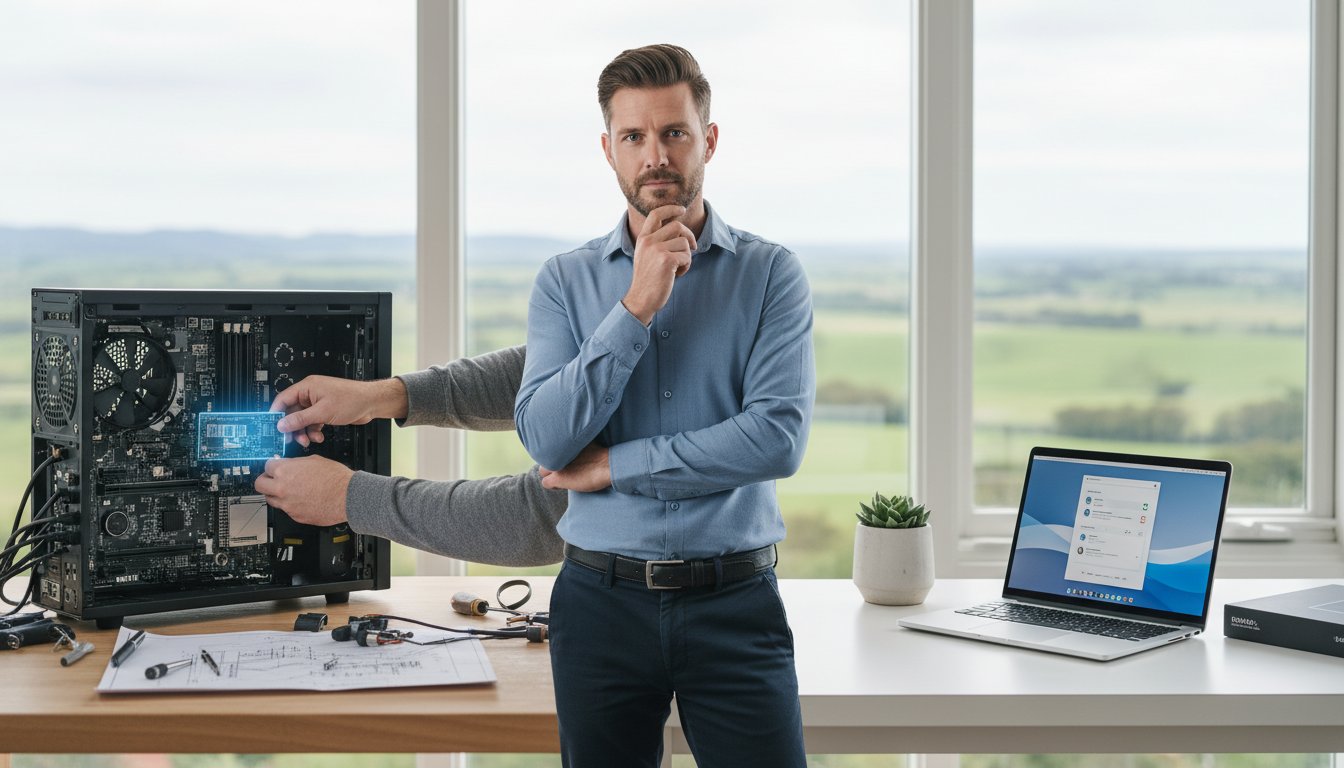
On October 14, 2025, David sat at his desk in Toowoomba, watching a spinning icon for the tenth time that morning. He faced a common dilemma: should he spend A$1,500 on a new machine or try to save his five-year-old PC? Many Australians find themselves asking, is it worth repairing an old computer when the hardware starts to lag? It’s a stressful choice because nobody wants to throw good money after bad, especially when you’re worried about losing personal files or expensive software licenses during the transition.
We understand that feeling of uncertainty. If your screen has gone dark or your system is crawling, don’t panic! You’re right to be cautious; technology moves fast, and sometimes a “quick fix” is just a temporary bandage on a terminal problem. Our mission is to keep you connected and protected without the headache of unnecessary downtime. This guide provides the exact framework we use at Aspire Computing to decide if your PC needs a simple hardware upgrade or a trip to the recycling centre. You’ll discover how to achieve a fast, reliable computer while potentially saving over A$800 compared to a full replacement. We’ll break down the “50% rule” for repair costs and identify the specific components that can give an older machine a new lease on life in 2026.
Key Takeaways
- Learn to apply the “50% Rule” to calmly determine if your repair costs justify the investment or if it is time to retire your machine.
- Discover why upgrading components in a 5-year-old high-end PC often delivers better performance than a brand-new A$600 budget laptop.
- Uncover the hidden “Setup Tax” and data migration risks that retailers often ignore when pushing you toward a new purchase.
- Use our methodical framework to finally decide is it worth repairing an old computer or if a “Fatal Flaw” like motherboard failure makes replacement the only option.
- Find out how professional diagnostics can protect your digital life and ensure your technology keeps you connected without unnecessary spending.
The Repair vs. Replace Dilemma: Is Your Old Computer Still Viable?
When your screen stays black or the cooling fans start making a sound like a jet engine, your first instinct might be a sense of panic. It’s a frustrating moment that disrupts your work and personal life. Before you rush to the nearest big-box retailer, take a breath. A methodical assessment often reveals that your machine has plenty of life left. The core question you need to answer is: is it worth repairing an old computer or should you start fresh?
At Aspire Computing, we’ve helped Toowoomba residents navigate this choice since 1999. We focus on “Solid Bones.” This concept refers to high-quality components like power supplies, sturdy cases, and mid-to-high-end processors that remain relevant for 7 years or longer. However, 2026 brings new challenges. Software demands and security requirements for modern operating systems mean hardware diagnostics are more critical now than they were even three years ago. We look at your specific hardware to see if it can handle the next wave of digital demands.
Understanding the 50% Rule of Thumb
The 50% Rule is a simple financial benchmark. If the cost of parts and labour exceeds half the price of a comparable new machine, replacement is usually the better path. You must include “hidden” costs in this math. A new A$900 laptop isn’t just A$900; you also have to factor in 2 to 3 hours of setup time and data migration. If a repair costs A$350, it’s often the smarter investment. Budget laptops under A$700 frequently fail this rule because their build quality is lower. Aspire Computing provides transparent, fixed-fee quotes so you can make this calculation with total certainty.
Laptop vs. Desktop Lifespans in 2026
Laptops and desktops age differently. By 2026, most portable 14-inch laptops hit a “fork in the road” around the 4 or 5-year mark. Heat builds up in small spaces, and battery health typically drops below 60% capacity. Desktops are different. A 7 or 8-year-old tower is often a prime candidate for a “quick fix” upgrade. Because towers are modular, we can replace a single failing component for a fraction of the cost of a new system. Build quality matters too. A business-grade machine from 2021 will likely outlast a cheap consumer model bought in 2024. When deciding if is it worth repairing an old computer, always check the chassis material and cooling efficiency first.
- Laptops: Expect 4-5 years of peak performance.
- Desktops: Often viable for 8+ years with minor hardware refreshes.
- Business Grade: Built with higher-tolerance capacitors and better thermal management.
Evaluating the Bones: When Hardware Upgrades Outperform New PCs
Deciding is it worth repairing an old computer often comes down to three specific “bones”: the Processor (CPU), the Memory (RAM), and the Storage. If these core parts are solid, a few affordable swaps can make a five-year-old machine feel brand new. Many Australians walk into big-box retailers and buy a “budget” laptop for A$500, only to find it performs worse than their old one. This happens because a 2019 Intel i7 processor still carries more “muscle” for multitasking than a 2024 entry-level Celeron or Pentium chip found in cheap new models. Don’t be fooled by a shiny new chassis; the raw power inside an older high-end machine is frequently superior to modern entry-level hardware.
The SSD Revolution: Why Speed Isn’t Just About the CPU
The single biggest reason old computers feel slow isn’t actually a “tired” processor; it’s the mechanical hard drive (HDD). These old drives use spinning platters that physically cannot keep up with modern software demands. Replacing an HDD with a Solid State Drive (SSD) or an NVMe drive removes the primary performance bottleneck that plagues older systems. You will see a massive shift from five-minute boot sequences to a crisp 30-second startup. An SSD is the single most impactful upgrade for any PC over three years old. For a modest investment of roughly A$80 to A$150, you can achieve a 10x increase in data access speeds, making the system feel more responsive than the day you bought it.
RAM and Windows Compatibility in 2026
As we head toward 2026, 16GB of RAM has become the essential minimum for a smooth Windows experience. If your computer “freezes” when you have ten browser tabs and a Word document open, it’s likely running out of memory, not dying. Extra RAM allows your PC to handle more tasks simultaneously without swapping data to the slower hard drive. Most motherboards from the last six years can easily accommodate a 16GB or 32GB kit. If you aren’t sure what your specific machine can handle, a quick hardware assessment from a local expert can clarify your upgrade path. Adding RAM is often the cheapest way to extend a computer’s functional life by another three years, keeping your system snappy and stable for daily use. When considering if is it worth repairing an old computer, remember that a RAM boost costs a fraction of a new machine but solves 90% of common lag issues.
The Hidden Costs of Buying New: What Retailers Don’t Tell You
A shiny new box on a retail shelf looks like a simple solution, but the price tag on the sticker is rarely the final cost. When people ask is it worth repairing an old computer, they often forget the “Setup Tax” that comes with a fresh purchase. Moving your digital life from one machine to another isn’t always a “plug and play” experience. It involves significant time, potential data loss, and the frustration of re-configuring every setting you’ve spent years perfecting.
The Setup Tax: Time, Data, and Software
Most Australian home users and small business owners spend between 4 and 8 hours personalising a new machine. This includes installing Windows updates, removing “bloatware” apps that come pre-installed, and setting up peripheral devices. If you aren’t tech-savvy, a professional data transfer service can add A$150 to A$300 to your total bill.
The risks are higher if your current machine is already failing. Photos, emails, and important tax records can be trapped on a hard drive that refuses to spin. If your device won’t boot, Aspire Computing offers specialized data recovery to ensure your history isn’t erased during the transition. Beyond files, you must also consider software licenses. Re-installing Microsoft 365, accounting packages like Xero or MYOB, and printer drivers often requires hunting for lost product keys and passwords, which adds layers of stress to your week.
Toowoomba Environmental Factors: Heat and Dust
Living in the Darling Downs presents unique challenges for hardware. The fine dust common in regional Queensland is a silent killer for electronics. It settles inside cases, coats cooling fans, and leads to overheating. This often causes “fake” hardware failure where a computer slows down to a crawl to protect itself from heat damage.
Before you commit to a new purchase, consider that a professional internal clean and a thermal paste refresh can often “repair” a slow computer for a small fraction of the replacement cost. Keeping your current machine running also helps manage the local e-waste crisis. With Queensland producing thousands of tonnes of electronic waste annually, extending the life of your hardware by even two years keeps functional components out of Toowoomba landfills. When you weigh these factors, you’ll find that is it worth repairing an old computer often comes down to simple maintenance rather than total replacement.

Signs Your Computer is Truly End of Life (EOL)
Every piece of technology has a limit. While our team at Aspire Computing loves to extend the life of your gear, there comes a point where a machine becomes a “money pit.” Identifying these fatal flaws early helps you avoid wasting hundreds of dollars on a device that will never perform to modern standards. When you’re weighing up is it worth repairing an old computer, you need to look at the hardware’s physical and digital foundation.
Motherboard and CPU Bottlenecks
A dead motherboard in a laptop older than 6 years is usually the end of the road. In these older units, the cost of the part combined with the labour to strip the machine down often exceeds the total resale value of the computer. Many “big brand” manufacturers use proprietary parts that aren’t interchangeable with standard components. This makes sourcing a replacement board for an older Dell or HP both difficult and expensive in the Australian market. If repair parts are no longer manufactured, replacement is the only logical path forward for your productivity and peace of mind.
Physical Integrity and Screen Damage
The physical build of your device often dictates its lifespan. Modern ultrabooks have moved toward “glued-in” batteries and fused components, which significantly changes the repair equation. If you’re looking at a cracked 4K laptop screen, the replacement cost can easily soar above A$550. When you compare that to a brand-new entry-level laptop at A$800, the repair makes little sense.
This calculation can change, however, if you can find affordable replacement parts. Specialist online retailers for IT equipment, such as Computech-Solutions, often carry a wide range of components like LCD panels that can make a screen replacement more economical.
You should also pay close attention to your laptop hinges. To check for trouble, feel for any resistance or listen for “clicking” sounds when opening the lid. If the plastic chassis is bulging near the hinges, it indicates a structural failure that could eventually snap internal display cables.
- Obsolete Architecture: Systems using 32-bit processors or DDR2 RAM are now considered museum pieces. They lack the instructions needed to run modern security software.
- Storage Standards: If your motherboard doesn’t support NVMe or at least SATA SSDs, it’s time to move on.
- Windows 11 Compatibility: Many PCs from 2017 or earlier don’t meet the strict TPM 2.0 requirements for the latest operating systems.
Don’t risk your data on a failing system. If your device is showing these terminal signs, contact Aspire Computing today for a professional assessment of your best upgrade options.
How Aspire Computing Helps You Decide (and Save)
Deciding if your tech has reached the end of the road shouldn’t feel like a gamble. At Aspire Computing, we remove the guesswork with professional diagnostics. We tell you exactly what’s wrong before you spend a single cent on replacement parts. Our “Protect and Connect” approach ensures we focus on your productivity, not just selling you the latest shiny box on the shelf. Determining is it worth repairing an old computer depends on your specific needs, and we provide the data you need to make that call.
- Professional diagnostics: We identify the bottleneck, whether it’s a failing hard drive or a cluttered operating system.
- Local Toowoomba service: You won’t have to send your PC to a capital city for weeks. We handle everything right here in town.
- Productivity first: If a A$180 component can give you two more years of high-speed use, we’ll recommend that over a A$1,200 new purchase.
- Repairable alternatives: If you must replace your machine, we build custom PCs designed to be repaired and upgraded, preventing future e-waste.
Personal Service from Chaim Lee and the Team
Chaim Lee and the team have supported the Toowoomba region since 1999. With over 25 years of local experience, we’ve seen every hardware trend and common failure point imaginable. A generic retail salesperson is often trained to hit sales quotas, but a local expert is motivated by community trust. We want your computer to work perfectly so you’ll come back to us for years to come. If your device just feels sluggish, our Computer & Laptop Repair services can often provide a quick tune-up that restores original speeds for a fraction of the cost of a new machine.
Our Methodical Repair Process
We believe in transparency and speed. Our team helps you answer the question: is it worth repairing an old computer or is it time to move your data to a more reliable system? We follow a clear, four-step process to ensure you aren’t left in the dark:
- Identification: We run stress tests to find the exact hardware or software fault.
- Transparent Quoting: You receive a fixed price for the repair so there are no surprises.
- Fast Execution: We aim for a 24 to 48 hour return on most standard repairs.
- Remote Support: For minor software “repairs” and glitches, we can often log in remotely to fix the issue instantly.
Don’t let a slow computer disrupt your day any longer. Contact Aspire Computing today for a professional opinion on your old computer and discover the most cost-effective way to stay connected.
Make the Right Call for Your Technology
Deciding if is it worth repairing an old computer often comes down to a simple cost comparison between a A$150 component upgrade and a A$1,200 new laptop. Most hardware manufactured after 2021 remains viable for modern software if the “bones” of the system are healthy. If your device isn’t suffering from physical motherboard damage or total screen failure, a strategic upgrade can extend its lifespan by another three years.
Since 1999, Aspire Computing has served the Toowoomba community with a focus on our “Protect and Connect” mission. Owner Chaim Lee provides personal, professional service that cuts through the marketing noise of big-box retailers. We help you identify when a machine is truly at its end of life and when it just needs an expert touch to run like new again. Don’t let a slow startup screen force you into an unnecessary purchase.
Talk to the Toowoomba Computer Experts today for reliable local IT support that keeps you moving forward.
Frequently Asked Questions
Is a 5-year-old laptop worth fixing in 2026?
Yes, a 5-year-old laptop is often worth fixing in 2026 if the screen and keyboard remain in good condition. You can expect to pay around A$250 for a professional refresh compared to A$1,300 for a comparable new machine. We see many 2021 models that still perform excellently with a simple SSD upgrade or a fresh battery. This saves you 80% of the cost of buying new.
How much does it typically cost to speed up an old computer?
Speeding up an older system typically costs between A$180 and A$400 depending on the parts required. A standard 500GB SSD upgrade costs roughly A$140 plus labour, while adding 8GB of RAM usually sits around A$75. When clients ask is it worth repairing an old computer, we point to these upgrades. They often make a machine 5 times faster for a fraction of the price of a replacement.
Can I upgrade my old computer to run the latest Windows?
You can upgrade to the latest Windows if your processor was manufactured after 2018 and includes a TPM 2.0 chip. Microsoft requires at least an 8th Generation Intel CPU or an AMD Ryzen 2000 series for Windows 11. If your machine is older, it won’t receive official security updates. We check your specific hardware ID to ensure 100% compatibility before starting any software installation or upgrade process.
What happens to my data if I decide to buy a new computer instead of repairing?
Your data remains on your old hard drive and can be migrated to your new device using professional cloning tools. We offer a complete data transfer service that moves your photos, documents, and emails for a flat fee, usually starting at A$120. If the old computer doesn’t turn on, we use specialized recovery hardware to extract files. You don’t lose anything during the transition to a new system.
How long should a desktop computer last before it needs replacing?
A well-maintained desktop computer should last between 6 and 9 years before it becomes obsolete. While business environments often replace hardware every 3 years, home users can extend the lifespan by performing a professional tune-up every 24 months. Replacing a power supply for A$150 or a CMOS battery for A$15 can prevent major failures. This proactive approach keeps your machine running reliably for nearly a decade.
Is it better to buy a cheap new laptop or repair a high-end old one?
It’s almost always better to repair a high-end old laptop than to buy a cheap A$500 model from a big-box retailer. Entry-level laptops often use low-grade plastic and slower components that struggle with basic tasks. When deciding is it worth repairing an old computer, consider that a A$350 repair on a premium device provides better screen quality and faster processing than a budget new unit.
What are the signs that my hard drive is failing?
Common signs of hard drive failure include loud clicking noises, frequent system crashes, and files taking 3 times longer to open than usual. Around 15% of traditional mechanical drives show signs of wear after 3 years of heavy use. If you see a “Disk Boot Failure” message, shut the power off immediately. We use diagnostic software to check your drive’s health and can often catch failures before your data is lost.
Does Aspire Computing offer on-site repairs in Toowoomba?
Aspire Computing provides on-site repair services throughout Toowoomba and surrounding suburbs like Highfields and Cambooya. Since 1999, Chaim Lee has helped locals solve tech issues at their homes or offices to ensure total continuity. We arrive with the right tools to fix your PC, laptop, or printer without you needing to unplug a single cable. It’s our way to protect and connect the local community.

B.App.Sc., Cert. Computer Engineering PC Service and Repair
As the owner of Aspire Computing founded in 1999, Chaim Lee has been working for over 20 years as the Leading Computer Technician.
He has a life long interest in electronics, computing, science and technology. He has completed studies and gained qualifications in Applied Science, Computer Repair and Service, Microsoft Installation and Maintenance, Technical Writing, Workplace Training, and Technical Sales Training.

Write a Comment