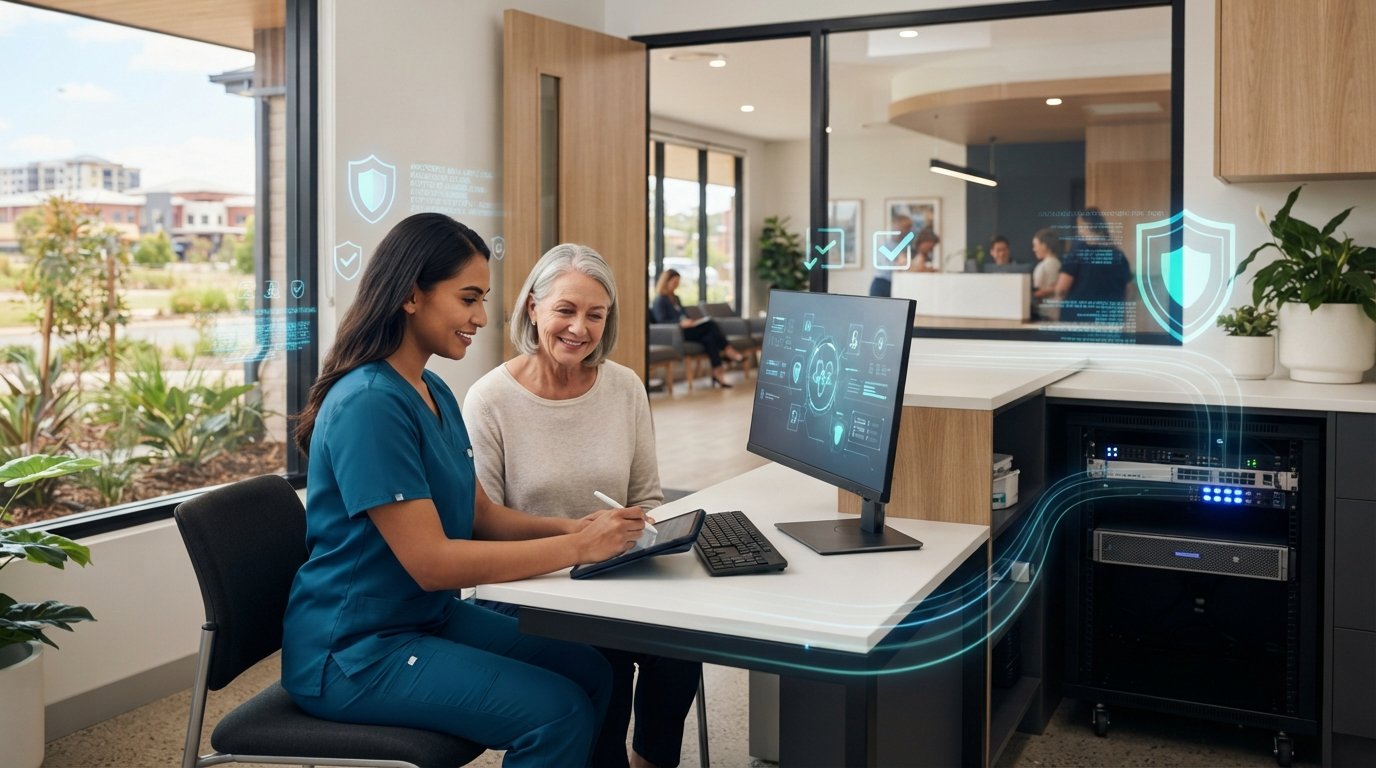
A patient is sitting in your consult room, but as you try to pull up their history, Best Practice freezes. You’re left staring at a spinning icon while your waiting room fills up and your NBN connection struggles to stay active. It’s a frustrating situation that highlights why specialized IT support for medical clinics Toowoomba is a clinical necessity rather than just a back-office expense. You need systems that work as hard as you do, especially when patient safety is on the line.
You likely worry about the legal repercussions of a data breach, especially with Privacy Act penalties reaching up to A$50 million for serious violations. It’s challenging to stay on top of the RACGP 6th Edition Standards while managing daily consultations and staff needs. I understand that the transition to digital-only records and the recent end-of-life for Windows 10 have added a heavy layer of complexity to your practice management.
This guide provides a comprehensive compliance checklist to help you secure your clinic and streamline your operations. I’ll walk you through essential updates for SQL Server, NASH certificate renewals, and the implementation of the Essential Eight security framework. You’ll learn how to ensure 100% clinical software uptime so you can focus entirely on delivering exceptional patient care.
Key Takeaways
- Understand why specialized IT support for medical clinics Toowoomba is essential for maintaining 100% uptime with clinical software like Best Practice and MedicalDirector.
- Identify the critical hardware and connectivity requirements, including 4G/5G failover, to ensure your digital records remain accessible during NBN outages.
- Learn how to align your practice with the RACGP 6th Edition Standards and Australian Privacy Principles to avoid significant legal and financial penalties.
- Discover the multi-layered cyber security strategies needed to protect sensitive patient data from ransomware and unauthorized access.
- Recognize the value of a local Darling Downs partner who can provide rapid, on-site assistance for hardware failures and printer issues that remote support cannot fix.
Why Specialist IT Support for Medical Clinics in Toowoomba is Critical
For a busy medical practice, an hour of offline time isn’t just a minor inconvenience; it’s a total breakdown in patient safety. When systems fail, consultations stop, scripts can’t be issued, and your waiting room quickly becomes a source of significant stress for both staff and patients. Investing in specialized IT support for medical clinics Toowoomba ensures that your technology remains a tool for healing rather than a barrier to care. Many general IT providers understand basic networking but lack the specific knowledge required to manage the sensitive databases and strict uptime requirements of a modern healthcare environment.
Medical software demands a level of precision that standard office setups don’t require. If your IT partner doesn’t understand how Best Practice or MedicalDirector interacts with your server, a simple update can lead to hours of clinical downtime. You need a team that recognizes the difference between a standard file server and the high-stakes environment of a primary care facility.
To understand the foundational security requirements for Australian clinics, watch this video on the Essential Eight framework:
Toowoomba’s unique geographic landscape, including varying NBN reliability across the Darling Downs and Lockyer Valley, requires a proactive approach to connectivity. The shift toward telehealth has placed unprecedented demand on clinic infrastructure. If your internet drops during a video consult, you don’t just lose time; you lose the ability to provide care to vulnerable patients who may not be able to travel to the surgery.
The Intersection of Patient Care and Technology
Practitioner burnout is often linked to “technology friction.” When a doctor spends five minutes of a fifteen-minute appointment fighting with a slow interface, the quality of the interaction suffers. Reliable health informatics systems are the backbone of real-time medical records, ensuring that every clinician has the data they need at the point of care. A local clinic recently found that remote-only support couldn’t solve a hardware conflict between their scanner and their clinical software, leading to days of manual data entry. They needed a local expert who could be on-site in Toowoomba to physically resolve the issue and restore their workflow.
Common IT Failures in Healthcare Practices
Medical offices are often “paperless-adjacent,” meaning scanners and printers remain mission-critical for referrals and pathology. A jammed printer or a scanner that won’t sync can halt an entire afternoon of appointments. Database corruption in clinical software is another major risk that can be catastrophic without a robust business continuity plan. During high-volume telehealth sessions, network bottlenecks often occur if the router isn’t configured for medical traffic priority. Since 1999, Aspire Computing has specialized in resolving these specific local hurdles, providing the reassurance that help is just a phone call or a short drive away.
The Essential Medical IT Infrastructure Checklist
A high-performing clinic requires more than just the right software. It needs a physical foundation designed to withstand the heavy processing demands of modern healthcare. When you invest in IT support for medical clinics Toowoomba, the first step is often auditing the hardware that keeps your practitioners productive. Without medical-grade workstations and a resilient network, even the best clinical software will feel sluggish and unreliable.
Reliable Hardware for Toowoomba Practices
Consumer-grade laptops from a big-box retailer aren’t enough for a busy Harristown clinic. These devices lack the durability and security features required for constant clinical use. Professional workstations are built with higher-quality components that offer better longevity and less heat-related throttling. I always recommend dual-monitor setups for every consultation room. This allows doctors to view patient history on one screen while managing scripts or referrals on the other, significantly reducing cognitive load. If your current systems are struggling to keep up, you might find my guide on PC Hardware Upgrades helpful for identifying performance bottlenecks.
Networking and Internet Stability
Internet connectivity is the lifeblood of the modern practice. Troubleshooting slow NBN speeds in Toowoomba’s CBD often reveals that the issue isn’t the line itself, but the internal hardware. Managed switches are essential for prioritizing medical data traffic, ensuring a telehealth call doesn’t drop because someone in the back office is downloading a large file. For mobile practitioners moving between rooms, we optimize Wi-Fi to ensure seamless roaming without signal drops. Every clinic should also have a business-grade NBN connection backed by a 4G or 5G failover. This ensures that if the main line goes down, your practice stays online and your e-prescribing remains active.
To maintain a secure and efficient environment, your infrastructure must also include:
- High-Speed Peripherals: Scanners must be capable of handling high-volume batches, and printers need to be configured for secure, jam-free prescription printing.
- Software Lifecycle Management: Clinical and billing platforms require regular patching to stay secure and compatible with the latest OAIC Guide to Health Privacy standards.
- The 3-2-1 Backup Rule: Keep three copies of your data on two different media types, with at least one copy stored securely off-site. This is the gold standard for patient data safety.
Managing these moving parts can be overwhelming while you’re trying to focus on patient outcomes. If you’re unsure if your current setup meets these standards, a quick check of your clinic’s IT health can provide the peace of mind you need to move forward confidently.
Navigating IT Compliance for Healthcare Practices in Australia
Compliance in the healthcare sector is a legal obligation that carries significant weight. Under the Privacy Act 1988, medical practices are classified as APP entities regardless of their annual turnover. This means you’re legally required to protect patient health information according to strict standards. With the passage of the Privacy and Other Legislation Amendment Act 2024, corporate penalties for serious data breaches have increased to a maximum of A$50 million. Reliable IT support for medical clinics Toowoomba helps you avoid these catastrophic financial and reputational risks by ensuring your systems are configured correctly from the start.
The Notifiable Data Breaches (NDB) scheme requires you to inform the OAIC and affected individuals if a breach is likely to result in serious harm. Since healthcare remains Australia’s most targeted industry for cyberattacks, having a documented incident response plan is now a necessity rather than an option. Implementing the ACSC Essential Eight mitigation strategies provides a proven baseline to prevent approximately 94% of common healthcare data breaches. These strategies are particularly effective against ransomware, which currently represents 42% of malicious healthcare attacks in Australia.
Meeting Modern RACGP Standards
The RACGP officially released the 6th edition of the Standards for General Practices on 26 August 2026. A major change is the requirement for digital-only clinical information systems; paper-based records are no longer accepted for accreditation. We focus on strict access control to ensure only authorized staff can view sensitive records. This includes enforcing individual logins for every team member and implementing strong password policies. We also ensure your operating systems are supported, as running Windows 10 without extended updates now fails RACGP Criterion C6.4 following its 2025 end-of-life date. RACGP IT compliance is the benchmark for Australian medical data safety.
Patient Data Privacy and the Law
Transferring data between allied health providers and specialists requires more than just a standard email. Unencrypted email is a major compliance risk because it can be intercepted easily. Instead, we configure secure messaging services like Argus or Healthlink to ensure end-to-end encryption for referrals and results. These systems rely on NASH SHA-2 certificates, which require a mandatory two-year renewal cycle via PRODA. Using non-compliant storage solutions, such as consumer-grade cloud drives, exposes your clinic to serious legal liabilities. Since 1999, I’ve helped Toowoomba clinics maintain these complex connections, ensuring that patient data stays within the secure pipelines mandated by Australian law.

Cyber Security & Disaster Recovery for Clinics
Healthcare data is incredibly valuable on the dark web, but the real threat in 2026 is operational paralysis. Ransomware attackers target local practices because they know you cannot provide care without access to patient histories. If your systems are locked, your clinic stops. Implementing multi-factor authentication (MFA) across all systems, including remote access and clinical software, is one of the most effective ways to block unauthorized entry. When combined with specialized IT support for medical clinics Toowoomba, these layers of security create a formidable barrier against modern cyber threats.
Phishing scams remain the most common entry point for malware. A single staff member clicking a malicious link in an email can compromise your entire network. This is why employee training is your first line of defence. Your team needs to recognize the signs of a sophisticated scam before they provide credentials or download an attachment. I’ve found that a well-informed team is just as important as the firewall protecting your server.
Proactive Malware and Virus Protection
Free antivirus software is designed for home users, not for protecting a medical database. Managed endpoint protection provides real-time monitoring and threat detection that home-grade software misses. I focus on regular system tune-ups to identify and patch vulnerabilities before they can be exploited. Keeping your workstations optimized reduces the risk of software conflicts that can leave backdoors open. For a deeper look at keeping your systems clean, read my guide on Virus and Malware Removal.
Disaster Recovery Planning
A backup is only as good as its last successful test. I’ve seen clinics discover their backups were failing only when they actually needed them during a crisis. We balance on-site storage for rapid local recovery with encrypted off-site storage for protection against physical disasters like fire or theft. For a clinic in Newtown or Harristown, the goal is always a 24-hour recovery objective for all patient files. This ensures that even after a total server failure, you aren’t offline for more than one business day. If you haven’t tested your recovery speed lately, it’s time to secure your practice today with a professional audit of your current backup strategy.
Why a Local Toowoomba IT Partner Beats a National Call Centre
When your clinic faces a technical failure, the last thing you need is a 45-minute wait on hold with a national call centre. A technician in a distant city might understand the theory of your problem, but they can’t physically walk into your practice to swap out a faulty network switch or troubleshoot a local server. Choosing local IT support for medical clinics Toowoomba means you’re partnering with someone who understands the local landscape. I’m familiar with the quirks of regional NBN connections and the specific operational needs of Darling Downs healthcare providers.
I’ve been serving the Toowoomba community since 1999, which gives Aspire Computing a unique perspective on the challenges small practices face. You won’t be treated as an anonymous ticket number in a massive corporate database. Instead, you’ll have a direct line to a local expert who takes personal accountability for your clinic’s uptime. This personal relationship builds trust and ensures that your IT strategy aligns perfectly with your clinical goals. Supporting the Toowoomba economy by choosing local specialists also helps keep essential technical expertise right here in our community.
Personalised Service for Small Clinics
Small clinics often find that national providers try to push “one-size-fits-all” solutions designed for large enterprises. My base in Newtown allows me to offer direct, hands-on expertise tailored to your specific budget and workflow. Whether you’re a solo practitioner or a multi-doctor surgery, you deserve technology that works for you without the corporate overhead. If you’re looking for broader insights into how technology can help your practice grow, my IT Support for Business guide offers practical advice for small business owners navigating the local market.
Rapid Response in the Darling Downs
Speed is critical when clinical software goes down. Remote support is excellent for software patches, but it’s useless when a printer won’t connect or a laptop screen is shattered. My service area is built for rapid response across the region, including:
- Toowoomba CBD and surrounding suburbs like Harristown and Newtown
- Highfields and the northern Darling Downs
- The Lockyer Valley and surrounding rural communities
The advantage of an IT partner who can be at your door in 30 minutes cannot be overstated. It’s the difference between a minor delay and a cancelled afternoon of appointments. This level of reliable IT support for medical clinics Toowoomba ensures your practice remains resilient regardless of hardware failures. It’s time to stop settling for distant support and book an IT Health Check for your clinic today to ensure your systems are ready for the future.
Future-Proof Your Practice with Local Expertise
Your clinical software and patient data are the lifeblood of your surgery. Maintaining compliance with the RACGP 6th Edition Standards and the Australian Privacy Principles requires a dedicated strategy. By prioritizing medical-grade hardware and robust disaster recovery, you protect your patients and your professional reputation. Specialized IT support for medical clinics Toowoomba ensures that your technology remains a silent partner in delivering care rather than a source of frustration.
I’ve been serving the Toowoomba community since 1999, specializing in the unique IT needs of local small businesses and healthcare providers. Whether you face a hardware emergency or need to audit your cyber security, I provide the rapid on-site response that national call centres can’t match. You deserve a local partner who understands your software and values your practice’s stability. Secure your Toowoomba practice with a free IT audit from Aspire Computing today. Let’s make your clinic’s technology reliable, secure, and stress-free.
Frequently Asked Questions
What are the specific IT requirements for RACGP accreditation?
The RACGP 6th Edition standards require digital-only clinical systems and strict information security protocols. You must ensure all operating systems are currently supported; for example, Windows 10 workstations now fail accreditation unless you have paid for extended security updates. Other key requirements include having a documented cyber incident response plan, implementing multi-factor authentication for all remote access, and assigning a designated digital governance role to manage your clinic’s data risks.
How do I choose between Best Practice and MedicalDirector software?
The choice between Best Practice and MedicalDirector usually depends on your specific clinical workflow and interface preferences. Best Practice is highly regarded for its robust database management, while MedicalDirector offers flexible cloud-based solutions like Helix. Regardless of the platform you choose, ensure your IT support for medical clinics Toowoomba understands the specific SQL server requirements and background sync services each software needs to maintain 100% uptime for your practitioners.
Is my clinic’s internet fast enough for telehealth and cloud records?
Telehealth and cloud-based records generally require a stable connection with at least 5 to 10 Mbps upload speed per active video consultation. Standard residential NBN plans often lack the priority traffic handling and upload consistency needed for a busy medical practice. I recommend a business-grade NBN plan with 4G or 5G failover. This setup ensures your appointments and PBS e-prescribing remain active even if the primary fiber connection is interrupted.
What should I do if my medical clinic’s server crashes?
If your server crashes, immediately activate your business continuity plan and contact your local IT partner for an emergency on-site response. Avoid making repeated restart attempts, as this can worsen database corruption in clinical software like Best Practice. A local expert can physically inspect the hardware at your Newtown or Harristown practice and begin the data recovery process or restore your latest backup to meet your 24-hour recovery objective.
How often should I backup my patient data?
Patient data should be backed up daily at a minimum, though many modern clinics now utilize hourly or real-time incremental backups. Following the 3-2-1 rule is the safest approach: keep three copies of your data on two different media types, with one copy stored securely off-site. It is vital to regularly test these backups to ensure that your clinical files are actually recoverable in the event of a hardware failure or cyberattack.
Does Aspire Computing offer on-site support for clinics in Newtown and Harristown?
Yes, Aspire Computing provides rapid on-site IT support for medical clinics Toowoomba, including Newtown and Harristown. Being based at 46 Brigalow St, Newtown, I can often be at your door quickly to resolve hardware emergencies, printer failures, or network issues that remote support cannot fix. This local presence has been a core part of how I’ve supported Darling Downs healthcare providers and small businesses since 1999.
How can I protect my clinic from ransomware attacks?
Protecting your clinic requires a multi-layered approach centered on the ACSC Essential Eight mitigation strategies. Implementing multi-factor authentication (MFA) and managed endpoint protection is critical for blocking unauthorized entry. You should also conduct regular staff training to help your team identify phishing scams, as human error contributes to many data breaches. Regular system tune-ups also help identify and patch security vulnerabilities before attackers can exploit them to lock your files.
Do I need a special router for a medical practice?
A standard home router is not sufficient for a professional medical environment. You need a business-grade router that supports Quality of Service (QoS) to prioritize clinical data and telehealth traffic over general office internet use. These devices offer significantly better security features, such as advanced firewalls and secure VPN capabilities for remote staff. This ensures your clinic remains compliant with Australian Privacy Principles while providing a stable connection for patient care.

B.App.Sc., Cert. Computer Engineering PC Service and Repair
As the owner of Aspire Computing founded in 1999, Chaim Lee has been working for over 20 years as the Leading Computer Technician.
He has a life long interest in electronics, computing, science and technology. He has completed studies and gained qualifications in Applied Science, Computer Repair and Service, Microsoft Installation and Maintenance, Technical Writing, Workplace Training, and Technical Sales Training.

Write a Comment